Decider v1.3 Open-Sourced: New 'locate' Feature Added, Decision Model Performance Significantly Improved

Decider v1.3 open-sourced with new locate character-level localization, leading performance across multiple tasks.
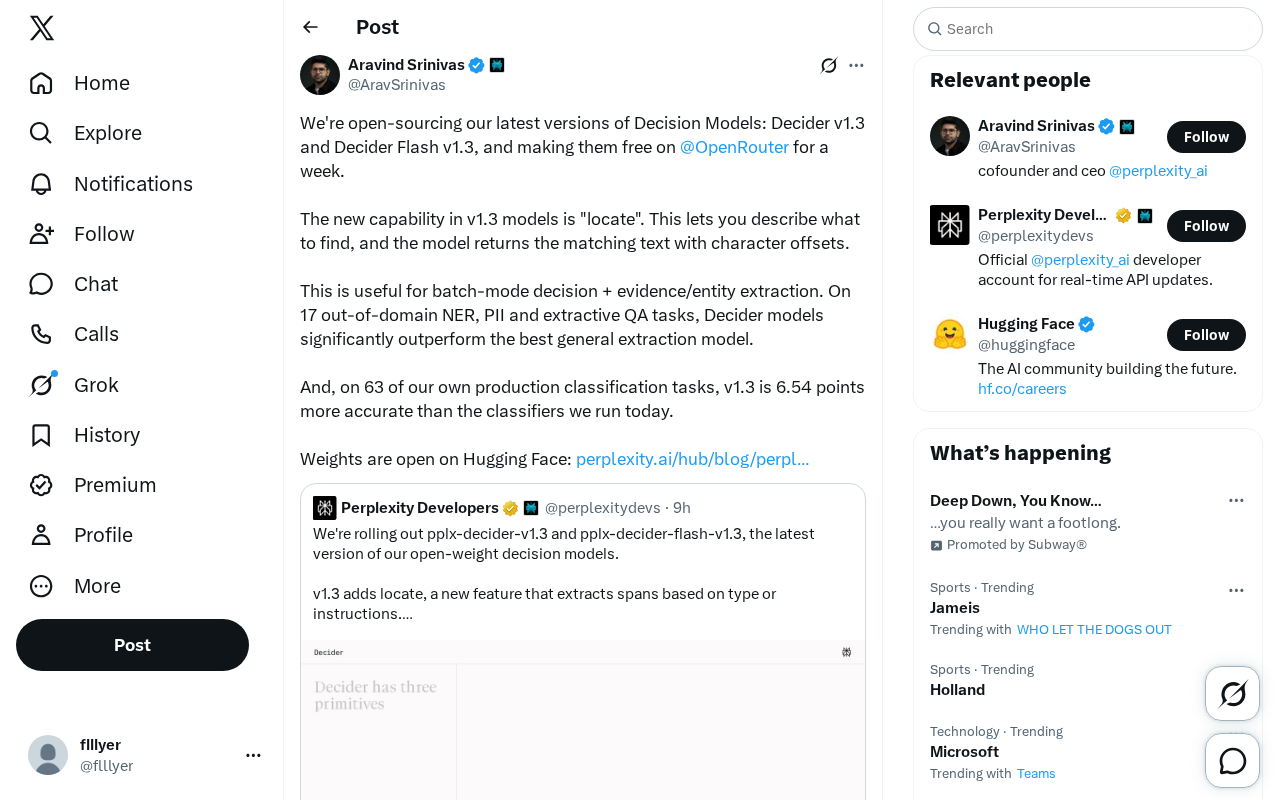
Decider v1.3 and Decider Flash v1.3 are officially open-sourced, with model weights public on Hugging Face and free access via OpenRouter for one week. The core upgrade is the new locate feature: users describe target content in natural language, and the model returns the matching text span and its character offsets, suited for decision-making, evidence extraction, and entity recognition in batch mode. Official data shows the model significantly outperforms the current best general extraction models on 17 out-of-domain NER, PII detection, and extractive QA tasks, and improves accuracy by 6.54 percentage points over the online classifier on 63 internal production classification tasks. The open-source and free-trial strategy is expected to lower the barrier to trial and drive adoption in automated information extraction workflows.
The decision model space has seen a new development. Decider v1.3 and Decider Flash v1.3 are now officially open-sourced and available for free on OpenRouter for one week. This update not only releases the model weights but also introduces a new capability called "locate," aimed at improving decision-making and information extraction efficiency in batch mode.
Core Upgrade: locate Feature and Performance
locate Feature: Precise Text Span Localization
The biggest highlight of v1.3 is the new "locate" capability. Users can describe in natural language what they want to find, and the model returns the matching text span along with its character offsets. This feature is particularly well-suited for decision-making, evidence extraction, and entity recognition in batch mode, and can significantly reduce manual annotation workload.
Character offsets are a way of representing a location in text processing, using a pair of integers to mark the start and end positions of a text span in the original string (typically left-closed, right-open), e.g., [12, 25] denotes the span from the 12th character up to but not including the 25th. Compared with returning plain text, offsets have the advantage that the caller can directly highlight, redact, or replace content in the original document without worrying about subtle discrepancies between model-generated text and the source (such as spaces, punctuation, or full-width/half-width variations) that prevent alignment. In scenarios requiring "pointing back to the original text" such as PII detection, log redaction, and contract clause extraction, offsets are a key output format; they also facilitate precise string validation and post-processing in code.
Performance Validation: Clear Advantages on Cross-Domain Tasks
According to official data, on 17 out-of-domain named entity recognition (NER), personally identifiable information (PII) detection, and extractive question answering (extractive QA) tasks, the Decider model significantly outperforms the current best general-purpose extraction models. This indicates that the model retains strong generalization ability on unseen domain data.
Out-of-domain (OOD) refers to situations where test data differs noticeably from the model's training data in domain, style, or annotation scheme—for example, using a model trained on news corpora to process medical records or legal documents. Out-of-domain evaluation better reflects a model's true generalization ability than in-distribution testing, and is closer to the reality of constantly drifting input distributions in production environments. Named entity recognition (NER) is the task of identifying and classifying entities such as person names, organizations, and locations in text; PII detection focuses on personal identifiers such as email addresses, phone numbers, and ID numbers, and is commonly used for compliance redaction; extractive QA requires the model to excerpt an answer span from a given document rather than generate freely. What these three task types share is that their outputs can all be reduced to "a span in the source text," which aligns closely with locate's character-level localization capability and makes them core benchmarks for evaluating information extraction models.
Production Accuracy Improvement
Beyond academic benchmarks, the official announcement also disclosed evaluation results on 63 internal production classification tasks: v1.3 improves accuracy by 6.54 percentage points compared with the classifier currently running in production. This figure directly reflects the model's improvement in real business scenarios.
Open-Source and Free Access Strategy
This release continues the open-source strategy, with model weights now publicly available on Hugging Face for researchers and developers to download and use. At the same time, in partnership with OpenRouter, users can call both models for free for one week, lowering the barrier to trying them out.
Hugging Face is currently the most mainstream platform for hosting and distributing open-source models, offering centralized storage of model weights, configuration files, tokenizers, and model cards, along with inference libraries such as Transformers, so developers can download and deploy locally in just a few lines of code. Open weights mean users can run models in their own environments, making it easier to handle sensitive data, control inference costs, and fine-tune, without relying on a vendor's API. OpenRouter, meanwhile, is a model aggregation gateway that provides access to models from multiple vendors through a unified API interface; developers can compare results and run A/B tests simply by switching the model name. Providing limited-time free access through OpenRouter usually means the platform bears the inference cost, with the goal of accumulating real usage data and developer feedback in the short term and lowering the barrier to trial.
Industry Impact and Outlook
Decider v1.3's "locate" feature offers a new interaction paradigm for information extraction tasks, combining natural language descriptions with precise character-level localization. The open-source and free-trial strategy is expected to attract more developers to build applications on top of the model, further promoting the adoption of decision models in automated workflows.
As model capabilities continue to evolve, how to efficiently apply large models to structured information extraction and decision support remains a focus of industry attention. This update to Decider provides a noteworthy practical example.
Related articles

Why Microsoft CEO Nadella Still Backs Nvidia After Jensen Huang's Departure
Microsoft CEO Nadella publicly expresses confidence in Nvidia interim CEO Colette Kress. This article analyzes Nvidia's power transition after Jensen Huang's departure, Microsoft's compute dependency, and the trust logic of the AI supply chain.

Nadella: Critical Infrastructure Is 'Unpatchable' as AI Cybersecurity Arms Race Escalates
Microsoft CEO Nadella addresses AI cyberattack fears, saying much critical infrastructure is unpatchable, downplaying the Outlook outage, and analyzing AI's dual role in cybersecurity.

Musk Backs Jensen Huang: Firing Him Is Like Cutting Jordan
Musk says Jensen Huang is loyal to the U.S. and likens firing him to cutting Michael Jordan—highlighting politicization anxieties in the AI chip industry and defending talent value.