Decoding OpenAI's Naming Logic: The Rules Behind Model Codenames and Version Numbers

OpenAI model naming logic: scale dominates capability, and version numbers encode release order, family relationships, and improvement magnitude.
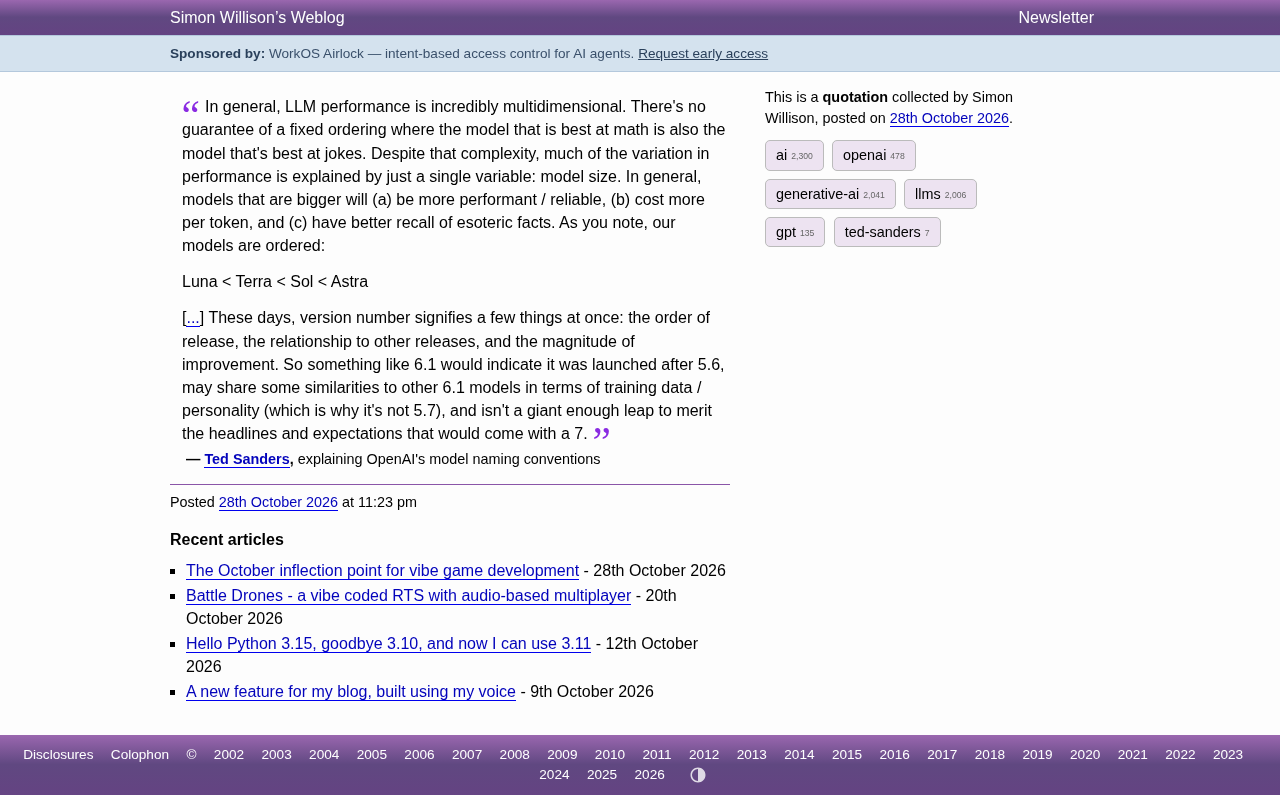
Based on Ted Sanders's explanation on Hacker News, this article outlines the logic of OpenAI's model naming system. It points out that although LLM performance is extremely multidimensional, model scale is the main variable explaining performance differences, reflected in the ordered internal codenames Luna < Terra < Sol < Astra. Public version numbers (such as 6.1 and 5.6) simultaneously carry three meanings: release order, relationship to other versions, and improvement magnitude. This naming approach serves both internal product management and the management of user expectations regarding upgrade magnitude, avoiding unrealistic expectations for minor iterations. The article argues that clear naming rules help developers and enterprise users accurately assess the actual impact of model upgrades and provide a transparent perspective that the industry can learn from.
OpenAI's model naming system has long been a hot topic among developers and users. From GPT-4 to GPT-4o, and on to various internal codenames, how exactly are these names determined? An explanation by Ted Sanders on Hacker News lifts the veil on this naming logic.
Model Capability Is Dominated by Scale, but Not in a Single Dimension
Ted Sanders points out that LLM performance is "extremely multidimensional." There is no fixed ranking that guarantees the model strongest at math is also strongest at telling jokes. However, despite this complexity, a large portion of the variation in performance can be explained by one variable: model scale.
Generally speaking, larger models (a) perform better and more reliably, (b) cost more per token, and (c) have better recall of obscure facts. This explains why OpenAI uses an ordered set of codenames to distinguish model tiers: Luna < Terra < Sol < Astra.
This view is consistent with the industry's general understanding of Scaling Laws, but Sanders emphasizes the tension between "multidimensional performance" and "single-variable dominance," reminding us not to simply equate scale with all-around superiority.
Scaling Law is the core empirical principle for understanding the evolution of large model capabilities. It states that as model parameters, training data, and compute increase, the model's loss decreases according to a power law, and this trend remains stable across multiple orders of magnitude. This means that scaling alone can bring predictable performance gains without relying on major architectural breakthroughs. OpenAI systematically validated this principle in work such as GPT-2 and GPT-3, and used it as the basis for planning its model R&D roadmap. However, the Scaling Law describes loss reduction in an average sense and does not guarantee that every specific capability improves in sync—this is precisely why Sanders emphasizes the tension between "multidimensional performance" and "single-variable dominance." Understanding the Scaling Law helps explain why model tiers are distinguished by ordered codenames: the scale tier itself is the primary basis for capability stratification.
The Triple Meaning of Version Numbers
Beyond internal codenames, public version numbers (such as 6.1 and 5.6) also carry rich information. Sanders explains that a version number simultaneously indicates three things:
- Release order: 6.1 was launched after 5.6.
- Relationship to other versions: 6.1 may be similar to other 6.1 models in training data or "personality," which is also why it is not called 5.7.
- Magnitude of improvement: the improvement in 6.1 is not large enough to support the headline expectations associated with 7.
In other words, version numbers are not a simple linear increment but a comprehensive encoding of release cadence, model family membership, and upgrade magnitude. This naming approach facilitates internal management while also signaling to the outside world the pace of model iteration.
Semantic Versioning is a common version numbering convention in software engineering, usually in the form of "major.minor.patch," corresponding respectively to incompatible major changes, backward-compatible feature additions, and bug fixes. OpenAI's version numbers (such as 6.1 and 5.6) are similar in form, but their semantics are not entirely the same: they do not strictly follow the rule that "a major version change means incompatibility," but instead compress release order, model family membership, and improvement magnitude into the number. The advantage of this approach is that it is concise and easy to communicate; the cost is that external users find it difficult to judge the specific content of an upgrade from the number alone. By comparison, traditional software version numbers mainly serve dependency management, while large model version numbers also carry the function of managing marketing expectations—a notable feature that distinguishes model products from ordinary software.
The Product Thinking Behind the Naming
From the Luna-to-Astra codename system to the triple semantics of version numbers, these reflect OpenAI's careful consideration in productizing its models. On the one hand, ordered codenames make models of different scale tiers immediately clear; on the other hand, the design of version numbers also balances marketing expectation management—avoiding unrealistic user expectations for minor upgrades.
For developers and enterprise users, understanding this naming logic helps them more accurately assess the actual impact of model upgrades rather than being misled by version numbers.
Expectation Management refers to guiding users, through information design, to form expectations that match reality during product launches, avoiding disappointment caused by excessive anticipation or information asymmetry. In the AI model field, this is especially important: users often directly equate a jump in version number with a jump in capability, thereby forming unrealistic expectations for minor iterations. By controlling the magnitude of version number jumps (for example, naming a version with limited improvements 6.1 rather than 7), OpenAI is effectively signaling to the market that "this upgrade is incremental." Similar practices are seen in other software products: Chrome once maintained rapid major version number growth for a long time to emphasize continuous updates, while some enterprise software deliberately slows major version number growth to convey stability. Naming is therefore not only a technical identifier but also a product communication strategy.
Implications for Industry Naming Practices
OpenAI's approach is not unique, but its transparent explanation is worth learning from. Against the backdrop of increasingly complex model capabilities and accelerating release cadence, clear naming rules can reduce communication costs and help users establish reasonable performance expectations. Sanders's sharing offers a rare internal perspective for understanding the iteration logic of large model products.
Related articles

Gemini 4 Carbon Tops Global Rankings as AI Productivity and Open-Source Ecosystems Surge
Google DeepMind's Gemini 4 Carbon tops global benchmarks, built for complex agents and system security. ByteDance launches Doubao Work integrated with Feishu, Anthropic's AI autonomously breaches 5 system-level attack chains, and ModelBest and Fudan open-source on-device multimodal and image generation models.

Overseas Creator Breaks Down N8n AI Agent Business Playbook: From Tooling to Monetization
An overseas creator breaks down the N8n AI agent business playbook: comparing Zapier, Make, and N8n, detailing four monetizable automation categories—lead capture, WhatsApp follow-up, booking, and content pipelines—plus agency pricing and a sales playbook.

Empacer: The Voice-First AI Assistant for Small Business Owners That Topped Product Hunt
Empacer is a voice-first AI assistant for small business owners: three-question setup, voice requests turned into customer replies, social posts, and invoices—all owner-approved. It won #1 Product of the Day on Product Hunt with 231 upvotes and 47 comments.