DeepFinance Benchmark: Can AI Handle Due Diligence for Multi-Billion Private Equity Firms?

DeepFinance benchmark shows the strongest AI satisfies only 57.6% of expert criteria; due diligence still needs human judgment.
DeepFinance is an end-to-end benchmark for private equity and investment banking with 21 tasks averaging 27.1 human hours, each with a ~19-file data room and 84 expert criteria covering output, workflow, and judgment. Across 22 configurations, the best (GPT-6 Astra, max reasoning) satisfied only 57.6%, with the top four statistically indistinguishable. Frontier models show two failures: right answers from wrong inputs, and finding evidence without acting. The benchmark shifts focus from answer correctness to process reliability, showing models suit support roles while conflicting-information weighing and key assumptions still need humans.
When AI Enters the Private Equity Due Diligence Room
The daily work of private equity (PE) and investment banking (IB) professionals goes far beyond pulling numbers from financial statements. Behind a real deal memo is an analyst making trade-offs between conflicting data sources, forming reasonable assumptions when information is incomplete, and leaving an auditable trail behind every step of reasoning. Most existing AI benchmarks stop at "retrieving answers" and "getting the math right"—leaving a gulf between them and real, high-intensity financial work.
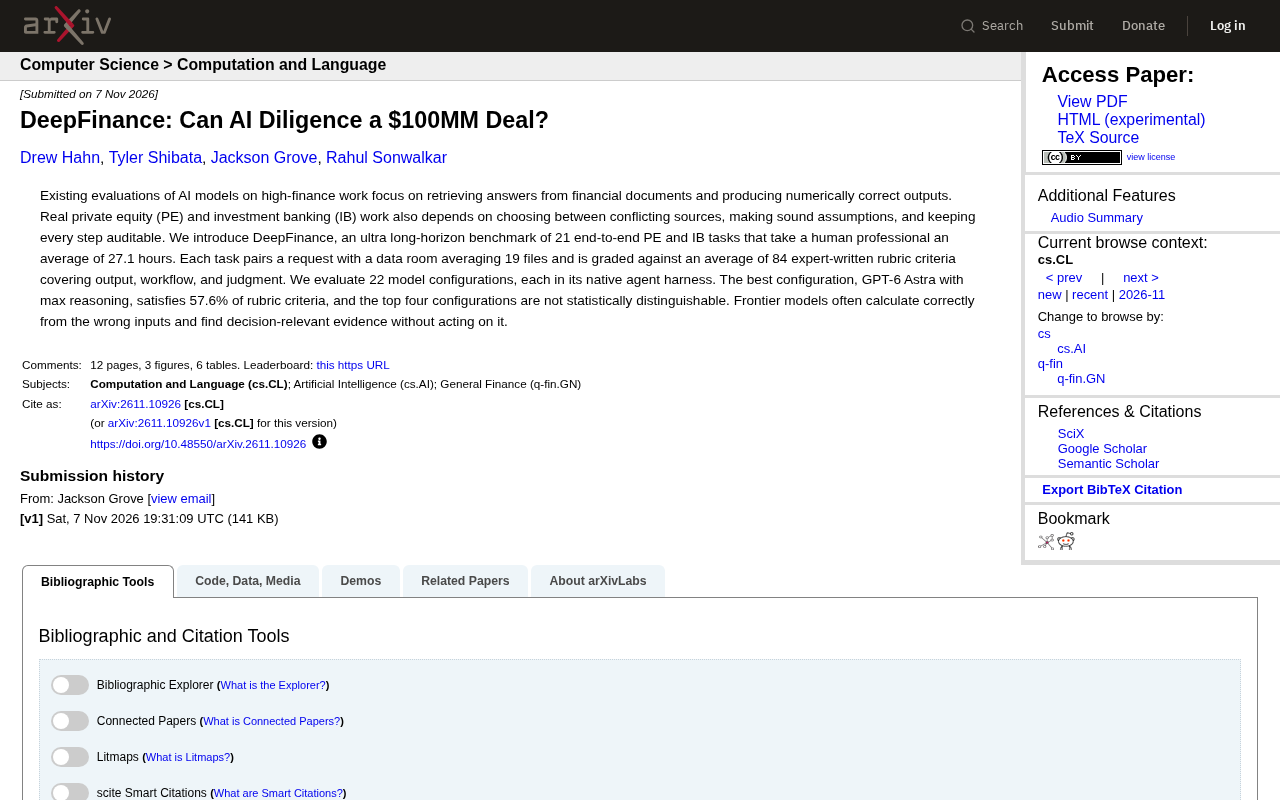
The DeepFinance benchmark is designed to close that gulf. It contains 21 end-to-end PE and IB tasks, each taking human professionals an average of 27.1 hours to complete. Each task comes with a data room averaging 19 files and is scored against an average of 84 expert-written criteria spanning three dimensions: output results, workflow, and quality of judgment.
Evaluation Design: Long-Horizon, Multi-File, Judgment-Heavy
DeepFinance's "ultra-long-horizon" nature is what sets it apart from previous benchmarks. An average human completion time of 27.1 hours means the tasks are not single-turn Q&A, but complex undertakings that require sustained multi-step operation, repeated consultation of the data room, and interim judgments along the way. The average data room of 19 files simulates the reality of real deals, where information overload and conflicting information coexist.
The scoring system also deserves attention. The 84 expert criteria do not merely check final numbers—they fold "how you arrived at that number" into the assessment. This means that even if a model happens to land on the correct final answer, it cannot score highly if its workflow or basis for judgment does not hold up. This design directly addresses the financial industry's hard requirement for auditability.
Agent harness refers to the runtime framework built around a large language model, responsible for tool invocation, context management, multi-step task orchestration, and preservation of intermediate results. The same model can perform very differently under different harnesses: the harness determines which tools the model can call (e.g., file retrieval, code execution, spreadsheet parsing), how long tasks are segmented, and when intermediate conclusions are written back into context. DeepFinance runs each configuration in its native harness, so what is evaluated is the overall system capability of "model + toolchain" rather than isolated model weights. This also explains why engineering-side orchestration strategy matters as much as the actual model choice for the final score.
Report Card for 22 Configurations: A Ceiling of 57.6% Satisfaction
The research team evaluated 22 model configurations, each running in its native agent harness. The best-performing configuration was GPT-6 Astra with maximum reasoning effort, which satisfied 57.6% of the scoring criteria. More intriguingly, the top four configurations are statistically indistinguishable from one another—suggesting that the capability gaps among current frontier models on this class of tasks are not as significant as the ranking differences commonly seen on leaderboards.
The 57.6% figure itself sends a clear signal: even the strongest configuration fails to satisfy more than four in ten expert criteria. For PE and IB scenarios that routinely involve enormous sums of money, this level of reliability is still a clear distance away from independently shouldering due diligence work.
Two Typical Failure Modes of Frontier Models
The paper identifies a particularly insightful phenomenon: frontier models often "compute the right answer from the wrong inputs" and "find evidence relevant to a decision but fail to act on it." The former means the model's computational ability is already quite reliable, but information discrimination and assumption-setting remain weak points; the latter points to a break between "discovery" and "action"—the model can locate key information but does not turn that information into part of subsequent reasoning or conclusions.
These two failure modes map precisely onto the parts of financial due diligence that most test experience: judging which data source is more credible, and whether a single piece of adverse evidence is sufficient to overturn an entire investment thesis. These capabilities are hard to acquire naturally by expanding retrieval scope or adding more computation steps.
"Computing the right answer from the wrong inputs" is especially dangerous in financial due diligence, because plausible-looking final numbers can mask upstream data-source misselection or assumption bias. In real deals, the same metric often appears in management reports, audit workpapers, and third-party databases, each with different definitions and timeliness; if a model fails to identify conflicts or misuses stale data, no amount of downstream computational precision can salvage the conclusion. This kind of failure is hard to catch by adding computation steps—it requires the model to be able to trace and question the provenance of its inputs, which is exactly what the "quality of judgment" dimension of the expert criteria focuses on.
What This Means for AI in Finance
The value of DeepFinance is not in producing a score, but in shifting the evaluation focus from "is the answer right" to "is the process reliable." For institutions exploring AI-assisted due diligence, this benchmark suggests a pragmatic positioning: current models are better suited to supporting roles such as information organization, preliminary screening, and calculation verification, while in areas that require weighing conflicting information and setting key assumptions, human judgment remains irreplaceable.
The design choice of running models in their native agent harness is also worth noting. It shows that what is evaluated is the overall performance of "model plus toolchain," not bare model capability. This means that engineering-side orchestration, tool-calling strategy, and context management matter as much as the model actually selected.
FAQ
What does DeepFinance evaluate? It evaluates how AI models perform on end-to-end private equity and investment banking tasks, covering three dimensions: output, workflow, and judgment.
How did the best model perform? The best configuration, GPT-6 Astra with maximum reasoning effort, satisfied 57.6% of expert scoring criteria; the top four configurations are statistically indistinguishable.
Where are the models' main weaknesses? Models often compute correct results from wrong inputs, or find key evidence but fail to act on it—reflecting shortcomings in information discrimination and in translating judgment into action.
One-line Summary
DeepFinance benchmark shows the strongest AI satisfies only 57.6% of expert criteria; due diligence still needs human judgment.
Paragraph Summary
DeepFinance is an end-to-end evaluation benchmark for private equity and investment banking, containing 21 tasks that take humans an average of 27.1 hours, each with a data room averaging 19 files and 84 expert scoring criteria covering output results, workflow, and quality of judgment. The study evaluated 22 model configurations; the best, GPT-6 Astra with maximum reasoning effort, satisfied only 57.6% of criteria, and the top four are statistically indistinguishable. Frontier models exhibit two typical failures: computing correct answers from wrong inputs, and finding key evidence without acting on it. The benchmark shifts evaluation focus from answer correctness to process reliability, indicating that current models suit supporting roles such as information organization and calculation verification, while weighing conflicting information and setting key assumptions still require human judgment.
Related articles

Hermes Agent Beginner's Guide: Hands-On with a Self-Evolving AI Agent
A beginner's guide to Hermes Agent, the open-source self-evolving AI agent that gained 41.7K GitHub stars in two months—covering Harness Engineering, the learning loop, three-layer memory, WSL installation, and hands-on configuration.

AI Agent in Action: Building a Smart Office Assistant with WorkBuddy
A practical case study shows how Tencent WorkBuddy batch-converts and archives files, compares chat LLMs with AI Agents, and analyzes WorkBuddy's credit system, use cases, and positioning for office automation selection.

From Single-GPU Bottlenecks to Hundreds of Billions of Parameters: 6 Key Questions in Large Model Distributed Parallelism
Based on a Bilibili tutorial, this article organizes core knowledge of large model distributed parallelism: starting from decoder-only architecture's token-by-token generation and the essence of X times W computation, it analyzes six key questions including data parallelism, tensor parallelism, and pipeline parallelism under single-GPU bottlenecks. Suitable for learners in private deployment and model training scenarios to build systematic understanding.