DeepSeek Completes Its Toolchain, ChatGPT Payment Still Requires Human Confirmation
DeepSeek, OpenAI, Salesforce, and llama.cpp all update—fewer steps but clearer boundaries on cost and permissions.
From November 12–13, DeepSeek, OpenAI, Salesforce, and llama.cpp released updates in succession, all aimed at reducing manual steps and letting AI do more. DeepSeek opened application APIs for web search, file input, link reading, and tool calling, which developers can compose and call, but they must verify permissions and costs themselves, and the Flash model is specified. ChatGPT launched a wallet feature where agents can compare prices and place orders on users' behalf, but before payment users must still verify the item, total price, and card information and confirm via biometrics, initially limited to US Pro users. Salesforce released the SOV Transcribe 1 speech transcription model under the Apache 2.0 license, supporting seven languages but not Chinese, and it's non-streaming. llama.cpp released version 1.0, committing to major version numbers for incompatible changes, but hardware performance still depends on quantization method and device.
AI Weekly Roundup: Agent Capabilities Leap Forward, but Control Stays in Human Hands
According to official announcements from November 12–13 compiled by Bilibili creator "Xiluo," DeepSeekAd, OpenAI, Salesforce, and llama.cpp rolled out updates in quick succession, all pointing in the same direction: helping AI cut fewer corners and get more done. But behind every announcement, costs, permissions, and scope of applicability were pushed to the forefront.
DeepSeek Opens Application APIs, Handling the "Wiring" Work
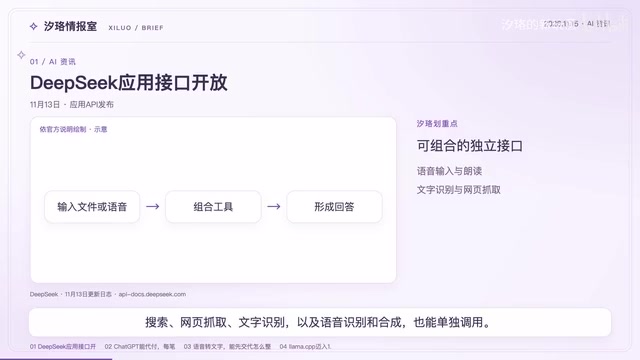
On November 13, DeepSeek opened up a full suite of application APIs. When building chat assistants, developers can directly plug in web search, file input, link reading, tool calling, and data stitching—all handled server-side, saving them the hassle of building integrations themselves.
Search, web scraping, OCR, and speech recognition and synthesis can also be called individually. A document Q&A tool, for example, could combine file reading with voice input. But a distinction needs to be made: this is about opening up application capabilities, not releasing a new foundation model. The official documentation specifies the Flash model, and search, parsing, and speech each carry their own tool fees. The open-source chat demo client can import conversation history, but it's positioned as a demo project. For developers, what's saved is the wiring work—permissions, costs, and answer quality still need to be checked on your own.
"Flash model" is one of DeepSeek's model tiers, categorized by inference cost and response speed. It's typically positioned as a lightweight, fast version suited for high-frequency, low-latency chat and tool-calling scenarios, while more capable versions are offered at higher cost. The "application APIs" mentioned in the article refer to the peripheral capability interfaces built around the model—such as web search, web page parsing, OCR, speech recognition and synthesis, and tool calling—all encapsulated server-side, so developers can compose and call them via API without maintaining their own crawlers, parsers, or speech pipelines. "Wiring" refers to the engineering work of connecting these scattered capabilities into a complete workflow.
"Tool calling" (function calling) means the model outputs structured parameters based on user intent, an external program executes the specific operation (such as querying a database, calling a search, or sending a request), and the result is passed back to the model to continue generating a response. It turns the model from "only able to talk" into "able to trigger actions," but permission control, cost billing, and result reliability must all be designed with fallbacks by the developer.
ChatGPT Wallet: Agents Run Errands, but You Still Nod Before Paying
ChatGPT has launched a wallet feature that lets agents help users complete purchases. But before payment, you still need to verify the item, total price, and selected card, then confirm via face or fingerprint verification before the payment goes through. The network provides payment credentials that substitute for real card information—according to official descriptions, neither the agent nor the merchant can access your actual card details.
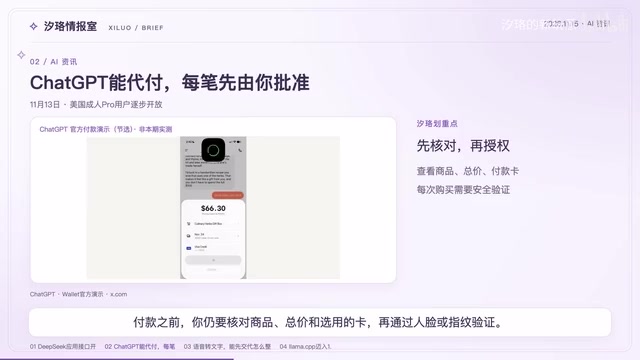
Initially available only to Pro users in the US aged 18 and over, and requiring an eligible US-issued card. This step connects price comparison with ordering, but it doesn't mean all websites already support authorized payments, nor does it mean the order has succeeded. After checkout, you still need to check the merchant's confirmation. Think of it as letting the assistant run one more step—how much you spend and what you buy are still up to a human to decide.
A "payment credential" (payment token) is substitute card information generated by the payment network for a single transaction, typically bound to the real card number but one-time or restricted to a specific merchant. Merchants and agents can only see this credential rather than the user's real card details. This mechanism stems from network tokenization technology, designed to reduce the risk of card number leaks and make transactions traceable and revocable.
"Biometric confirmation" refers to authorizing payment through the device's face or fingerprint verification, essentially keeping the final decision with the user. Even if the agent has completed price comparison, added items to the cart, and filled in information, the user must still actively confirm payment—this complies with regulatory requirements for strong customer authentication and also prevents financial losses caused by model misjudgment. Note that whether an authorized payment succeeds also depends on whether the merchant's website has integrated the corresponding payment protocol, and whether the order is ultimately established is still subject to merchant confirmation.
Salesforce Speech Transcription: Open Weights, but Chinese Absent
Salesforce has released a new speech transcription model, SOV Transcribe 1, focused on turning recordings into text that better fits your needs. You can request verbatim preservation, or clean up verbal pauses, adjust punctuation and number formatting, and even provide names or specialized terms in advance to help recognize content that's easily misheard.
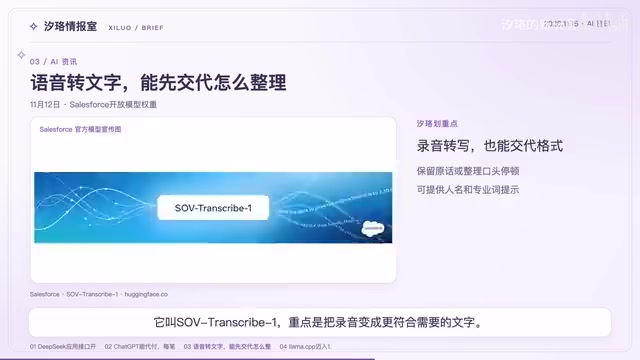
The model uses the Apache 2.0 license, so teams can run it on their own infrastructure. However, it performs non-streaming transcription—it's not a real-time conversational model that outputs words as you speak. The model card lists seven languages including English, but Chinese is not on the supported list. So it's better suited for validating against real business recordings first—don't interpret open weights as meaning it can replace all dictation tools out of the box.
"Open weights" means the trained model parameters are publicly released, and teams can download and run or fine-tune them on their own infrastructure, but training data and complete training code may not be disclosed. It's not entirely equivalent to "open source": the former focuses on usability, while the latter also involves reproducibility and licensing freedom. Apache 2.0 is a permissive open-source license that allows commercial use, modification, and redistribution, but requires retaining copyright notices and license text.
"Non-streaming transcription" means the system first receives the complete audio and then outputs text all at once, rather than outputting words as you speak. Non-streaming typically leverages the full context for better error correction and punctuation restoration, often achieving higher accuracy than streaming, but with higher latency—making it unsuitable for real-time subtitles or voice conversations. The supported languages listed on the model card determine the actual usable scope; Chinese not being listed means there's no official guarantee for Chinese recognition performance, so it's best to validate with real business recordings before deciding whether to adopt it.
llama.cpp 1.0: A Milestone for Interface Stability
The local AI tool llama.cpp has released version 1.0. It's responsible for running models on different hardware, including local machines. One of the key focuses this time is interface stability: going forward, incompatible interface changes will be clearly communicated to developers via major version numbers. For those building software on top of it, it's easier to judge before upgrading whether code changes are needed.
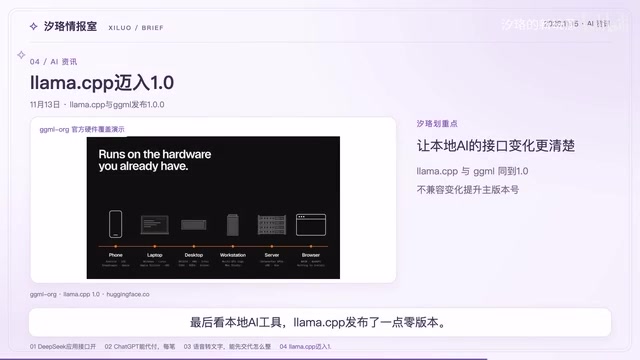
This version also updates the web interface, adding features like chat grouping and text editing. But 1.0 doesn't mean all models will run smoothly on your computer—speed and memory requirements still depend on the model's quantization method and actual hardware. If you use other software that depends on it, you'll also need to wait for that software to complete its own adaptation.
"Model quantization" refers to compressing model weights from high-precision floating-point numbers to lower bit widths (such as 4-bit or 8-bit integers) to significantly reduce memory usage and computation, at the cost of potentially losing a small amount of precision. The quantization method (such as different quantization levels in the GGUF format) directly determines whether a model can run on consumer-grade GPUs or CPUs, as well as generation speed.
Semantic versioning (SemVer) conventions state that a major version number change indicates incompatible interface changes, a minor version number indicates backward-compatible new features, and a patch number indicates fixes. llama.cpp's commitment to using major version numbers to flag breaking changes means that software depending on it can judge whether code changes are needed before upgrading by checking the version number. But 1.0 only represents that the interface is stabilizing—it doesn't guarantee performance: actual speed and memory requirements still depend on quantization level, model size, and hardware configuration, and software using it as a dependency also needs to complete its own adaptation before benefiting.
Summary: Fewer Manual Steps, but Costs and Boundaries Are Equally Clear
All four announcements reduce manual steps while also pushing costs, permissions, and scope of applicability to the forefront. What DeepSeek saves is integration cost; what ChatGPT payment retains is human confirmation; Salesforce opens weights but doesn't cover Chinese; llama.cpp stabilizes interfaces but the hardware threshold remains. Would you rather have AI help you organize files first, or help you complete a shopping trip?
One-line Summary
DeepSeek, OpenAI, Salesforce, and llama.cpp all update—fewer steps but clearer boundaries on cost and permissions.
Paragraph Summary
From November 12–13, DeepSeek, OpenAI, Salesforce, and llama.cpp released updates in succession, all aimed at reducing manual steps and letting AI do more. DeepSeek opened application APIs for web search, file input, link reading, and tool calling, which developers can compose and call, but they must verify permissions and costs themselves, and the Flash model is specified. ChatGPT launched a wallet feature where agents can compare prices and place orders on users' behalf, but before payment users must still verify the item, total price, and card information and confirm via biometrics, initially limited to US Pro users. Salesforce released the SOV Transcribe 1 speech transcription model under the Apache 2.0 license, supporting seven languages but not Chinese, and it's non-streaming. llama.cpp released version 1.0, committing to major version numbers for incompatible changes, but hardware performance still depends on quantization method and device.
Related articles

No Coding Required: He Shipped an App Store App by 'Cutting Features' and Nitpicking with AI
A game designer with zero frontend/backend skills shipped a dual-platform App Store app with AI—not via one-click generation, but by cutting scope and nitpicking like a demanding client.

What Is Harness Engineering? From Concept Origins to Enterprise-Level Agent Implementation
What is Harness Engineering? This article traces the concept's origins and analyzes enterprise-level Agent requirements for tool call fault tolerance, data security, tenant isolation, and memory gaps.
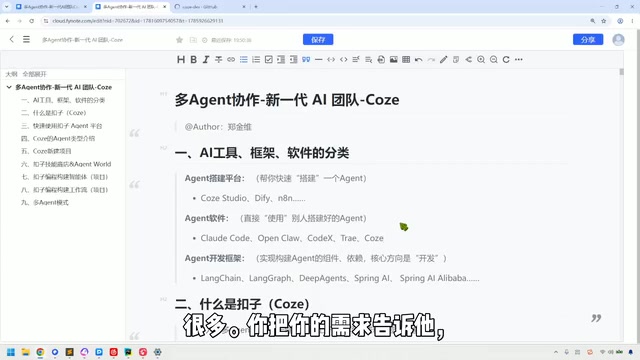
Coze in Practice: A Three-Tier Agent Classification and a Multi-Agent Collaboration Guide
A Bilibili tutorial breaks down the multi-agent collaboration toolchain into three categories: building platforms like Coze Studio and Dify, Agent software like Claude Code, and development frameworks like LangChain—plus a Coze demo of industry templates, three-platform interoperability, local Agent integration, and the trade-offs of credit consumption.