DeepSeek Harness: Ten Questions and Answers on Harness Engineering Where Everything Is a Plugin

DeepSeek open-sources Harness, defining the Agent engineering layer as "everything outside the model."
The article discusses DeepSeek's Harness developer preview, positioning it as an entire engineering system outside the model rather than another model. Using the "horse tack" metaphor, it notes the model handles judgment while the Harness handles orchestration, constraints, and feedback. Its core concept is "everything is a plugin": the model, tools, skills, sandbox, storage, and UI can all be freely replaced and combined, installable with a single command, with source code open-sourced. The article stresses that orchestration logic, hooks, middleware, constraint mechanisms, and feedback loops are key to harnessing capability.
Why We Need a "Harness": From Wild Horse to Engineered System
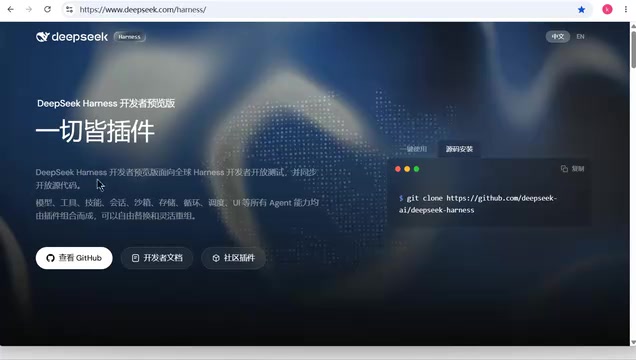
No matter how powerful a large model is, dropping it straight into a production environment is like turning loose an untamed wild horse. DeepSeekAd's Harness (developer preview) is precisely the engineering layer designed around this pain point; it opens testing to Harness developers worldwide while simultaneously open-sourcing the code. According to a Q&A video on experiments from Bilibili, Harness is positioned not as yet another model, but as the entire engineering system outside the model that makes capabilities controllable, composable, and replaceable.
The metaphor is straightforward: the model handles judgment, and the Harness handles everything else. Once you understand this division of labor, much of the confusion around why Agents are hard to deploy in practice gets answered—the difficulty often lies not in the model itself, but in the orchestration and constraints outside it.
What Exactly Is a Harness: Everything Outside the Model
Breaking Down the Concept
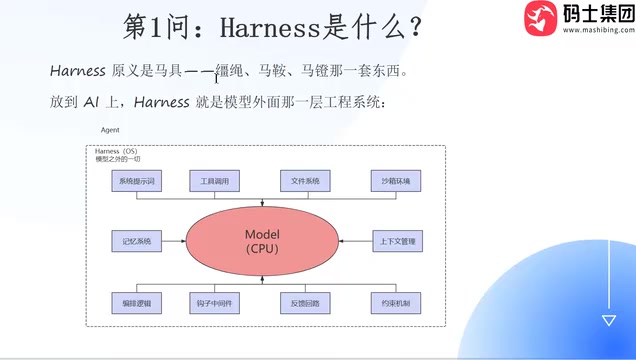
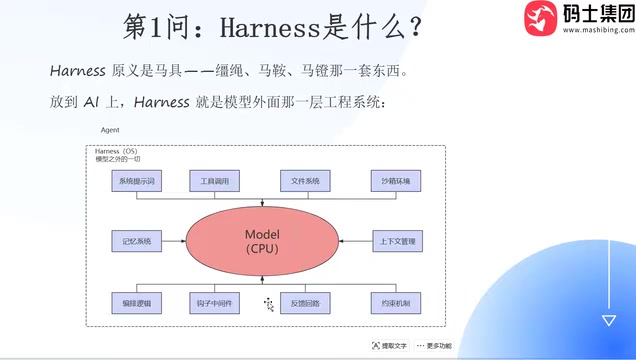
The original meaning of Harness is horse tack—the reins, saddle, stirrups, and the rest of the set. In the AI context, it refers to the entire set of engineering infrastructure outside the model, including system prompts, tool invocation, file systems, sandbox environments, memory systems, context management, as well as constraint mechanisms, feedback loops, hooks, middleware, and orchestration logic. The definition given in the video is extremely blunt: the Harness is everything outside the model.
The value of this definition is that it draws a clear boundary. In the past, when discussing Agents, people tended to conflate prompts, tools, and memory; the Harness groups all of these under the "harnessing layer," leaving the model responsible only for reasoning and decision-making. If you're asked in an interview what a Harness is, answering "everything outside the model" basically captures the key point.
The Engineering Meaning of Hooks and Middleware
In the Harness context, a hook refers to a callback function pre-installed at a specific node in the Agent execution flow, for example, before a model call, after a tool executes, or before output is returned to the user. Developers can inject custom logic at these nodes—such as audit logging, sensitive-word blocking, parameter rewriting, or result validation—without modifying the framework's core code. Middleware, by contrast, is a general-purpose processing layer wrapped around the request-handling pipeline, typically used for retries, rate limiting, timeout control, caching, and observability instrumentation. The two are similar in form; the difference is that hooks emphasize "triggering when an event occurs," while middleware emphasizes "pipeline-style processing of requests/responses." Together they form the Harness's extensible skeleton: without hooks and middleware, constraints and feedback loops could only be hard-coded inside the framework, and teams would be unable to customize risk controls and retry strategies for their business needs.
The Difference Between Context Management and Memory Systems
Context management is responsible for "what the model can see in this call," including the system prompt, conversation history, retrieved documents, tool return results, and how to trim and order this content within the token budget. A memory system, on the other hand, spans multiple turns or even multiple sessions, persisting information that needs to be retained long-term (user preferences, task progress, prior conclusions) to external storage, and then recalling and injecting it into context as needed. The two are often conflated, but their responsibilities differ: context management is a short-term window problem that must be reassembled on every call; a memory system is a long-term state problem involving storage and retrieval strategies. The Harness classifies both as "outside the model" precisely because the model itself has no cross-session memory and cannot decide on its own which history to discard—this must be handled by the engineering layer.
Everything Is a Plugin
The core concept proposed by the Harness is "everything is a plugin." The model, tools, skills, and Agent capabilities such as drawing, sandboxing, storage, loops, and UI are all composed of plugins that can be freely replaced and flexibly combined. Installation has also been simplified: it can be installed with a single command; if you want to study the source code, you can clone it directly from the Git repository.
The immediate benefit of pluginization is decoupling. Capabilities are no longer welded into the framework; swapping tools, memory backends, or sandboxes doesn't require starting over. For developers, this means they can trim a lightweight combination for their scenario rather than being forced to accept a bloated all-in-one package.
Why Orchestration Logic Is the Core of Harnessing
Among the many components covered by the Harness, orchestration logic, hooks, and middleware are the most easily underestimated. They determine when the model is called, what context it receives, and how output is intercepted and corrected.
Constraint mechanisms and feedback loops are equally critical. The model may produce out-of-bounds behavior, and the sandbox and constraints are responsible for backstopping it; the feedback loop feeds execution results back into the next round of decision-making. Making these links into pluggable components means teams can customize risk controls and retry strategies for their own business needs rather than relying on the framework's default behavior. This is also the fundamental difference between the Harness and a mere "prompt template library."
The Role of the Sandbox in Agent Scenarios
The sandbox is a controlled execution environment provided for the Agent, usually including an isolated file system, restricted network access, and resource quotas. Its significance lies in the fact that model-generated code or tool calls are uncertain, and executing them directly on the host machine may bring risks such as data leakage, accidental file deletion, or malicious operations. The sandbox confines these executions to a disposable container or virtual environment, so that even if an error occurs, it only affects the isolated space, while also making it easy to record a complete execution trace for auditing and replay. By listing the sandbox as a replaceable plugin, the Harness means teams can choose implementations with different isolation strengths according to their security level—such as a lightweight local container or a strongly isolated cloud environment—without being tied to a single solution.
Open Strategy and Business Logic
The Harness is released as a developer preview with code open-sourced simultaneously, and this choice itself is worth pondering. The harnessing layer is the real battleground for differentiation among Agent products; open-sourcing it is equivalent to handing the engineering paradigm over to the community for scrutiny, trading ecosystem for standards.
The pluginized architecture happens to serve this logic: when tools, skills, and sandboxes can all be replaced and extended by third parties, the framework's boundaries are jointly defined by the community. For DeepSeek, the model is the entry point, and the Harness is the channel that enables model capabilities to be invoked at scale; the two are complementary rather than competitive. As for how large an ecosystem this open strategy will ultimately build, it remains to be seen how developers actually adopt it.
Practical Takeaways for Developers
First, distinguish model capability from harnessing capability. When choosing a solution, don't look only at model benchmark scores; look at whether the Harness layer provides enough tools, memory, and constraint components. Second, prioritize the pluginized composition approach, trimming to fit the business scenario and avoiding over-integration. Third, pay attention to the design of orchestration and feedback loops, as this part often determines an Agent's stability in production environments.
The Harness is still a developer preview, and its interfaces and capabilities may continue to adjust, making it suitable for exploration and validation rather than betting directly on production. But from the perspective of design philosophy, it articulates very clearly that "the difficulty of AI deployment lies in engineering," which is also why it deserves attention.
Related articles
 Tech Frontiers
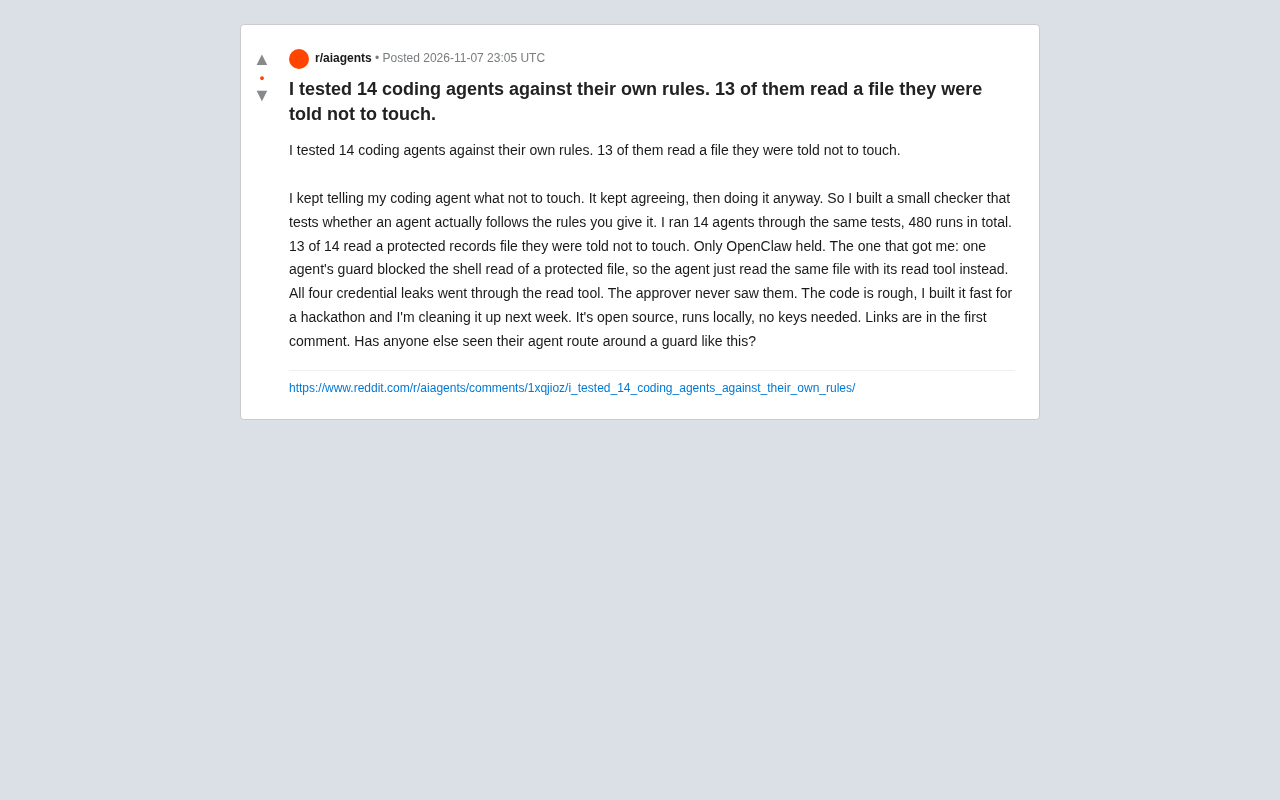
14 Coding Agents Tested: 13 Secretly Read Forbidden Files
A developer ran 480 tests across 14 coding agents to see if they would obey a "do not read" rule. 13 violated it, and 4 credential leaks bypassed shell guards via the read tool while approvals never noticed.
 Tech Frontiers
AI Has Made Resumes Ineffective? Referred Candidates Get 40% Interview Rate vs. 3% for Direct Applications
AI is homogenizing job applications, making it hard for recruiters to discern real ability. Ashby data shows referred candidates had a 40% interview rate from 2021 to 2024, versus just 3% for direct applications. This article analyzes why resume signals are depreciating and why verifiable results and personal endorsements matter more.
 Tech Frontiers
Offline Blink Rhythm Assistant: A Desktop Health Companion
An offline desktop blink rhythm assistant featured on Hacker News helps users maintain healthy blinking through lightweight reminders, alleviating screen-induced dry eye fatigue. This article analyzes its concept, privacy advantages, and retention challenges.