Deploying a LangChain Customer Service Bot on WhatsApp: Build Your Own Console or Resell a White-Label Solution?
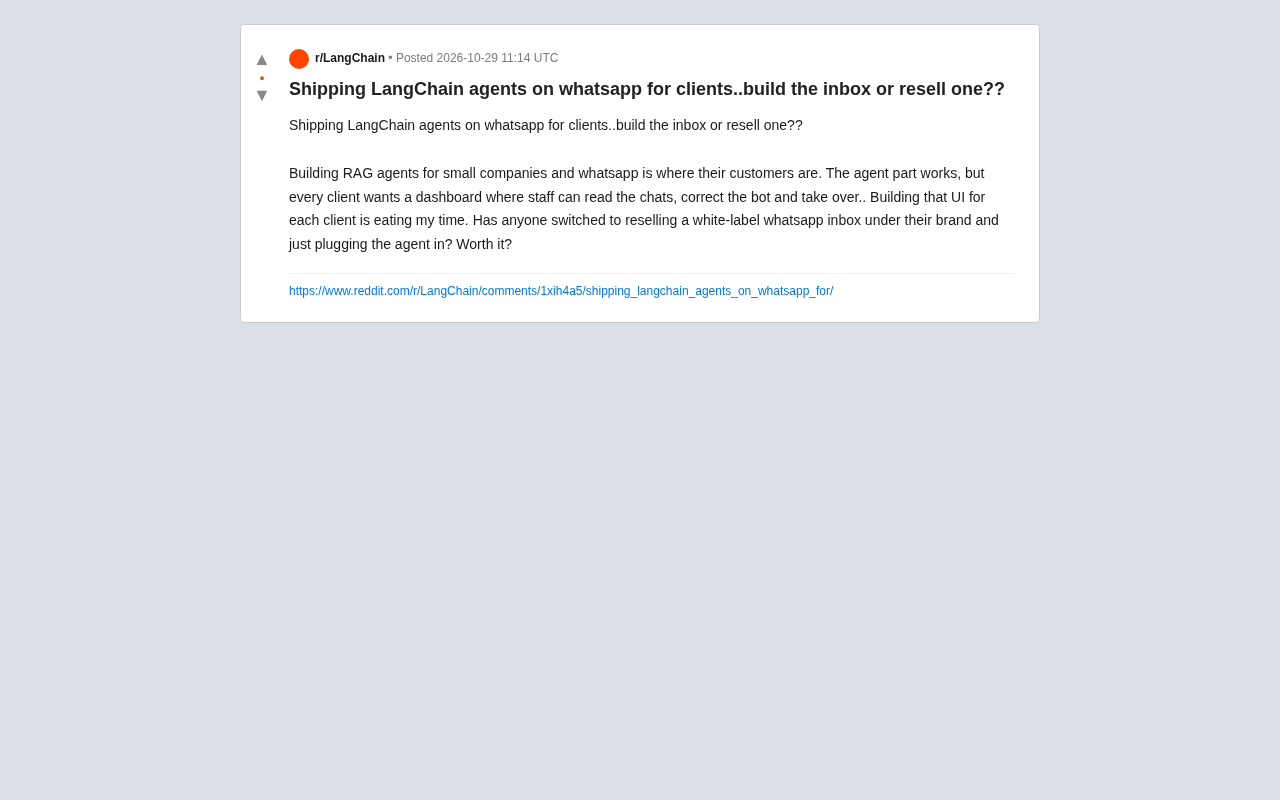
The real cost of deploying AI customer service is the operational console; build vs. white-label demands a time-cost calculation.
Starting from a Reddit developer's case, the article notes that after a LangChain RAG bot is delivered, clients really need an operational console to view chats, correct bot replies, and take over manually — not just Q&A. Rebuilding the UI per client becomes a cost sinkhole. It compares building your own inbox with reselling a white-label WhatsApp inbox, and proposes a pragmatic strategy: resell early to validate, build core modules later.
When a LangChain-powered RAG customer service bot moves from demo to real clients, WhatsApp becomes the battleground of choice for small and medium businesses. But developers quickly discover that getting the agent itself working is only the first step — the real cost sinkhole is that every client wants a dashboard where they can read chat history, correct the bot's answers, and take over conversations manually. Rebuilding the UI for each client devours time endlessly. So a practical question surfaces: build your own customer service inbox, or resell a white-label solution?
What Clients Want Isn't an Agent — It's a Console That Can "Catch Them"
According to the original Reddit poster, he builds RAG agents for small companies, and WhatsApp is where his clients are most concentrated. The agent's Q&A capability is already usable, but every client raises the same requirement: employees need a dashboard to read conversations, correct the bot's answers, and take over chats when necessary. This means the deliverable is far more than an API or a chat window — it's a set of operational tools.
The essence of this demand is "controllability." Businesses don't dare hand customer communication entirely to a black-box model; they need to see what the bot is saying and be able to hit the brakes at any time. Without this console, no matter how smart the agent is, it's hard to get truly adopted. The author says outright that building this UI separately for each client is consuming a huge amount of his time — and that's where the problem starts.
RAG (Retrieval-Augmented Generation) is a technique that combines information retrieval with text generation: the system first retrieves document fragments relevant to the user's question from a knowledge base, then feeds these fragments as context to a large language model to generate an answer. Compared with pure generative models, RAG can significantly reduce hallucinations and ensure answers are grounded in a company's private data, which is why it's often used in customer service Q&A scenarios. But RAG's performance depends heavily on knowledge base quality and retrieval strategy. When relevant content can't be retrieved or the model misinterprets things, answers can be wrong. This is precisely the fundamental reason businesses need humans to review and correct the bot's answers — RAG is not "train once and it's forever correct," but a system that requires ongoing operational tuning.
Building Your Own Inbox: Maximum Control, but Underestimated Time Cost
Building your own means developing a chat inbox from scratch, including conversation lists, message streams, human takeover buttons, and bot reply correction features. The benefits are obvious: full data autonomy, deeply customized experience, seamless integration with your own agent, and no ongoing distribution costs in the long run.
But the price is an exponential rise in engineering complexity. A multi-agent collaborative customer service inbox involves real-time message synchronization, agent assignment, permission management, message status tracking, and other backend capabilities. These have little to do with RAG and LangChain themselves, yet they're enough to slow down delivery for every project. For independent developers or small teams, rebuilding it for each new client means marginal costs barely decline and delivery cycles get stretched out.
White label refers to a product or service produced by one party that allows another party to sell it under their own brand. In the SaaS world, white-label solutions typically provide a complete functional backend; buyers only need to swap the logo, domain, and color scheme to deliver it externally. For developers, white label means not having to build the UI and collaboration layer from scratch, but updates, pricing, and data storage of the underlying product remain controlled by the original vendor. The opposite is "building your own," i.e., fully self-developed, owning all code and data. White label is often used to enter the market quickly and validate demand, but in the long run it may limit customization depth and generate ongoing revenue-share costs.
Reselling a White-Label Solution: Trade Revenue Share for Time — Worth Doing the Math
The other path the author proposes is: resell a white-label WhatsApp inbox under your own brand and simply plug your agent into it. This approach hands the UI and collaboration layer to a mature product while you focus on the core value of the agent and RAG. The benefit is a massive boost in delivery speed — clients get a polished operational tool rather than a half-finished product.
The cost lies in ongoing distribution fees and dependence on the underlying product: the brand is white-labeled, data flows to a third party, feature iteration is controlled by others, and long-term profits are eroded by revenue sharing. For a volume-driven business pursuing rapid replication, this math may work out; for projects pursuing high ticket prices and deep customization, it may not.
This is exactly where the original poster's confusion lies — he doesn't offer a conclusion but seeks the community's experience. The answer to this question depends heavily on the business model: number of clients, value per client, and the developer's own willingness to invest in UI engineering.
A Hybrid Path: Resell First to Validate, Then Build to Accumulate
From an engineering economics perspective, a pragmatic strategy is to handle this in phases. When clients are few early on, reselling a white-label solution can quickly validate market demand and leave time for agent quality itself; when the client count grows and the white-label solution's marginal costs begin to show, gradually build core modules yourself and bring high-frequency features back in-house.
Another approach is to build only a "lightweight console" — not a full ticketing and agent-seat system, but just the three high-frequency features: conversation viewing, human takeover, and reply correction. This covers the core demands of most clients while avoiding getting stuck in the quagmire of full-stack customer service system development. The key is identifying which features clients actually use and which merely sound complete.
Marginal cost refers to the additional cost incurred by each new unit (here, each new client). In software delivery, if every client requires a separately deployed and configured custom UI, then marginal costs barely decline as the client count increases — and may even rise due to maintaining multiple instances. Conversely, standardized, multi-tenant SaaS products have extremely low marginal costs. The article's discussion of choosing between building and white-labeling is essentially comparing the marginal cost structures of the two models: building requires high upfront investment but is controllable later, while white label is fast upfront but requires ongoing per-client payments. Understanding this helps in choosing the right path based on business scale.
Editorial View
This discussion reflects a common pattern in AI application deployment: model capability is only a small part of the product, and the operational tools around it are often the bulk of the delivery. LangChain lowers the barrier to building agents, but it doesn't reduce the complexity of customer service workflows themselves. Developers need to make a clear trade-off between "control" and "delivery speed" rather than defaulting to the assumption that every client deserves a custom backend. Calculating the time cost per client before deciding whether to build or buy is more worthwhile than diving straight in.
One-line Summary
The real cost of deploying AI customer service lies in the operational console; building your own or reselling white label requires doing the time math.
Paragraph Summary
Starting from a Reddit developer's case, the article points out that after a LangChain RAG customer service bot is delivered, what clients truly need is an operational console to view chat history, correct bot answers, and take over manually — not just Q&A capability. Rebuilding the UI for each client becomes a cost sinkhole. The author compares building your own inbox with reselling a white-label WhatsApp inbox: building offers strong control but high engineering complexity and marginal costs that are hard to reduce; white label delivers fast but requires ongoing revenue sharing and dependence on third parties. The article ultimately proposes a pragmatic strategy: resell early to validate the market, then build core modules later, or build only lightweight high-frequency features like conversation viewing, human takeover, and reply correction. The decision depends on client count, value per client, and the team's willingness to invest in UI engineering.
Related articles

Last Week Tonight Exposé: The Dangerous Ties Between Politicians and White Supremacy
Last Week Tonight investigates Georgia Senate candidate Mike Collins and Florida candidate Marshall Rawson, exposing their multiple ties to white supremacists and the Republican Party's silent response.
AI Buzz Weekly: GPT-6.5 Leak, New Claude Model, and MiniMax's Cost-Effectiveness
This week's AI buzz roundup: suspected GPT-6.5 leak, Microsoft configs showing GPT-6.1 Tera, Anthropic's new model that can identify entire classes of bugs, disappointing early Gemini 4 Carbon results, and MiniMax M3.1 Flash beating Claude Opus 5 and GPT-5.6 Sol in benchmarks at extremely low cost.

AI Briefing: Gemini 4 Carbon Released, Ant Open-Sources Ling-3.1
AI Briefing: Google releases Gemini 4 Carbon qubit model, claiming to surpass Opus 5.5 with half-price tokens; Ant open-sources Ling-3.1-1019 for real-task Personal Agents; domestic AI drug discovery succeeds in 18 of 19 projects, hitting all 6 GPCR targets; zero-revenue company valued at $20B raises another $1B; Sichuan convenience store robot sales fail.