Desigma: A Free Figma Alternative Built with Rust

Free, open-source design tool Desigma, written in Rust, debuts to challenge Figma.
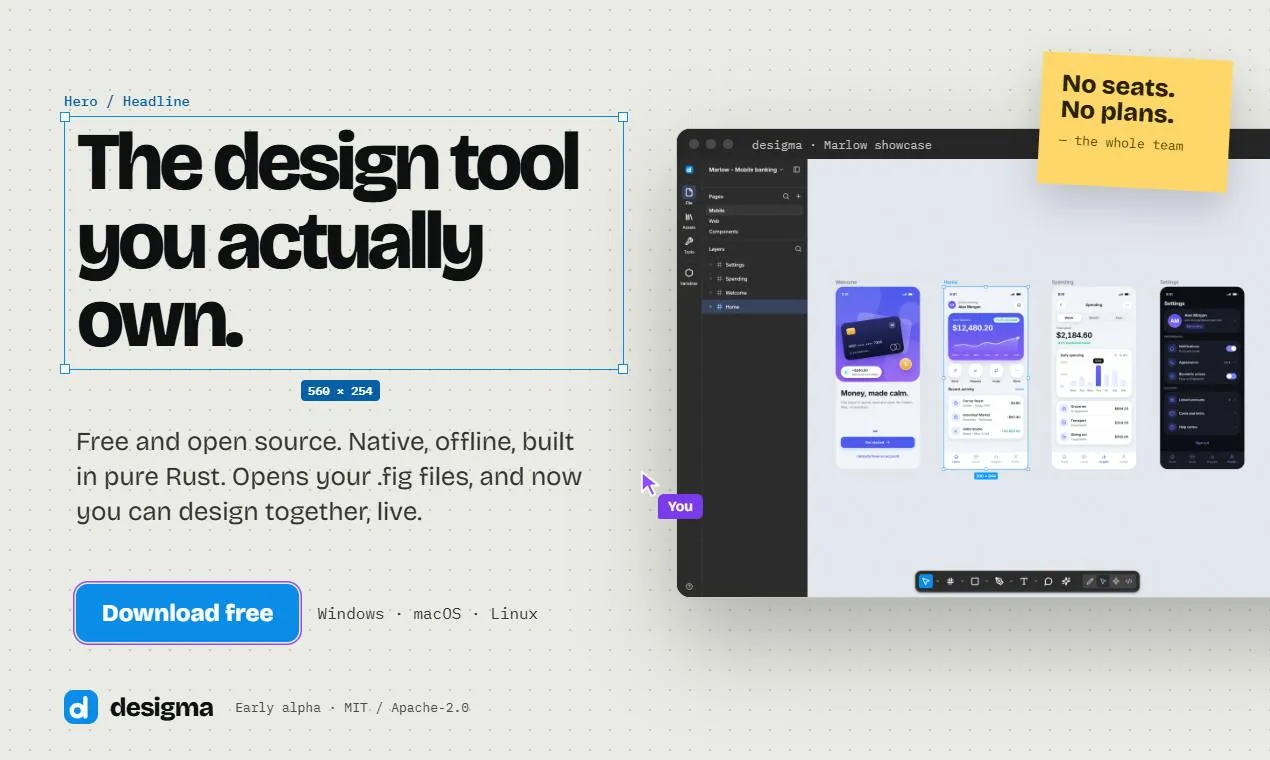
Desigma is a free, open-source design tool written in Rust that debuted on Product Hunt as a "Figma alternative," earning 79 upvotes, 4 comments, and a 12th-place ranking for the day. The article analyzes its technical choices: Rust offers memory safety and high performance, potentially differentiating it in canvas rendering and complex vector graphics, though real performance is still unverified. Its free, open-source strategy addresses the pain point of Figma's subscription price hikes and gives teams data autonomy and customizability. However, the design tool ecosystem has extremely high barriers—Figma's collaboration, component libraries, and developer handoff chain are hard to replicate short-term. Desigma's docs and feature list remain limited and it's still early-stage, unlikely to challenge Figma soon, but worth watching for developers and small teams eager to try new things.
The design tool space has long been dominated by Figma, but the open-source community has never stopped challenging it. Desigma, which recently debuted on Product Hunt, has caught the attention of many developers and designers with its tagline: "A free Figma alternative written in Rust."
Why Is Rust Worth Noticing?
Desigma's most striking feature is that it's built with Rust. Rust is known for memory safety and high performance, and in recent years it has spread rapidly across system tools, WebAssembly, and frontend infrastructure. Building a design tool in Rust means lower runtime overhead and a smoother interactive experience—especially important for design software that needs to render canvases in real time and handle complex vector graphics.
By comparison, Figma is built on a web tech stack. While this makes cross-platform support convenient, it occasionally hits performance bottlenecks when handling large design files. If Desigma can leverage Rust's strengths at the architectural level, it may deliver a differentiated experience in responsiveness and resource usage. However, the project is still in its early stages, and its real-world performance remains to be validated by the community.
WebAssembly (Wasm) is a binary instruction format that runs in modern browsers and is often seen as the key pathway for Rust to enter the frontend world. Rust can be compiled to Wasm and executed at near-native speed inside the browser sandbox while maintaining memory safety. For design tools, this means heavy-lifting logic such as canvas rendering and vector graphics computation can run in Wasm rather than relying entirely on JavaScript. Figma itself made extensive use of WebAssembly early on to accelerate rendering, so if Desigma takes the Rust + Wasm route, its technical path has similarities with Figma—with the differences showing up more in language-level safety guarantees and toolchain maturity.
Open Source and Free: Lowering the Barrier to Design Tools
Desigma is released as an open-source project on GitHub (repository: deepfounder-ai/desigma) and is explicitly labeled "free." This positioning directly addresses a pain point Figma has created in recent years: as Figma shifted to a subscription model and adjusted its pricing, some individual users and small teams began looking for more economical alternatives.
Open source also means greater customizability and data autonomy. Teams can deploy and modify the code themselves to fit specific workflows without worrying about platform lock-in. One of Desigma's makers is Kir Leshkevich, and the project is currently seeking community contributors to develop it together.
Vendor Lock-in refers to the situation where users become so deeply tied to a platform through data formats, workflows, or collaborative relationships that migration costs become extremely high, leaving them with no bargaining power. Design tools are especially prone to lock-in: source file formats are not public, component libraries and comment histories accumulate within the platform, and team collaboration processes are built around the platform. The value of open-source tools lies in source file formats and code that are auditable, exportable, and self-hostable, allowing teams to migrate or build upon them when necessary. However, open source does not automatically mean no lock-in—if the file format is still controlled by a single project, the lock-in risk is simply transferred from a commercial company to a community project.
Early Stage and Community Feedback
On Product Hunt, Desigma received 79 upvotes and 4 comments, ranking 12th for the day. For a fledgling open-source design tool, this result reflects some market interest but also shows that it has not yet entered the mainstream spotlight.
The barriers to entry in the design tool ecosystem are extremely high: Figma doesn't just provide an editor—it has built a complete chain of component libraries, collaborative comments, developer handoff, and more. For Desigma to become a true alternative, it will need to invest continuously in these supporting features. Currently, the project's documentation and feature list on GitHub are still fairly limited, and the community will need more time to observe its ability to execute on its roadmap.
Product Hunt rankings are calculated in real time based on upvotes received that day. A 12th-place ranking typically corresponds to a range of dozens to around a hundred votes—a position that means "gained initial exposure but didn't reach the top tier." This ranking is better used as a reference for early market signals rather than as proof of product maturity. The real barriers for design tools lie in long-chain capabilities such as real-time multi-user collaboration, version history, component systems, and developer handoff—none of which can be demonstrated through a single launch-day vote count. So 79 votes and 4 comments show the project has reached early adopters, but there is still considerable distance to go before validating product-market fit.
A New Open-Source Attempt at Design Tools
Desigma's emergence represents a new attempt by the open-source community to take on proprietary design tools. Its choice of Rust opens up possibilities for performance, while its free and open-source strategy lowers the barrier to entry. But the success of a design tool depends not only on code quality but even more on ecosystem building and polished user experience. For developers and small teams willing to try something new, Desigma is worth keeping an eye on; for design teams that prioritize stable collaboration, it will struggle to challenge Figma's position in the short term.
In the future, if Desigma can attract enough contributors, gradually fill in core features, and build a plugin ecosystem, open-source design tools may indeed carve out a territory of their own.
One-line Summary
Desigma, a free open-source design tool written in Rust, has arrived—aiming to challenge Figma.
Paragraph Summary
Desigma is a free open-source design tool written in Rust that debuted on Product Hunt positioned as a "Figma alternative," earning 79 upvotes and 4 comments and ranking 12th for the day. The article analyzes its technical choices: Rust brings memory safety and high performance, potentially enabling differentiation in canvas rendering and complex vector graphics processing, though real-world performance remains unverified. Its free and open-source strategy targets the pain point created by Figma's subscription price hikes and gives teams data autonomy and customizability. However, the design tool ecosystem has extremely high barriers—Figma's collaboration, component libraries, and developer handoff chain are hard to replicate in the short term. Desigma's documentation and feature list are still limited, and it remains in an early stage. It won't threaten Figma's position anytime soon, but it's worth watching for developers and small teams willing to try something new.
Related articles

Last Week Tonight Exposé: The Dangerous Ties Between Politicians and White Supremacy
Last Week Tonight investigates Georgia Senate candidate Mike Collins and Florida candidate Marshall Rawson, exposing their multiple ties to white supremacists and the Republican Party's silent response.
AI Buzz Weekly: GPT-6.5 Leak, New Claude Model, and MiniMax's Cost-Effectiveness
This week's AI buzz roundup: suspected GPT-6.5 leak, Microsoft configs showing GPT-6.1 Tera, Anthropic's new model that can identify entire classes of bugs, disappointing early Gemini 4 Carbon results, and MiniMax M3.1 Flash beating Claude Opus 5 and GPT-5.6 Sol in benchmarks at extremely low cost.

AI Briefing: Gemini 4 Carbon Released, Ant Open-Sources Ling-3.1
AI Briefing: Google releases Gemini 4 Carbon qubit model, claiming to surpass Opus 5.5 with half-price tokens; Ant open-sources Ling-3.1-1019 for real-task Personal Agents; domestic AI drug discovery succeeds in 18 of 19 projects, hitting all 6 GPCR targets; zero-revenue company valued at $20B raises another $1B; Sichuan convenience store robot sales fail.