Discogs Founder Kevin Lewandowski: 25 Years Building a Vinyl Haven

Twenty-five years in, Discogs serves vinyl collectors with a version database and a UGC trading flywheel.
The article reviews Kevin Lewandowski's 25-year journey founding Discogs: the platform started as a record marketplace and evolved into a comprehensive music database covering albums, singles, and all manner of reissues and regional versions, becoming the core destination for vinyl collectors. It attributes success to meeting collectors' needs for accurate version information, a reliable trading environment, and community atmosphere, and to a UGC-plus-e-commerce flywheel. It also profiles the founder through his AeroPress habit, reflecting a philosophy of simple tools. Finally, it highlights the long-term value of vertical communities and the relevance of its data-structuring approach for AI and tech professionals.
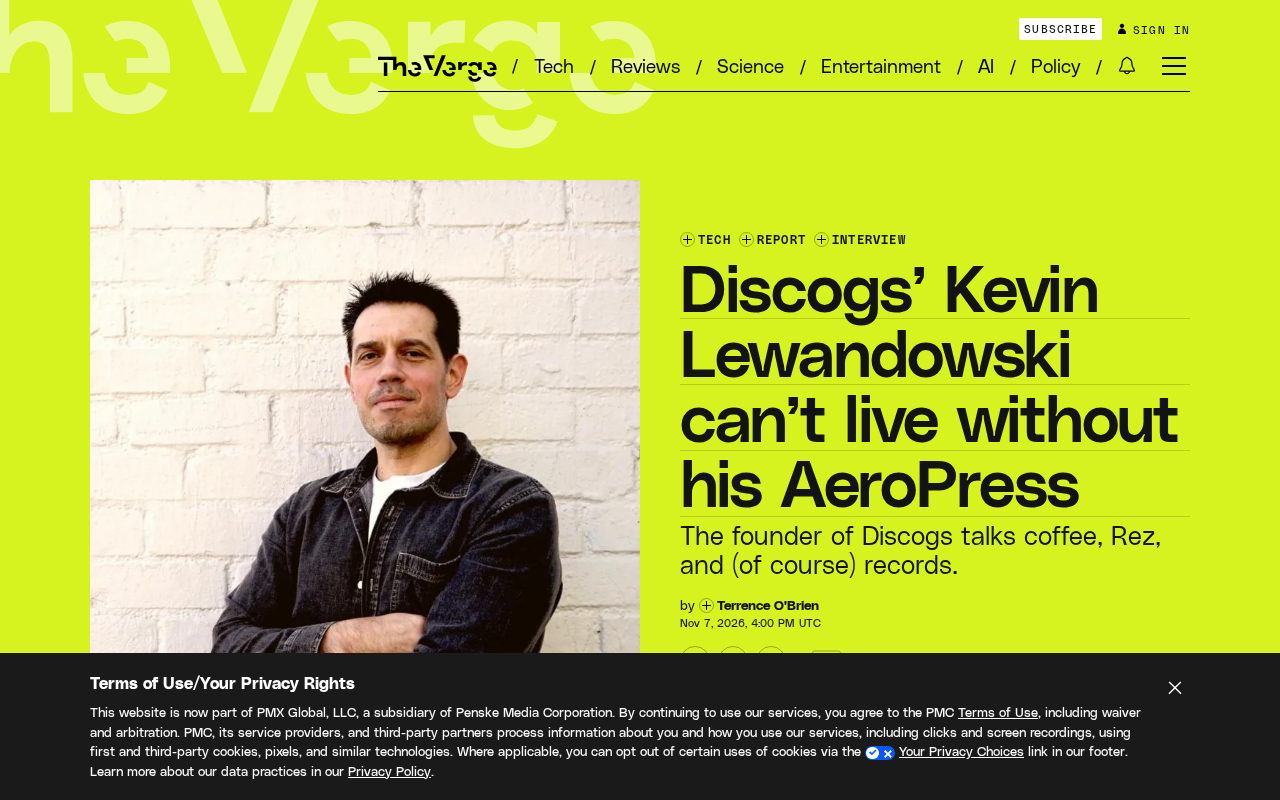
Twenty-five years ago, Kevin Lewandowski founded Discogs. The site is now widely recognized as the online destination for vinyl collectors and music geeks of all kinds. At its core is a marketplace for buying and selling records, but it is far more than that—Discogs has grown into a surprisingly comprehensive database covering not only albums and singles but also every version imaginable.
From Marketplace to Music Database
Discogs began with a simple need: to give record collectors a reliable trading platform. But Lewandowski's vision was clearly bigger. Over time, Discogs accumulated a massive amount of information on record versions, from albums and singles to all manner of reissues and regional pressings—virtually everything.
According to the original report, Discogs has become a "shockingly comprehensive database" whose coverage far exceeds that of ordinary music databases. For collectors obsessed with record versions, it is virtually the only choice.
Discogs' data model: Release as the core entity
To understand why Discogs can cover "every version," you need to understand its data model. Unlike most music databases, which center on the Album or the Work, Discogs' core entity is the Release. Different reissues, different regional pressings, different mastering, even different cover printing of the same album are all recorded as separate Releases in Discogs, each with its own unique ID.
These Releases are then grouped together via Master Release, which collects all versions of the same work under one main entry so users can compare them side by side. Above that are entities such as Artist and Label, forming a multi-layered network of relationships. It is precisely this "version-first" modeling that lets collectors pinpoint details such as a record's country of origin, year, and matrix codes, and that makes Discogs far superior in version scholarship to ordinary music databases centered on track information.
A Glimpse into the Founder's Life: AeroPress and Beyond Vinyl
The AeroPress mentioned in the headline is an indispensable object in Lewandowski's life—a manual coffee maker known for its simplicity, portability, and consistent output. Perhaps it echoes his entrepreneurial philosophy in some way: use simple tools to produce professional results.
However, the original material says little about the specific contexts and details of AeroPress use; it serves more as a slice of life in a personality profile. For tech entrepreneurs, such daily habits often reflect their pursuit of efficiency and a sense of control.
The Product Logic Behind 25 Years of Persistence
Discogs has lasted 25 years not through flashy features but through continuously meeting its core users' needs. Collectors need accurate version information, a reliable trading environment, and an active community atmosphere—Discogs has built barriers on all three fronts.
From a product perspective, Discogs' success lies in combining UGC (user-generated content) with e-commerce: users contribute data to improve the database, and the database in turn attracts more users to trade. This flywheel effect is especially effective in vertical niches.
Why the UGC flywheel works better in vertical niches
The flywheel effect of combining UGC with e-commerce tends to be more viable in vertical niches than on general-purpose platforms, for three reasons. First, users in a vertical niche are experts themselves, so the marginal cost of contributing data is low and accuracy is high, making moderation relatively manageable. Second, the more detailed the data, the higher the switching cost—a collector's inventory and version information entered on one platform is hard to migrate elsewhere without loss, creating natural lock-in. Third, trading needs and data needs overlap heavily: people who want to buy a specific version are exactly the ones who care most about the accuracy of version information, creating a positive feedback loop between contribution and consumption.
Discogs has also established tiered contribution and voting-based moderation mechanisms, letting the community maintain data quality itself. This structure—where users are simultaneously data producers and buyers/sellers—is the key to building a moat in the gaps between the giants.
Takeaway: The Long-Termism of Vertical Communities
The Discogs case shows that vertical communities can still thrive in the cracks between the giants. The key is to serve a group of "obsessive" users well—users willing to pay a premium for accuracy and expertise. For AI and tech professionals, Discogs' approach to structuring data is also worth learning from: how to turn unstructured user contributions into high-quality data that is searchable and tradable.
One-line Summary
Twenty-five years after its founding, Discogs serves vinyl collectors with a version database and a UGC trading flywheel.
Paragraph Summary
The article reviews Kevin Lewandowski's 25-year journey founding Discogs: the platform started as a record marketplace and gradually evolved into a comprehensive music database covering albums, singles, and all manner of reissues and regional versions, becoming the core destination for vinyl collectors. The article notes that its success stems from continuously meeting collectors' needs for accurate version information, a reliable trading environment, and community atmosphere, and from combining UGC with e-commerce to create a flywheel effect. It also uses the AeroPress as a lens to sketch the founder's life and reflect his philosophy of simple tools. Finally, it summarizes the long-term value of vertical communities in the gaps between giants and highlights the relevance of its data-structuring approach for AI and tech professionals.
Related articles
 Tech Frontiers
Pushing the Limits of Extreme Sudoku on a 16GB GPU: Insights from Depth and Flow Matching
A researcher trained a 16.54M-parameter model on a 16GB GPU to solve extreme Sudoku, finding effective depth breaks the 60% plateau and flow matching with improved sampling pushes accuracy past 99% with ~50× lower layer-evaluation budget.
 Tech Frontiers
AI Agent Approval Workflows: Why Human Confirmations Always Get Mindlessly Clicked
Why do AI agent approval workflows always get mindlessly clicked? A Reddit discussion shows that separating rules from keys, low-frequency high-risk approvals, and GitHub Environments-style gates are the keys to effective approvals.
 Tech Frontiers
MuJoCo: An Analysis of DeepMind's Open-Source General-Purpose Physics Simulator
An in-depth analysis of Google DeepMind's open-source physics simulator MuJoCo: high-performance C++ kernel, MJCF modeling format, contact solving principles, MJX GPU acceleration, and robot reinforcement learning use cases.