Dots Phone: A Phone Plugin for OpenAI Dots That Lets AI Make Calls

Dots Phone is an open-source, self-hosted plugin that enables OpenAI Dots to make phone calls.
Dots Phone is an independent open-source plugin on Product Hunt that adds phone execution capabilities to OpenAI Dots. It generates a call brief to constrain AI behavior, dials through Twilio, and asks Codex for missing information instead of fabricating it. Self-hosted with your own OpenAI and Twilio accounts, it emphasizes data privacy but introduces deployment and billing barriers. With 71 votes and limited community discussion, it's an early-stage project suited for technical users to try in low-risk scenarios.
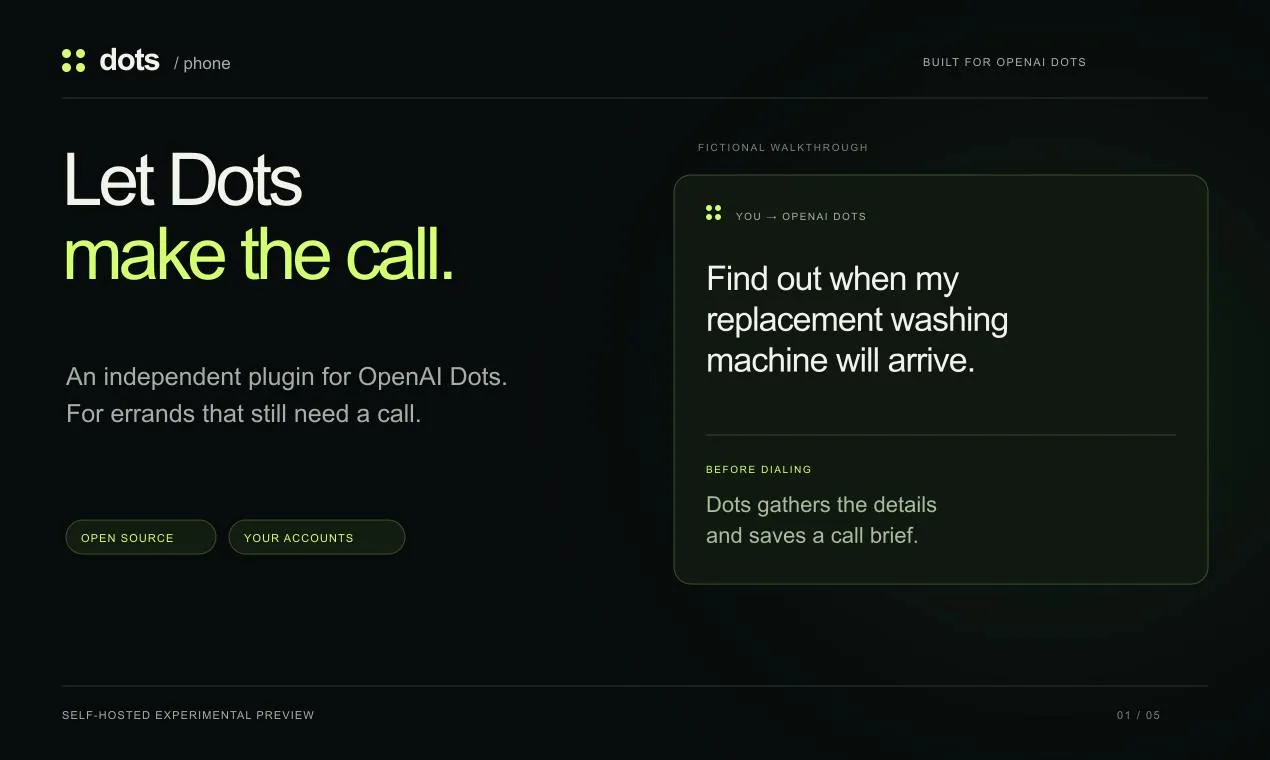
OpenAI Dots is an AI product focused on conversation, but it can't make phone calls on its own. An independent plugin called Dots Phone has appeared on Product Hunt, aiming to fill this capability gap: you give Dots a phone task, it first prepares a call brief, then dials on your behalf, and when information is missing, it turns to Codex for help before finally reporting the results back to you. The project received 71 votes on Product Hunt, ranking 19th, with tags covering productivity, open source, and artificial intelligence.
What Problem It Solves
Dots Phone's positioning is clear: to turn Dots from "good at chatting" into "able to get things done." Traditionally, having AI make phone calls requires stitching together speech recognition, dialogue management, telephony gateways, and more, but Dots Phone packages all of this into a single plugin. The creator, Gabe, designed it to be fully self-hosted, using your own OpenAI and Twilio accounts, which means call data and credentials stay in your hands rather than passing through third-party servers.
This approach addresses a real need: for scenarios like appointments, confirmations, and simple customer service follow-ups, phone calls remain an unavoidable channel. Letting AI handle them can save a significant amount of time spent on repetitive communication.
Twilio is a platform that provides cloud communication APIs. Developers can use it to initiate and receive calls and send and receive text messages through code without building their own telecommunications infrastructure. Twilio offers Programmable Voice capabilities, supporting speech synthesis, speech recognition, call recording, and real-time media streams, which is why it serves as the underlying telephony gateway for many AI voice bot projects. Using Twilio requires purchasing a phone number and paying based on call minutes, so when Dots Phone is used in self-hosted mode, users need to register their own Twilio account, configure a number, and bear the associated costs. Understanding this helps assess the actual barrier of the plugin's "self-hosted" model: it's not zero-cost, but rather returns credential and billing responsibility to the user.
Workflow: From Task to Call
According to the product description, Dots Phone's workflow can be broken down into several steps. First, Dots receives a phone task, such as "help me confirm Friday's restaurant reservation." It then generates a call brief that clearly lays out the objective, key information, and possible response strategies. The plugin then initiates the actual call, and if it discovers during the conversation that necessary details are missing, it requests supplements from Codex rather than making things up. After the call ends, Dots reports the results back to the user.
This chain of "brief first, then call, ask Codex when information is missing" is more controllable than simply converting speech to text and letting a large model reply. The briefing step essentially sets boundaries for the AI, reducing off-topic responses and hallucinations; Codex's involvement provides a structured mechanism for information completion.
Codex originally referred to OpenAI's series of code generation models, which later evolved into API capabilities supporting code understanding and generation (such as code-davinci-002 and others). In the context of this project, Codex is used as a structured information completion and reasoning backend: when necessary details are found to be missing during a call, the plugin sends requests to Codex to obtain supplementary content rather than letting the dialogue model improvise. This usage leverages Codex's strengths in structured output and instruction following, turning "what information is missing and how to fill it in" into a queryable subtask, thereby reducing the probability of hallucinations in the main dialogue flow.
Self-Hosting and Open Ecosystem
Dots Phone emphasizes self-hosted operation and is open source. For teams concerned about data privacy, this is attractive: your OpenAI API key and Twilio credentials stay in your own environment. At the same time, open source means the code can be audited, modified as needed, and easily integrated with other self-hosted tools.
However, self-hosting also means users need to handle deployment, Twilio number configuration, and OpenAI API call costs themselves. This is better suited for developers or small teams with some technical capability rather than a fully zero-configuration consumer product. Currently, discussion on Product Hunt is still limited, with only 1 comment, so community feedback is sparse and actual stability needs more verification.
Self-hosted refers to users deploying and running software on their own servers or local environments rather than using vendor-hosted cloud services. For Dots Phone, self-hosting means the plugin code, OpenAI API key, Twilio credentials, and call data all remain in the user's own environment without passing through third-party relay servers. This brings privacy and compliance advantages, but also transfers responsibility for deployment, upgrades, number configuration, and troubleshooting to the user. The opposite is the SaaS model, which is ready to use out of the box but routes data through the service provider. The combination of self-hosting and open source is common among developer-oriented AI tools, suitable for small teams that are sensitive to data flows and have operational capabilities.
A Direction Worth Watching
AI phone calls are not a new concept, but making it a Dots plugin and introducing Codex for information completion is a pragmatic combination. It demonstrates a practical form of "AI Agent calling external tools": Dots handles understanding and orchestration, Dots Phone handles executing phone actions, and Codex handles supplementing context. This division of labor makes each component's responsibilities clearer.
If you're already using OpenAI Dots and have outbound or inbound call needs, Dots Phone offers a self-deployable option. However, given that the project is still very early, it's advisable to try it first in low-risk scenarios, such as internal notifications or information confirmations, before gradually expanding to more formal call tasks.
One-line Summary
Dots Phone is an open-source, self-hosted plugin that enables OpenAI Dots to make phone calls.
Paragraph Summary
Dots Phone is an independent open-source plugin on Product Hunt that adds phone execution capabilities to the conversation-focused OpenAI Dots. After a user provides a phone task, the plugin first generates a call brief to constrain AI behavior, then actually dials through Twilio; if information is missing during the call, it requests supplements from Codex rather than fabricating, and reports results to the user afterward. The project uses a self-hosted model with the user's own OpenAI and Twilio accounts, emphasizing data privacy and controllability but also introducing deployment and billing barriers. It received 71 votes and ranked 19th on Product Hunt, with limited community discussion so far, making it an early-stage project suitable for technical users to try in low-risk scenarios, demonstrating an AI Agent division of labor where Dots orchestrates, the plugin executes, and Codex completes.
Related articles

Google Releases Gemini 4 Carbon: Its Strongest Model Yet, Debuting with a Cybersecurity Focus
Google releases Gemini 4 Carbon, calling it its strongest model, with a cybersecurity focus. It tops the third-party composite ranking at 59 points but leads by only one or two. This article analyzes its security test results, staged rollout, token pricing, and the divergence between self-reported and third-party tests on hallucinations.

LangChain Adds SchemagateRetriever: On-Demand Table Retrieval Cuts Text-to-SQL Prompts by 92.9%
LangChain docs add SchemagateRetriever: retrieves only the tables needed for text-to-SQL with permission filtering, cutting median prompt size by 92.9% on Spider 2.0 large schemas via offline BM25 selection with no model calls.

Multi-Step AI Agent Guardrail in Practice: Fact-Change Detection Drives False-Alarm Rate to 0%
Developer shares first version of a multi-step AI Agent guardrail: re-verifying dependency facts before irreversible actions cut false alarms from 50% to 17% across 23 scenarios, then to 0% via conservative normalization without lowering catch rate. Runs on local qwen2.5-7b.