dspy-wsp Released: Weight-Space Programming Comes to DSPy at ~$5–10 per Round
Cmpnd releases dspy-wsp, letting frontier LLMs edit small-model weights without gradients.
Cmpnd has released dspy-wsp, a DSPy optimizer prototype for weight-space programming. Instead of gradient descent, a frontier LLM reads a small model's weights, edits them in a sandbox, and tests each change — a three-step read/edit/validate black-box search. At ~$5–10 per run and positioned as a prototype rather than a production tool, it suits hypothesis testing on small models. It adds a parameter-level optimization dimension to DSPy, but weight edits are hard to explain and their generalization is questionable, so auditability is a key trade-off; near term it is more likely to complement gradient methods than replace them.
dspy-wsp Released: Weight-Space Programming Comes to DSPy
According to MarkTechPost, Cmpnd has released dspy-wsp — a DSPy optimizer prototype built around weight-space programming. Its core idea is quite disruptive: instead of relying on gradient descent, a frontier LLM directly reads a small model's weights, modifies them inside a sandbox, and tests the effect of each change.
What Is Weight-Space Programming?
Traditional model training relies on backpropagation and gradient signals, with the optimizer adjusting parameters along the direction computed from the loss function. Weight-space programming takes a different path: it treats the "weights" themselves as objects that can be understood and edited, with a reasoning-capable frontier model reading a view of the weights and making purposeful modifications directly in numerical space.
The appeal of this approach is that it bypasses the entire gradient-computation pipeline — no differentiable training loop is needed, and no loss function has to be redesigned for each task. The trade-off is that search efficiency depends heavily on the reading model's ability to understand weight semantics, as well as on the cost of repeated trial and error in the sandbox.
Backpropagation and gradient signals are the cornerstone of current deep learning training. The process is: forward propagation computes the loss, backpropagation uses the chain rule to derive the gradient of the loss with respect to each parameter, and the optimizer then updates the weights in the opposite direction of the gradient. This mechanism requires the entire computation graph to be differentiable and requires a clearly defined loss function for the task. Weight-space programming is seen as "another path" precisely because it skips this differentiable pipeline — no gradients, no loss construction — and instead treats weights as numerical objects that an external model can directly read and rewrite. This also explains why it depends so heavily on "weight-semantic understanding."
How dspy-wsp Works
dspy-wsp appears in the form of a DSPy optimizer. DSPy was originally used for programmatic optimization of prompts and pipelines, while dspy-wsp extends the optimization target from "prompts and pipelines" to "model weights."
According to public descriptions, its workflow can be broken into three steps:
- Read: a frontier LLM obtains a representation of the small model's weights;
- Edit: modifications are made to the weights inside an isolated sandbox;
- Validate: each change is tested and effective results are retained.
No gradients are involved throughout the process — it is a classic black-box search. The cost per run is stated to be roughly $5–10, meaning it is not a zero-cost experiment, but still acceptable for research-oriented exploration.
DSPy is a framework proposed by Stanford and other institutions that advocates building and optimizing LLM pipelines through "programming" rather than "hand-written prompts." In DSPy, developers declare input/output signatures and modules, and an optimizer (such as BootstrapFewShot or MIPRO) automatically searches over prompts, examples, and pipeline configurations. dspy-wsp continues this abstraction: the optimizer interface stays the same, but the adjustable object shifts from prompts and pipeline configurations to the model weights themselves, so it can be seen as a new parameter-level member of the DSPy optimizer family.
Positioning and Boundaries: A Prototype
It should be clear that Cmpnd positions dspy-wsp as a prototype, not a production-grade tool. A prototype-stage release usually means that the interface, stability, and scope are still evolving. It is more accurate to understand it as a directional validation: testing whether the pipeline of "a frontier model reads weights and edits them effectively" works on small models.
The cost figures also reflect this. A $5–10 cost per run corresponds to the economics of a single optimization round, not a large-scale replacement for training. It is better suited to hypothesis testing on small models than to being directly applied to industrial workflows that require repeated iteration.
Sandbox here refers to an isolated runtime environment: weight modifications are loaded, executed, and evaluated within it, so that even if a change causes the model to output anomalies or crash, it will not affect external systems. For weight-space programming, the sandbox is a prerequisite for safe trial and error, because edits proposed by frontier models may not be reasonable and may even break model behavior. The corresponding cost is that every edit requires a full load and evaluation, which is one of the reasons the per-round cost is pushed up to $5–10.
Significance for the DSPy Ecosystem
The existing value of DSPy lies in turning "tuning prompts" into "writing programs," making the optimization process reproducible and composable. dspy-wsp pushes this programming paradigm down to the parameter level, effectively adding a new optimization dimension to DSPy: when prompt-level optimization hits a ceiling, there may still be room at the weight level.
This extension also brings new problems. Prompt optimization is readable — at least you can see what changed; weight edits are hard to explain, and passing a sandbox test does not mean the change generalizes. For application scenarios that value auditability, this becomes a factor that must be weighed before adoption.
Three Directions Worth Watching
First, the practical boundary of gradient-free optimization. How far a frontier model's "understanding" of weights can go depends on how well the weight representation pairs with the model's reasoning ability. dspy-wsp provides a measurable testbed.
Second, the sustainability of the cost structure. A $5–10 cost per round accumulates quickly in scenarios that require multi-round search. Whether this model can scale depends on whether the hit rate of individual edits can be improved.
Third, the complementary relationship with gradient-based methods. Weight-space programming is unlikely to replace traditional training in the short term, but on tasks where fine-tuning data is scarce and loss functions are hard to define, it may become a pragmatic supplement.
Conclusion
The value of dspy-wsp is not that it will immediately change how models are trained, but that it turns the path of "using frontier models to edit small-model weights" into a runnable, reproducible experimental prototype. For developers interested in the DSPy ecosystem and alternative optimization paradigms, it is a starting point worth trying out.
Related articles
Gemini 4 Neon Hands-On: Value King or Confident Catastrophe?
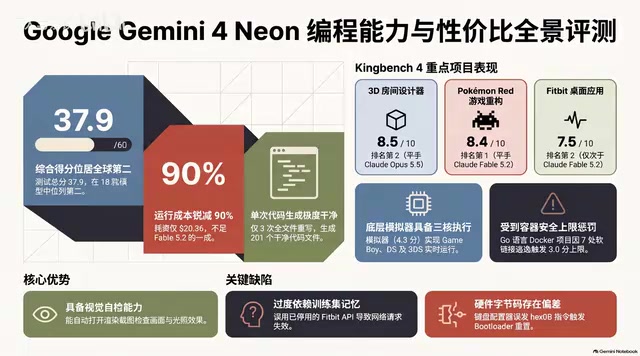
Gemini 4 Neon review: 1M-token context, four thinking levels, 201 files in one KingBench4 pass at one-tenth Fable 5.2's cost—but it hallucinates fake data, leaves 7 symlink escapes, and bricks keyboards.

Google Gemini 4 Neon Hands-On: 6 3D Works That Impress and Fail
Hands-on with Google Gemini 4 Neon on a 3060 laptop: 6 3D works tested. Sunshower Fishing Harbor and mechanical keyboard impress; soft-body physics and faces fall short.
Gemini 4 Neo Web Novel Writing Test: Faint AI Flavor, Textured Dialogue
Bilibili creator's first-look review of Gemini 4 Neo for Chinese web novel writing: testing a Three Kingdoms transmigration opening with faint AI flavor, emotionally textured dialogue, and strong crisis building, plus comparison of 4A/4H/4C models and full workflow demos.