Duly: Tap the Floating Orb and Just Say It to Organize Everything
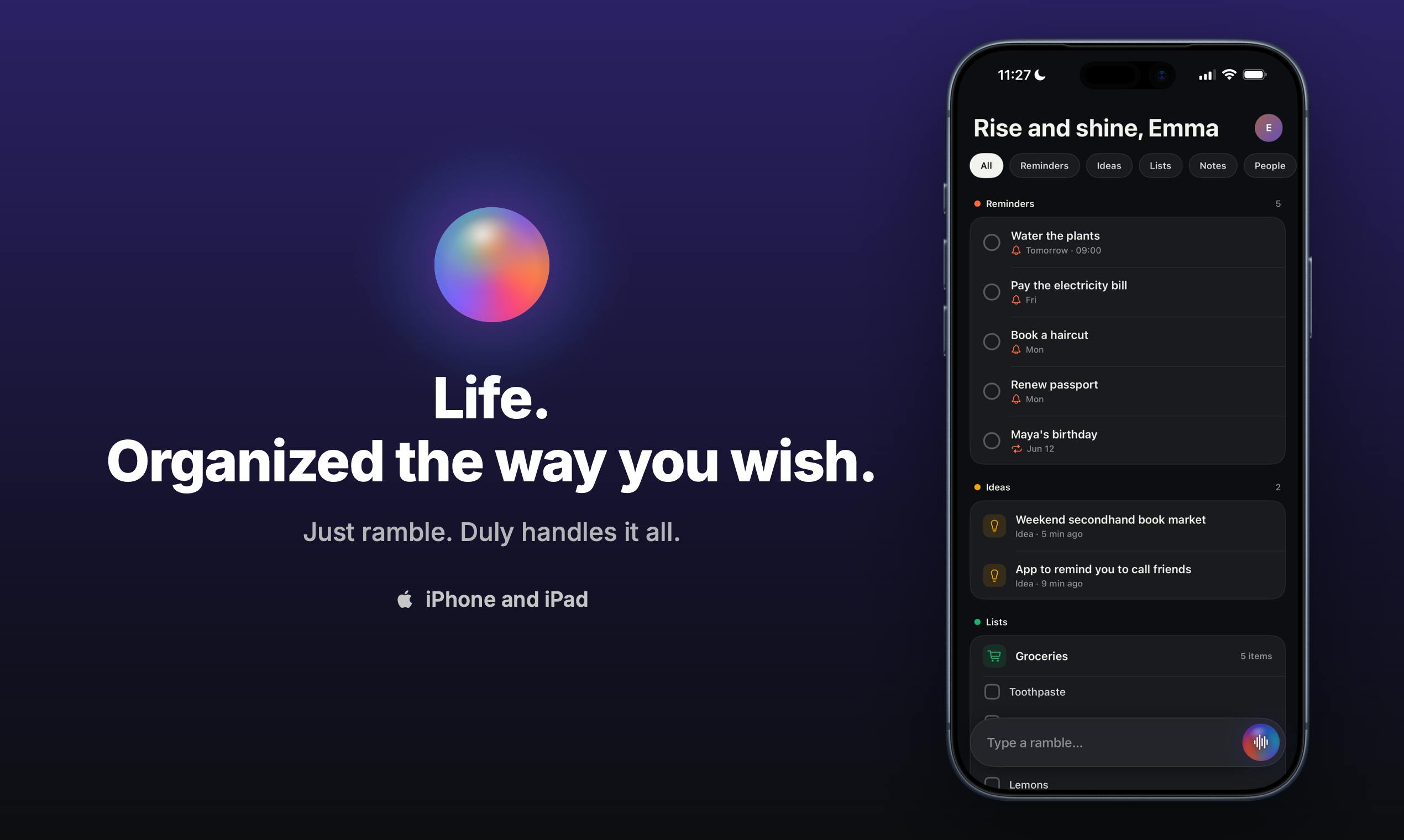
Duly turns casual voice input via a floating orb into reminders, lists, ideas, and notes.
Duly is an iOS productivity app whose core interaction is tapping a floating orb and speaking casually; it parses speech into reminders, lists, ideas, and notes, with voice-based editing. Built by indie developer Ömer Balkan, it's free for daily use and iOS-only, with 73 upvotes on Product Hunt. Its key risk: accuracy rests entirely on semantic parsing, and handling of vague expressions and accents decides whether it's a toy or a tool.
An iOS app called Duly has appeared on Product Hunt, built around the pitch "tap the floating orb, say whatever comes to mind, and leave the rest to me." It has no complex menus or hierarchies—instead, a single floating "orb" button captures all of the user's fragmented input and automatically breaks it down into reminders, lists, ideas, and notes.
One Entry Point, Four Outputs
Duly's interaction logic is pared down to the extreme: tap the orb floating on the screen, "ramble" into it, and the app parses what you said into structured content. The official example is straightforward—say "call mom at 6, buy milk," and what you get isn't just a voice transcript, but a reminder to call mom at six plus a shopping list item to buy milk.
Behind this lies a product judgment: what users really need isn't "recording" but "categorizing." Most note apps shift the cost of organization onto the user, while Duly attempts to accomplish capture + categorization + actionability in a single voice input. It covers four types of content—reminders, lists, ideas, and notes—and supports editing existing entries the same way.
Speech-to-Structure is the technical core of this kind of product. It refers to first transcribing a stretch of natural-language speech into text, then extracting entities and intents through semantic parsing and mapping them to predefined data structures (such as times, tasks, list items, and note bodies). Unlike plain speech transcription, structured output requires the model to recognize the action (calling), object (mom), and time (six o'clock) in "call mom at 6," and to generate a task object with a reminder time rather than a searchable block of text. A common implementation is speech recognition (ASR) plus a large language model for information extraction and slot filling, calling local reminder/list APIs to write into the system when necessary. The difficulties lie in multiple intents in a single sentence, ambiguous time expressions (is "six o'clock" morning or evening?), and recognition errors caused by accents and mixed languages—all of which feed directly into the accuracy of the structured result.
Why "Rambling" Is More Worth Building Than "Careful Note-Taking"
Traditional productivity tools are designed on the premise that users are willing to stop what they're doing, open the app, and pick the right template. In reality, inspiration and todos big and small often show up at the moments least suited to fiddling with a phone. By lowering the input barrier to "hold the orb and say one sentence," Duly is essentially trading with the user's laziness—exchanging one sentence for all the organizing that would otherwise follow.
This "capture first, structure later" approach isn't new; voice assistants and AI note-taking products have all tried it. But most either stop at transcription or require users to manually pick tags and categories. Duly's differentiator is making parsing and distribution the default behavior, so users don't need to understand the underlying classification system.
Capture vs. Organize is a classic division of labor in personal knowledge management. Traditional note tools require users to decide on a folder, tag, or template at input time—that's the "organize" action, which carries high cognitive load and easily interrupts the current task; "capture" only requires quickly saving the information. Separating the two, deferring organization, and letting the system do it automatically is a common strategy for reducing input friction. The cost is that organization quality depends on the accuracy of automated parsing—once parsing goes wrong, users have to go back and fix it, which increases cost instead. So the real experience of such products depends on balancing two links: capture must be fast enough, and structuring must be accurate enough and easy to correct. Duly lets edits go through voice too, precisely to compress the cost of the correction step.
Free Daily Use and the Trade-offs of the iOS Ecosystem
According to the Product Hunt page, Duly was built by indie developer Ömer Balkan, is free for daily use, and currently supports only iPhone and iPad. This positioning has two direct consequences: first, the free strategy lowers the barrier to trying it, making it a good lightweight entry point for a "second brain"; second, being iOS-only means cross-platform users can't yet get a consistent experience—Android and desktop users are out of scope.
At launch the product received 73 upvotes and ranked 20th, competing in the Productivity and Notes categories. For a lightweight tool from a solo developer, this initial traction shows that "minimalist voice capture" really does hit a pain point for some people.
Where the Real Barrier Lies for This Kind of Product
Speech-to-structure sounds like just calling a model, but the real difficulty in experience lies in fault tolerance and correctability. A single sentence may contain time, people, objects, and emotions all at once—what happens when parsing goes wrong? Duly's answer is "Change anything the same way"—edits go through voice too. This lowers the learning curve, but it also puts all the accuracy pressure on the understanding layer.
Another concern is the trust boundary. Reminders and lists bear directly on users' daily schedules, so if parsing deviates and the user doesn't check in time, the consequences are more serious than a mis-recorded note. What Duly shows today is the ideal path; whether it can stably handle vague expressions, accents, and Chinese-English mixing in real scenarios will determine whether it's a "toy" or a "tool."
Fault tolerance and correctability of semantic parsing is the dividing line for voice productivity tools. Natural language often contains vague times ("later," "sometime tomorrow"), omitted subjects, and multiple tasks in one sentence. The parsing layer needs to provide reasonable defaults when uncertain, or explicitly confirm with the user, rather than silently guessing. Common industry practices include: a second confirmation for low-confidence results, retaining the original voice and transcript for traceability, and providing one-tap shortcuts to reschedule or recategorize. For reminder-type content, the cost of error is higher than for notes, because a missed reminder or wrong time directly affects the schedule. So when evaluating such products, beyond how well they parse the ideal example, pay more attention to how they perform with vague expressions, accents, and mixed languages—and whether corrections after errors are lightweight enough.
Who Should Try It Now
If you've already piled up a stack of unsorted memos on your iPhone and are used to voice input, Duly is worth a try—its free daily-use strategy makes trial and error nearly costless. But if you rely heavily on cross-device sync or demand extremely high reminder accuracy, treat it as a supplementary entry point rather than your primary to-do system.
An indie developer's advantage in building productivity tools is the ability to iterate quickly on interaction details. Whether Duly can keep polishing parsing accuracy and editability will determine whether it survives the wave of Product Hunt attention.
One-line Summary
Duly uses floating-orb voice input to automatically break a casual sentence into reminders, lists, ideas, and notes.
Paragraph Summary
Duly is an iOS productivity app whose core interaction is tapping a floating orb button and speaking casually; the app automatically parses a stretch of speech into four types of structured content—reminders, lists, ideas, and notes—and supports editing existing entries the same voice way. The article argues that its product judgment is that users really need "categorizing" rather than "recording," lowering the input barrier by making parsing and distribution default behaviors. Duly was built by indie developer Ömer Balkan, is free for daily use, supports only iPhone and iPad, and received 73 upvotes and ranked 20th on Product Hunt. The article also points out its risk: all accuracy pressure falls on the semantic parsing layer, and how it handles vague expressions and accents will determine whether it's a toy or a tool.
Related articles

Did the US Midterms Vote No to AI Data Centers? A Map Reveals the Truth
After the US midterms, media claimed voters rejected AI data centers, but a map shows restrictive votes are concentrated in a few Ohio townships, affecting less than 1% of US towns—the national anti-AI wave is exaggerated.
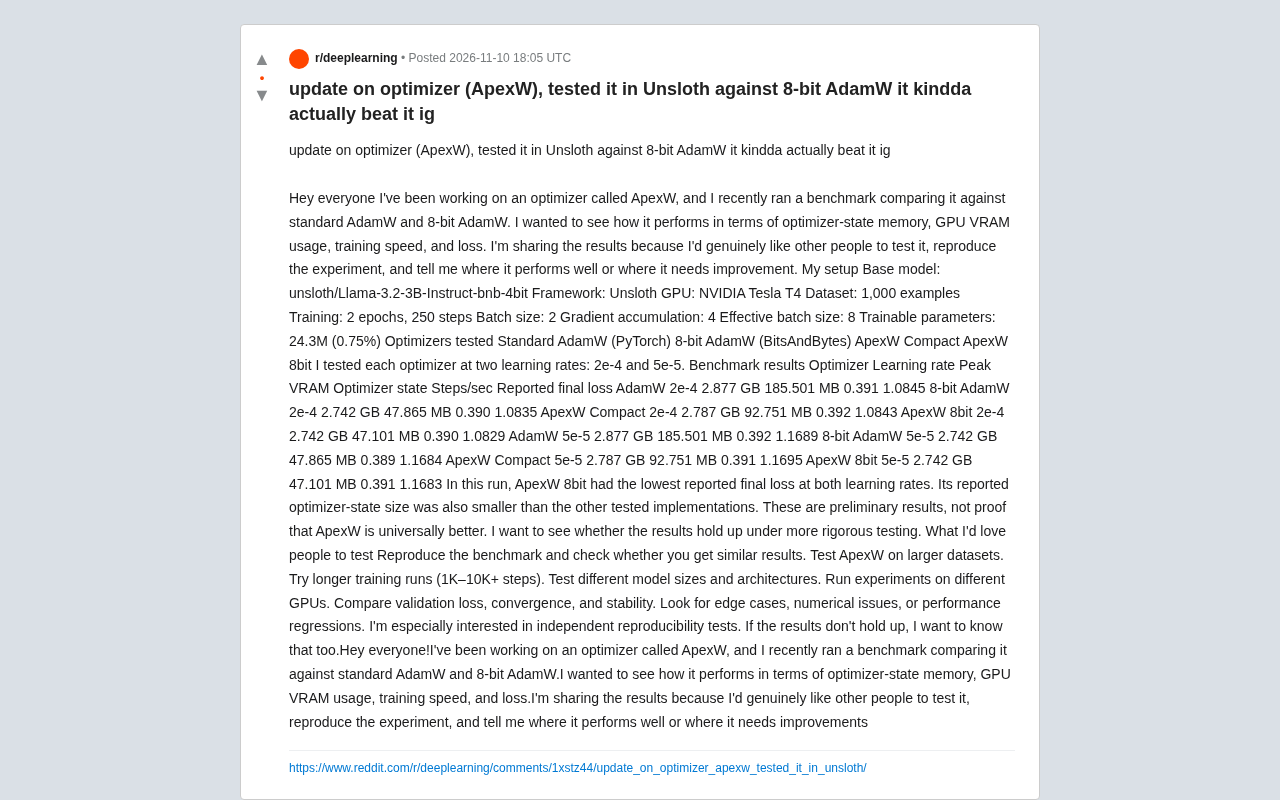
ApexW Optimizer Benchmark: Matches 8-bit AdamW in Unsloth with Lower Memory Usage
Developer shares benchmark of ApexW optimizer in Unsloth: ApexW 8bit has lower optimizer state memory (47.101 MB) and slightly better final loss than 8-bit AdamW, but similar speed. Needs independent reproduction.

US Computer Science Enrollment Drops 12.4% — Is CS Still Worth Studying?
CS enrollment fell 12.4% while health majors grew 6.2%. A CS master's grad explains why the degree's real value isn't coding but systems thinking.