Dynamic Course Correction in Running LangGraph Agents: Feasible Approaches Without Step-by-Step Interrupts

LangGraph native interrupts suit approval, not mid-run correction; message queues plus drain nodes are the current compromise.
Starting from a Reddit developer's question, the article discusses the gap in agent frameworks for steering mid-run: users want to input messages while the agent is running and have them picked up on the next step without pausing or restarting. LangGraph's interrupt() and Command(resume=...) target planned approval pauses and cannot cover unplanned correction; platform-level double-texting is more like discarding progress. The community proposes three approaches: inserting a message drain node before LLM calls, externally calling update_state(), and platform rollback. External writes carry race risks with the checkpointer; message queue plus drain node is the cleaner compromise. The author notes the framework lacks a supported external message injection primitive.

Why "steering mid-run" is a real pain point for agent deployment
Recently a developer on Reddit raised a very typical question: he had experienced a capability on the open-source tool agav — while the agent is running, the user can directly input a message, and the agent will pick it up on the next step and adjust direction, without pausing and without restarting. When the agent goes off track for five or six consecutive tool calls due to insufficient initial context, this "correct while running" experience is very practical.
He wanted to find an equivalent approach in LangGraph. The problem is that LangGraph's official interrupt(), interrupt_before combined with Command(resume=...) are better suited for "planned pauses," such as approving a tool call or manually modifying state. But course correction is unplanned — you cannot predict which node will go wrong, and stopping at every step to wait for input would destroy the meaning of autonomous agent operation.
This post touches on a common gap in current agent frameworks: most orchestration frameworks optimize for "controllable execution," not "intervenable execution."
The boundaries of LangGraph's existing interrupt mechanisms
interrupt() is suited for approval, not course correction
The design philosophy of interrupt() is "wait for human decisions at known positions." Its typical scenarios are: pause before a tool call and wait for manual confirmation; or pause before a high-risk node, let a person edit the state, and then resume. The trigger points for such pauses are deterministic and enumerable.
Course correction is the opposite: the agent may go off track at any node, and users often want to intervene only after observing several steps of erroneous behavior. If an interrupt is added before every LLM call, the agent degrades into a semi-automatic tool where "a human must nod at every step," and autonomy is completely lost.
The LangGraph checkpointer mechanism is the premise for understanding the above risks. LangGraph uses a checkpointer to persist graph state (including messages, node outputs, etc.) after each execution step, thereby supporting checkpoint recovery, time travel, and interrupt resumption. The resumption of interrupt() relies precisely on the interrupt point state saved by the checkpointer. This also means: state reads and writes are dominated by the graph's execution thread, and an external thread calling update_state() is equivalent to writing to the same persisted state without coordination, which may race with ongoing checkpoint writes. The official documentation does not promise atomicity for external writes during execution, so in production, additional serialization or locking mechanisms are needed to ensure consistency.
Platform-level double-texting is not steering
The poster also mentioned the platform-level double-texting (interrupt/rollback) approach, but judged it to be more like "discarding progress and starting over" rather than "steering on the existing trajectory." For runs that have already consumed a large number of tokens and tool call results, rolling back and rerunning is costly.
Three technical approaches proposed by the community
The original post listed three possible implementation ideas, which are worth breaking down one by one.
Approach 1: Add a "message drain" node before each LLM call
The idea is to insert a lightweight node before each LLM call to take new user input from an external message queue and merge it into messages. This way, user input takes effect at the next LLM step, achieving "pickup on the next step."
The advantage is that it does not rely on modifying LangGraph's internal state, and the logic is clear; the disadvantage is that an external queue is needed as a communication channel, and the insertion position of the drain node needs careful consideration — inserting too densely increases overhead, while inserting too sparsely increases response latency.
A message queue here serves as a decoupling channel between graph execution and external user input. New user input first enters the queue; each time the drain node executes, it takes out all pending messages in a non-blocking manner, merges them into messages, and then continues to the LLM node. The value of this design is: the writer and consumer are decoupled, avoiding race conditions caused by directly manipulating graph state; at the same time, it naturally supports batch processing and ordering guarantees for multiple messages. For selection, an in-process queue (such as asyncio.Queue) can be used for low-latency soft steering, or an external queue such as Redis can support multi-process deployment, at the cost of introducing additional infrastructure and latency.
Approach 2: Call update_state() externally during execution
LangGraph provides update_state() for modifying graph state. In theory, it can be called from an external thread while execution is active to write user messages into state. But the poster himself raised the question: is this safe when there is a checkpointer? Will there be race conditions?
This is a real risk point. LangGraph's state updates and checkpoint writes are not designed for high-concurrency external writes, and a running graph may be reading and writing the same state. Without official guarantees, this approach requires careful verification in production environments.
A race condition refers to multiple execution units concurrently accessing a shared resource, with the final result depending on their unpredictable execution order. In this scenario, the graph execution thread is advancing nodes and writing checkpoints, while an external thread simultaneously calls update_state() to modify the same state; if the two interleave, external messages may be overwritten, checkpoint records may be inconsistent with in-memory state, or an intermediate state may be read after resumption. Mitigation methods include: adding a mutex for state writes, serializing external writes into the graph's event loop, or using a message queue to turn writes into sequential operations consumed by in-graph nodes.
Approach 3: Platform-level interrupt/rollback
As mentioned above, this approach is closer to "stop the loss and start over," suitable for scenarios where course correction needs are infrequent and rerun costs are acceptable. It cannot achieve "preserve existing progress and fine-tune direction."
Realistic choices in production
The poster finally asked two very practical questions: is anyone doing this in production? Or does everyone just kill and rerun, eating the token cost?
From the discussion, the community did not provide an "officially recommended" answer. This itself shows: LangGraph's current native capabilities cover "human-in-the-loop approval," but "human-in-the-loop course correction" still needs to be built by yourself.
A more pragmatic combination is: use a message queue + drain node to achieve low-latency soft steering, and leave interrupt() for truly high-risk nodes that require hard pauses. If the team has extremely high requirements for state consistency, locking or serialization is needed on the external write path to avoid conflicts with checkpointer writes.
An observation on agent framework design
The kind of interaction in agav — "input while running, effective on the next step" — essentially treats user messages as a continuously writable input stream rather than a one-time initial prompt. This is fundamentally different from the model of most current frameworks, which is "construct input first, then start execution."
For LangGraph to natively support this mode, the framework layer may need to provide a supported "external message injection" primitive, rather than having developers piece it together with update_state or custom nodes. Until then, message queue + drain node is a relatively clean and controllable compromise.
For teams building agent products, it is worth thinking clearly in advance: do your users need to intervene during execution? If so, what are the granularity and latency requirements for intervention? The answers to these questions determine whether you should use interrupts, queue injection, or simply accept the rerun cost.
One-line Summary
LangGraph's native interrupts are suited for approval rather than mid-run course correction; message queues plus drain nodes are the current compromise.
Paragraph Summary
Starting from a Reddit developer's question, the article discusses the gap in agent frameworks regarding "steering mid-run": when the agent goes off track, users want to directly input a message and have it picked up and used to adjust direction on the next step, without pausing or restarting. LangGraph's interrupt() and Command(resume=...) are aimed at planned approval pauses and cannot cover unplanned course correction needs; platform-level double-texting is more like discarding progress and starting over. The community proposed three approaches: inserting a message drain node before LLM calls, externally calling update_state() during execution, and platform-level interrupt rollback. Among them, external writes carry race risks with the checkpointer, and message queue plus drain node is a relatively clean and controllable compromise. The author points out that the lack of a supported "external message injection" primitive at the framework layer is a common gap in intervenable agent execution.
Related articles
 Tech Frontiers
Edge AI on Microcontrollers: When Is It Actually Worth Deploying?
Drawing on Reddit discussions and Arm case studies, this article analyzes the real-world use cases for edge AI on microcontrollers: when each device needs independent inference, when a gateway or cloud is more reasonable, and the costs and boundaries of specialized hardware.
 Tech Frontiers
Pushing the Limits of Extreme Sudoku on a 16GB GPU: Insights from Depth and Flow Matching
A researcher trained a 16.54M-parameter model on a 16GB GPU to solve extreme Sudoku, finding effective depth breaks the 60% plateau and flow matching with improved sampling pushes accuracy past 99% with ~50× lower layer-evaluation budget.
 Tech Frontiers
AI Agent Approval Workflows: Why Human Confirmations Always Get Mindlessly Clicked
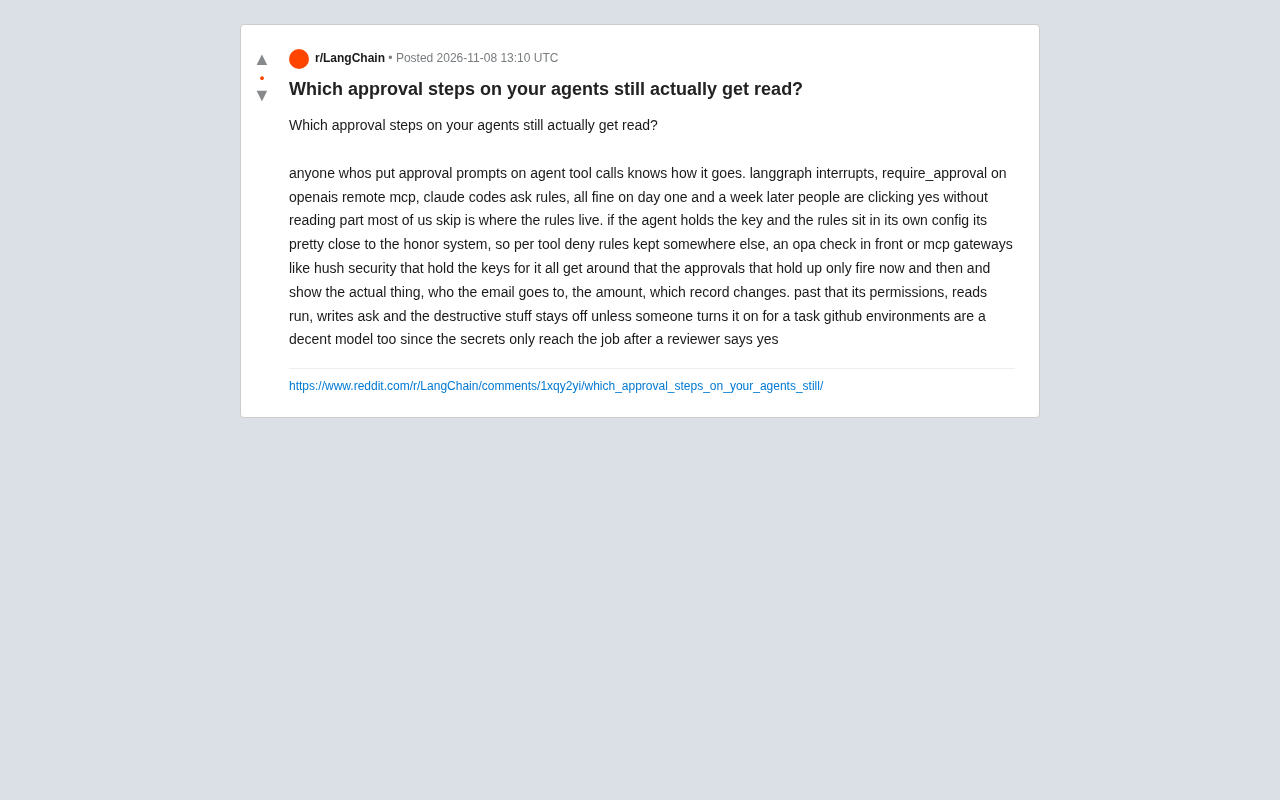
Why do AI agent approval workflows always get mindlessly clicked? A Reddit discussion shows that separating rules from keys, low-frequency high-risk approvals, and GitHub Environments-style gates are the keys to effective approvals.