Echo Time Review: A Smart Alarm Clock That Can Sense Your Sleep

Amazon launches the baseball-sized Echo Time smart alarm clock with a screen, featuring sleep sensing.
Amazon has released the Echo Time smart alarm clock, roughly baseball-sized and positioned between the Echo Dot with Clock and Echo Spot, featuring a 3.2-inch touchscreen centered on clock faces with multiple styles. Its biggest differentiator is sleep sensing, which can monitor the user's sleep state, likely via non-contact sensors such as microphones or radar rather than a wearable. The article analyzes its interaction advantages and light pollution concerns in the bedside scenario, noting that it targets users focused on sleep quality and bedroom smartification, but price, release date, and monitoring accuracy have not been announced—how well sleep sensing actually works will determine its success.
Amazon recently launched a smart alarm clock called Echo Time, a device that combines a smart speaker with clock functionality and adds sleep-sensing capabilities. A hands-on article from an overseas outlet gives us a glimpse of how the product actually performs.
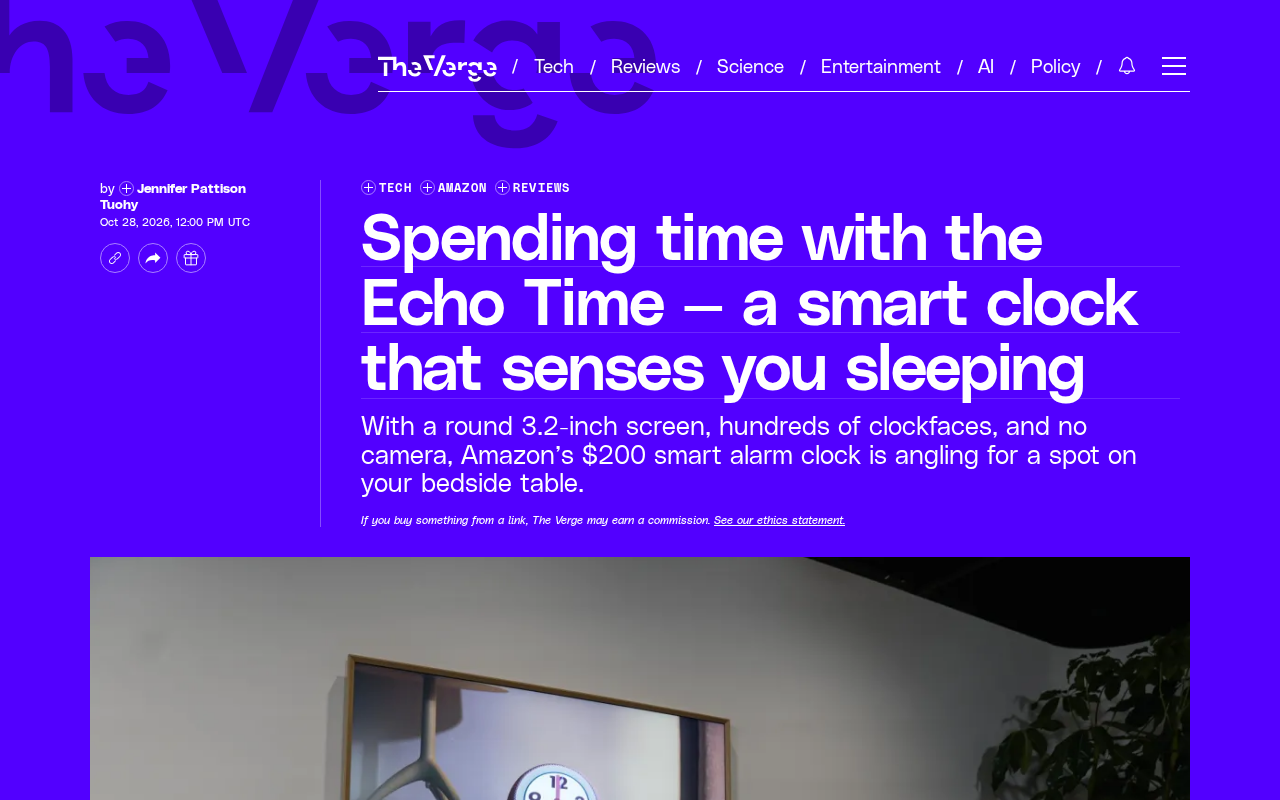
Design: A Baseball-Sized Speaker with a Screen
The Echo Time is described as being "baseball-sized," with an overall shape that looks like an "upsized descendant" of the Echo Dot with Clock and the Echo Spot. It features a 3.2-inch touchscreen, primarily used to display the user's chosen clock face. The screen supports multiple clock face styles that users can switch between according to their preferences.
In terms of product positioning, the Echo Time sits between a pure voice assistant and a screen-equipped smart home hub. It retains the speaker form factor but places the center of visual interaction on time display, which aligns with the core use case of an alarm clock product.
The Echo Dot with Clock is a smart speaker Amazon launched in 2019 with an LED dot-matrix display, which can show the time, weather, or a timer on the device body using simple light dots—but it is not a true screen. The Echo Spot, released in 2017, is a circular screen-equipped device with a 2.5-inch screen and a built-in camera, focused on video calls and visual information. Understanding the differences between these two products helps clarify the Echo Time's positioning: it follows the Dot's "voice-first, time display as secondary" approach while borrowing the Spot's screen interaction, and at the same time enlarges the screen to 3.2 inches, making "checking the time"—a bedside essential—the primary interaction surface rather than an auxiliary information panel.
Sleep Sensing: More Than Just an Alarm Clock
The "Time" in the product name may be just the surface; what truly sets it apart from ordinary smart alarm clocks is its sleep-sensing capability. According to the original report, the Echo Time can "sense you sleeping." This means it may use some kind of sensor or algorithm to monitor the user's sleep state, thereby providing smarter wake-up or sleep-assistance features.
However, the original article does not detail the specific technical principles or accuracy of its sleep monitoring. Based on available information, this feature is more likely implemented through non-contact sensors such as microphones or radar rather than a wearable device. If true, this would be a meaningful attempt by a smart speaker in the health monitoring space.
Non-contact sleep monitoring is currently a frontier direction in the smart home field. Mainstream technical approaches include millimeter-wave radar, ultra-wideband (UWB) radar, and microphone-based analysis of breathing sounds and movement sounds. The principle is to transmit electromagnetic waves and receive reflected signals, capturing the tiny displacements caused by chest movement to infer breathing rate, body movement, and sleep stages—without requiring the user to wear any device. The advantage of such solutions is that they are unobtrusive and continuous, but their accuracy is significantly affected by mattress thickness, multiple people in bed, and pet interference, and they typically can only provide trend-based judgments rather than medical-grade data. Amazon has previously ventured into the sleep space through the Halo band and Alexa's "sleep sounds" skill. If the Echo Time adopts a radar solution, it would mean its sleep-sensing capability upgrades from "acoustic assistance" to "physiological signal monitoring."
Screen and Interaction: Clock-Centered
The addition of a 3.2-inch touchscreen makes the Echo Time's interaction richer than that of a pure speaker. Users can not only control it by voice but also operate it directly on the screen. The screen's primary job is to display the clock, but it may also present information such as weather and reminders.
This design approach is similar to the Echo Spot, but the Echo Time places more emphasis on the core function of "time." For bedside scenarios, an always-on screen is both an information window and potentially a source of light pollution—depending on the screen's auto-brightness and sleep strategy.
The light pollution issue of bedside screen-equipped devices has clear design responses in the industry: first, using ambient light sensors to automatically adjust screen brightness based on room brightness, which can be reduced to very low levels at night; second, introducing a "standby screen-off" or "minimal digits only" mode to reduce blue light and overall illuminance; third, some products use reddish or warm-toned clock faces to reduce interference with melatonin secretion. In addition, always-on screens also involve burn-in risk, and OLED panels typically require pixel shifting or scheduled refresh strategies. These details directly determine whether a screen-equipped alarm clock can truly adapt to the bedroom scenario, and they are also key indicators for evaluating the maturity of the Echo Time experience.
Market Positioning and Competition
The smart alarm clock category has seen growing competition in recent years. The launch of the Echo Time is another move by Amazon in a segmented smart home scenario. It attempts to differentiate itself from ordinary screen-equipped speakers with the selling point of "sleep sensing."
At present, the price, release date, and detailed specifications of the Echo Time have not been disclosed in the original material. Judging from the product form, it may target users who care about sleep quality and bedroom smartification. If the sleep monitoring feature is accurate and reliable, it has the potential to become a new option for bedside devices.
Conclusion
The Echo Time is a smart alarm clock with a clever form factor and targeted features. It packs a screen, speaker, and sleep sensing into a baseball-sized device, attempting to secure a place in the bedside scenario. How well the sleep sensing actually works will be the key to its success.
(Note: This article is based on an initial hands-on report from an overseas outlet; more product details await official announcement.)
Related articles

LLM Application Development: A High-Paying Career Guide for Ordinary People
LLM application development offers fresh graduates up to 35K/month, with SP offers reaching 600K. This article explains the core skills, how to break in, and how ordinary people can seize AI opportunities through learning by doing.

Say Goodbye to AI Influencer Faces: A Complete Guide to Creating Visual Assets for AI Comic Dramas from Scratch
Bilibili creator shares a full workflow for zero-basics AI comic drama visual assets: use Doubao Work skills with script-first, visual references, and real-person texture to escape AI influencer faces, then lock character and scene consistency with asset sheet layouts, weapon detail images, scene nine-grids, and cinematic color palettes.

The AI Production Pipeline Behind Great Videos: From Research to Agent Validation
AI video production isn't just a model race. This article breaks down a transferable four-step pipeline: researching professional workflows, organizing a skill checklist, configuring agents, and experimental validation—and explains how general-purpose LLMs like DeepSeek can replace paid tools to run the entire process.