Embedding a RISC-V CPU Inside Qwen's Model Weights: A New Approach to AI Instruction Execution

Qwenputer embeds a 32-bit RISC-V CPU in Qwen3.5-4B's weights, enabling the model to execute instructions internally.
The Qwenputer project, discussed on Reddit, attempts to embed the complete behavior of a 32-bit RISC-V CPU into the weights of the Qwen3.5-4B model, so that instruction execution occurs within weight computations rather than by calling an external emulator. The author open-sourced the model weights and provided an online demo, but full technical details remain unpublished. The article interprets its significance from the perspectives of "weights as an executable carrier" and its relation to tool calling and computer use, arguing that it reflects a trend of moving models from "speaking" to "doing." Community reactions are mixed: supporters view it as an exploration of capability boundaries, while skeptics question whether a 4B model's capacity can handle complex programs. The project is still a proof of concept without independent reproduction, and the accuracy, speed, and generalization of instruction execution remain to be verified.
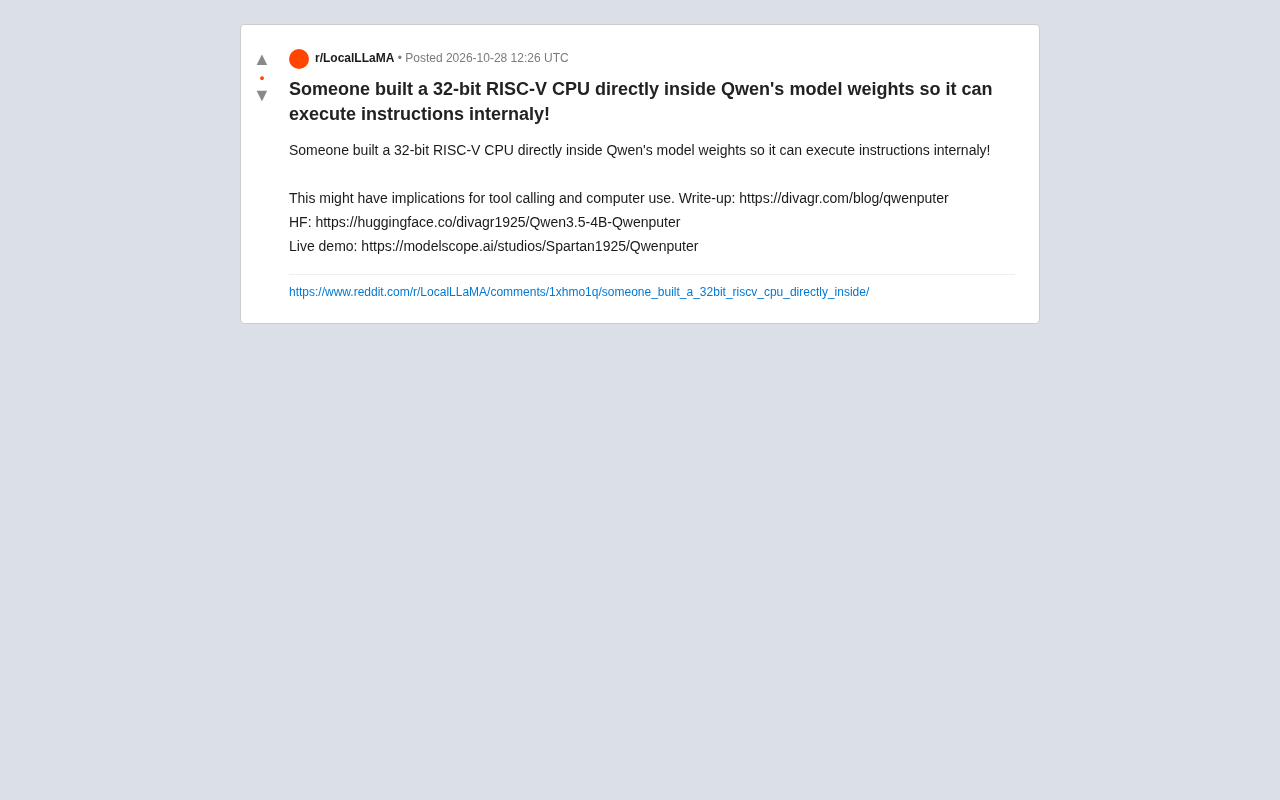
Recently, a Reddit post sparked heated discussion: someone built a 32-bit RISC-V CPU directly inside the weights of a Qwen model, enabling the model to execute instructions "internally." This sounds like science fiction, but the project author has not only published a technical blog post but also open-sourced the model on Hugging Face and provided an online demo on ModelScope.
What the Project Is: Qwenputer
According to the author's blog, the project is named Qwenputer, and the core idea is to embed the complete behavior of a 32-bit RISC-V CPU into the Qwen3.5-4B model in some way. In other words, the model is no longer just a language model predicting the next token; it has been trained/constructed with the ability to execute RISC-V instructions, with instruction execution occurring within the model's weight computations rather than by calling an external emulator.
The author has released the model weights (Qwen3.5-4B-Qwenputer on Hugging Face) and provided an interactive online demo so that interested people can try it out directly. This approach of "putting a CPU into the weights" is quite rare in the AI community, so it quickly attracted a lot of attention.
What Is RISC-V
RISC-V is an open-source instruction set architecture (ISA) that originated at UC Berkeley in 2010. Unlike architectures such as x86 and ARM, which require licensing and have complex, large instruction sets, RISC-V uses a reduced instruction set (RISC) design with an open specification that can be freely implemented and extended—anyone can design a processor based on it without paying licensing fees. It defines basic instructions such as integer arithmetic, load/store, jumps, and branches, and allows vendors to add extensions as needed. Precisely because its specification is clear and instruction behavior is deterministic, RISC-V is often used in teaching, embedded chips, and computer architecture research, making it an ideal vehicle for experiments like "encoding a set of deterministic instruction behaviors into model weights"—the semantics of each instruction are clearly defined and can be verified one by one.
Technical Implementation Speculation: Weights as Hardware
Based on public information, the author did not elaborate on all technical details in the post, but the blog link points to a complete write-up. We can understand its significance from several angles:
Model Weights as an "Executable Carrier"
Traditionally, model weights store language patterns, and inference consists of matrix multiplications and nonlinear transformations. Qwenputer attempts to make the weights carry a deterministic instruction execution logic—the RISC-V instruction set is clearly defined, and each instruction has fixed behavior. If the model can reliably produce correct register state changes and memory reads/writes based on input instructions, that means a set of executable "programs" is encoded in the weights.
Model Weights and "Weights as Programs"
The weights of large models are billions of floating-point numbers learned through gradient descent during training. They encode statistical patterns in the data, and during inference, matrix multiplications and activation functions turn these patterns into predictions of the next token. The so-called "weights as programs" means treating this set of parameters as an input-driven computational system: given an instruction as input, the network's layers collectively determine how states such as registers and memory change. This differs from the traditional understanding that "weights only store language patterns" and is closer to treating the neural network as a state machine defined by its parameters. This line of thinking is in the same vein as research showing that recurrent neural networks can simulate Turing machines and that neural networks can learn to execute algorithms, but it replaces abstract algorithms with concrete RISC-V instruction semantics, making it easier to verify instruction by instruction.
Relation to Tool Calling and Computer Use
The post author mentions that this technology may offer inspiration for tool calling and computer use. Currently, AI agents typically rely on external tools or APIs to perform operations, and the model itself does not "understand" low-level instructions. If a model can internalize instruction execution, in theory it could more directly simulate or control a computer environment, reducing dependence on external emulators.
Tool Calling and Computer Use
Tool calling refers to a model outputting structured call requests during generation, with an external system executing functions or APIs and returning the results to the model; the model itself does not perform the computation. Computer use goes a step further, letting the model understand interfaces through screenshots and output actions such as clicks and typing, which are actually executed by an external environment. What both have in common is that the real execution happens outside the model; the model is only responsible for decision-making and orchestration. The direction Qwenputer explores is to have the model weights directly carry instruction execution logic, thereby in theory reducing dependence on external emulators or execution environments. However, it is important to note that even if a model can "internally execute" instructions, its reliability, speed, and debuggability still cannot compare with a real CPU; in the short term, it is more likely to be a research supplement rather than a replacement.
Community Reaction and Potential Impact
The post received considerable attention on Reddit, with comments ranging from amazement to skepticism. Supporters see it as an interesting exploration of the boundaries of model capabilities that may offer new architectural ideas for AI agents; skeptics question the practicality and generalization ability of this "embedded CPU"—after all, how complex a program can a 4B-parameter model with limited capacity handle?
From a broader perspective, such experiments reflect a current trend in AI research: no longer being satisfied with making models "speak," but making them "do." Whether teaching models to use tools or directly execute low-level instructions, both are attempts to integrate language models more closely with computational processes.
Model Capacity and Scalability
A 4B-parameter model amounts to billions of floating-point weights. This may seem huge, but if used to encode a processor's behavior, its "effective capacity" would be severely constrained by precision, generalization, and training data coverage. A 32-bit RISC-V core involves dozens of basic instructions, a register file, and multi-level memory addressing. The model needs to produce correct state transitions for arbitrary instruction sequences and initial states, which is an enormous challenge for parameter efficiency. This is precisely the focus of community skepticism: the model may perform well only on short programs that were demonstrated, and there is still a lack of evidence on whether it remains stable with long instruction streams, edge cases, or unseen instruction combinations. This is also the key question in judging whether "weights as hardware" is a proof of concept or a scalable path.
Limitations and Questions to Be Verified
One additional point: currently, information about this project mainly comes from the author's own account and demo, and it has not yet been independently reproduced. Key metrics such as the accuracy of the model's RISC-V instruction execution, speed, and the range of supported instruction subsets all require more testing. In addition, whether embedding a CPU into weights is scalable and whether it can support more complex programs remain open questions.
However, as a proof of concept, Qwenputer demonstrates the possibility of model weights as a computational carrier. It may not immediately change the form of AI products, but it provides a concrete example for the imagination of "a model as a computer."
Conclusion
The Qwenputer project shows that the boundaries of large models' capabilities are being expanded in unexpected ways. Whether or not it ultimately becomes practical, this attempt to "build a CPU" inside weights is worth an in-depth look by anyone interested in AI agents and model architectures. Interested readers can visit the author's blog, the Hugging Face model page, and the ModelScope demo to experience it firsthand.
One-line Summary
Qwenputer embeds a 32-bit RISC-V CPU in Qwen3.5-4B's weights, enabling the model to execute instructions internally.
Paragraph Summary
The Qwenputer project, which sparked discussion on Reddit, attempts to embed the complete behavior of a 32-bit RISC-V CPU into the weights of the Qwen3.5-4B model, so that instruction execution occurs within weight computations rather than by calling an external emulator. The author open-sourced the model weights and provided an online demo, but full technical details have not yet been made public. The article interprets its significance from two angles—"weights as an executable carrier" and its relation to tool calling and computer use—and argues that it reflects a trend of moving models from "speaking" to "doing." Community reactions are mixed: supporters see it as an exploration of capability boundaries, while skeptics focus on whether a 4B model's capacity can handle complex programs. The project is still a proof of concept that has not been independently reproduced, and the accuracy, speed, and generalization ability of instruction execution remain to be verified.
Related articles

Thrive Holdings Takes ADT Private in $7.6 Billion Deal
Thrive Holdings acquires ADT for $7.6 billion in an all-cash take-private deal expected to close in Q1 2027. Analysis of the deal structure, ADT's asset value, and impact on the smart home security industry.

Only 40% of Statistics Cited by AI Are Traceable: A Credibility Crisis Emerges
A Hacker News discussion notes that only 40% of statistics cited by AI can be traced to specific studies. This article analyzes the causes, the impact on content creators and users, and practical ways to reduce risk.

Microsoft's Accelerating AI Transformation: The Layoff Logic Behind 60,000 Employee Buyouts
Microsoft offers voluntary buyouts to roughly 60,000 employees in the US, UK, Canada, and beyond—seen as the clearest signal yet that Nadella's AI workforce vision is being executed.