EnvOpt: A New Direction for Agent Environment Optimization, Cutting Costs by 72.7%

EnvOpt automates optimization of static environments beyond models and harnesses, significantly reducing costs and improving pass rates.
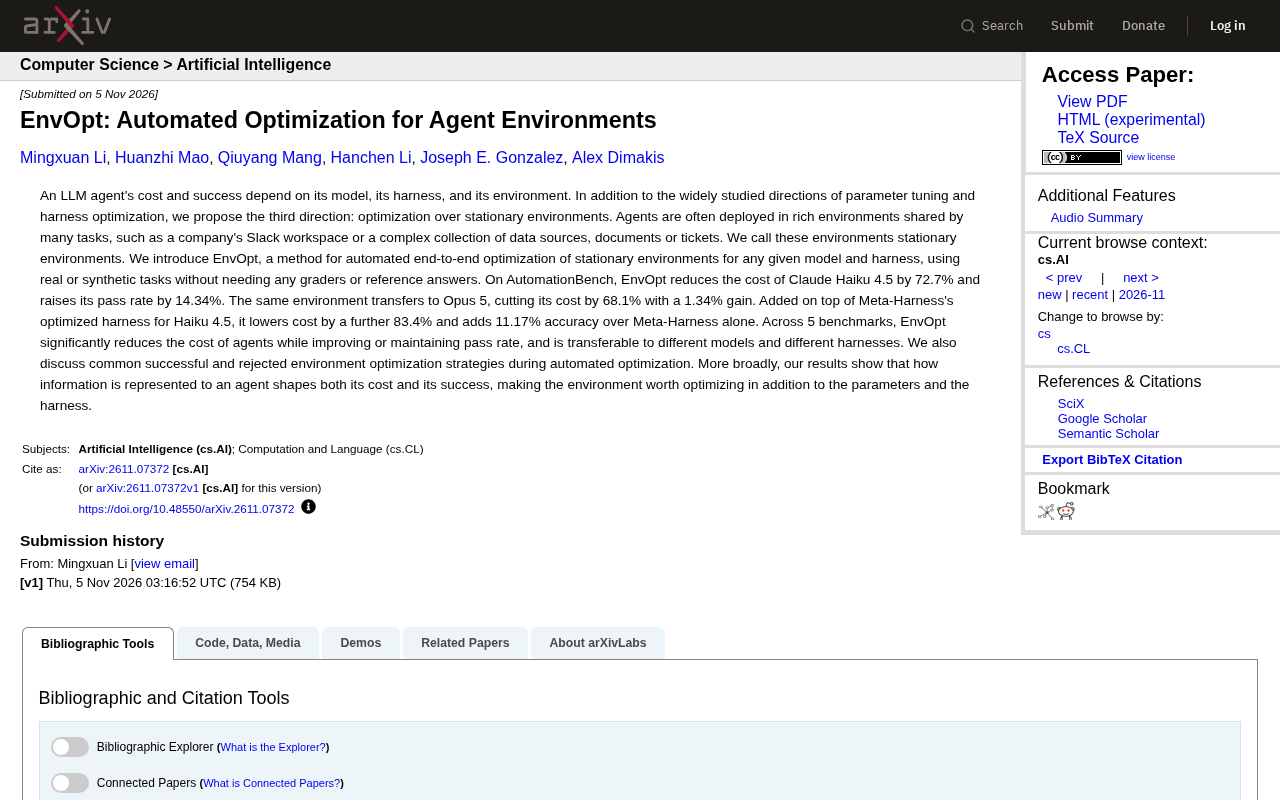
The article introduces EnvOpt, a method that argues agent cost and success rate are determined by three elements: model, harness, and environment—with the environment long overlooked as fixed background. EnvOpt performs end-to-end automated optimization of stationary environments without graders or reference answers, relying solely on real or synthetic tasks. On AutomationBench, it reduces Claude Haiku 4.5's cost by 72.7% and improves pass rate by 14.34%; the optimized environment transfers to Opus 5 and compounds gains when layered with Meta-Harness. Consistent results across 5 benchmarks suggest environment engineering may be a more cost-effective lever than switching models.
Agent cost and success rates are typically attributed to model parameters and the execution harness. But a new paper proposes a third optimization path: automated optimization of the "static environment" in which agents operate. This is EnvOpt—a method that optimizes environments end-to-end using only real or synthetic tasks, without requiring labeled answers.
Why Environments Deserve Dedicated Optimization
The paper points out that the cost and success of LLM agents depend on three elements: the model, the harness, and the environment. Parameter tuning and harness optimization have been extensively studied, but the environment itself has long been treated as fixed background. In reality, agents are often deployed in rich environments shared across many tasks—such as a company's Slack workspace, or a complex collection of data sources, documents, and tickets. The authors call such environments stationary environments.
The core insight is that the form in which information is presented to agents affects both cost and success rate simultaneously. With the same model and harness, a different environment representation can produce dramatically different results. This means the environment itself is a dimension worth optimizing, not merely a passive constraint.
Harness refers to the entire set of engineering code and logic wrapped around the base model that drives the agent to complete tasks, typically including prompt templates, tool-call parsing, multi-turn loop control, context management, and error retries. It determines "how the model is used" and is independent of the model parameters themselves. The same model with different harnesses can show significantly different task success rates, which is why harness optimization has become a hot direction in recent agent engineering. Understanding the division of labor among harness, model, and environment helps clarify EnvOpt's positioning—it does not change model weights or rewrite the harness, but adjusts the portion of the information world that the agent faces.
Stationary environments refer to external information collections that are shared across many tasks and do not change immediately with any single task, such as a company's long-running Slack workspace or a business knowledge base composed of data sources, documents, and tickets. The opposite is environments that are dynamically generated or evolve with each task. The defining feature of stationary environments is "organize once, reuse many times," so any improvement to their structure, naming, fields, and presentation can continuously yield benefits across numerous downstream tasks—this is the economic rationale for optimizing them separately.
What EnvOpt Does
EnvOpt is positioned as end-to-end automated optimization of stationary environments, adaptable to any given model and harness. Its key constraint is that it requires no graders or reference answers—it relies solely on real or synthetic tasks to drive optimization. This lowers the barrier to environment optimization, making it applicable to complex business scenarios that are difficult to annotate manually.
The paper also discusses commonly successful and rejected strategies in the automated optimization process, providing empirical guidance for future practice.
Graders and reference answers are common supervisory signals in agent evaluation and optimization: graders score agent outputs based on standard answers or rules, and the optimization process adjusts strategies based on score feedback. While precise, such signals are costly to construct and often difficult to define in advance for open-ended business scenarios. By deliberately avoiding this dependency, EnvOpt must extract optimization directions from the tasks themselves (real or synthetic success/failure signals), thereby covering complex environments where "what counts as a correct answer" is hard to articulate. This also explains why the paper separately discusses rejected strategies—without explicit graders, the search process is more prone to wandering into ineffective directions and requires effective filtering mechanisms.
Experimental Data: Dual Improvement in Cost and Pass Rate
On AutomationBench, EnvOpt reduced Claude Haiku 4.5's cost by 72.7% while improving the pass rate by 14.34%. More notably, the environment transferability: the same optimized environment applied directly to Opus 5 reduced cost by 68.1% with a further 1.34% increase in pass rate.
When EnvOpt is layered on top of a harness optimized by Meta-Harness for Haiku 4.5, the effect is further amplified: compared to using Meta-Harness alone, cost drops by an additional 83.4% and accuracy improves by an extra 11.17%. Across 5 benchmarks, EnvOpt significantly reduces agent costs while maintaining or improving pass rates, and transfers to different models and harnesses.
Implications for Agent Deployment
These results point to a pragmatic conclusion: as model capabilities converge, environment engineering may become a more cost-effective optimization lever. When deploying agents, enterprises should not only choose stronger models or more sophisticated harnesses but also examine how information is organized and presented to agents—document structure, data source organization, and ticket field design may all be hidden variables affecting cost and success rate.
EnvOpt's value lies in turning this from manual trial-and-error into an automatable process, and demonstrating that optimization results can be reused across models and harnesses. For teams building shared-workspace agent applications, this is a new path worth watching.
Related articles
 Tech Frontiers
Sherlock: An Open-Source Tool for Tracking Usernames Across Social Networks
Sherlock is an open-source Python tool that tracks social accounts across networks by username. This article covers its core features, why developers love it, typical use cases, and privacy compliance considerations.
 Tech Frontiers
GitHub Daily·Nov 07: Agent-Ready and Context Compression
GitHub Trending Nov 07: meta's agent-ready design system astryx, billion-context's 5x context compression, sherlock nearing 100k stars, plus local-first localthings and bare-metal GPU orchestration nvke.
 Tech Frontiers
Buoyant Open-Sources Kinference: An Inference Control Plane for vLLM on K8s
Buoyant open-sources Kinference, an inference control plane for vLLM on Kubernetes, with declarative routing, KV-cache-aware load balancing, and per-tenant metrics—claiming 95% lower median TTFT in official benchmarks.