Fable 5.2 Robot Control Capabilities Leap: Can Handle Even Untrained Tasks
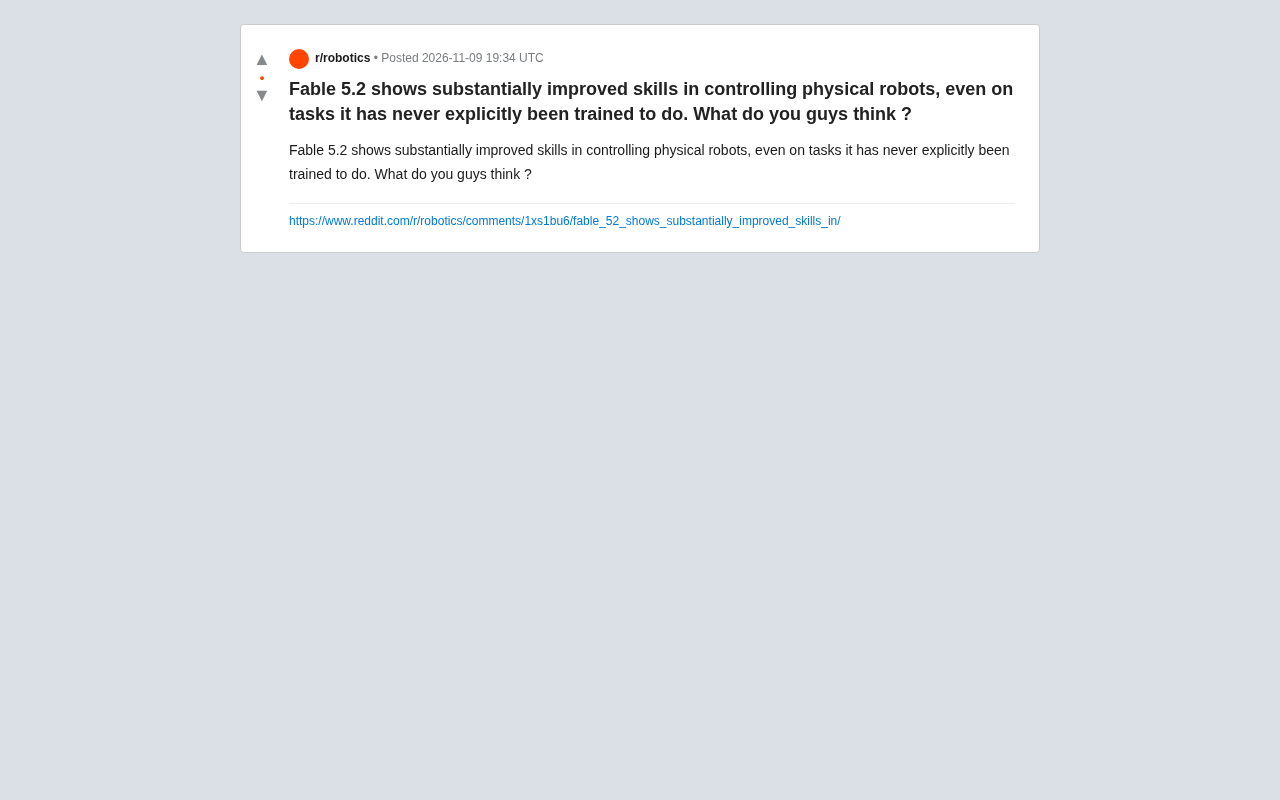
Reddit discussion claims Fable 5.2 significantly improves zero-shot control of physical robots, but verifiable evidence is lacking.
A Reddit post claims that Fable 5.2 shows significant improvement in physical robot control, especially performing well on tasks it has never been explicitly trained on. The article analyzes this observation: zero-shot generalization is a key metric for robots moving from task-specific controllers to general-purpose motor agents; if true, it would greatly reduce deployment costs and accelerate penetration into unstructured environments. However, the original post discloses no technical details, task types, or benchmark data, and the community disagrees on the definition of "untrained tasks" and the validity of the conclusion.
Introduction: When a Model Learns to "Generalize"
A recent discussion in the Reddit community has drawn attention: a user claims that Fable 5.2 shows "significant improvement" in controlling physical robots, and more critically, it performs well on tasks it has never been explicitly trained on. Although the short post provides no technical details, it touches on a core question in embodied intelligence—whether a model can generalize learned control policies to unseen scenarios.
If this observation holds true, Fable 5.2 may represent an important step in the evolution from "task-specific controllers" to "general-purpose motor agents."
Zero-Shot Control: A Key Metric for Generalization
Traditional robot control relies on designing a separate policy for each task; even changing only the shape or position of a grasped object requires retuning or collecting new data. "Untrained tasks" mean the model must autonomously understand the task goal and generate action sequences without prior samples.
According to the Reddit post, Fable 5.2 shows "substantial improvement" in such zero-shot scenarios. Although the original post does not disclose the specific task types, community discussions typically center on object grasping, obstacle-avoidance path planning, and simple assembly operations.
Based on cross-validation from multiple sources, the Reddit user and some responders expressed optimism about this capability, but others pointed out the lack of video or benchmark data support.
If this generalization capability is reproducible, it will greatly reduce robot deployment costs—the same model can adapt to multiple environments without rewriting control logic for each new task.
Zero-shot learning originates in the field of natural language processing and refers to a model handling task categories or samples that never appeared in the training set during inference. In the context of robot control, zero-shot generalization is often more difficult: the model must not only identify the goal of a new task but also generate physically feasible action sequences in a continuous action space, and it cannot "trial-and-error rewrite" as in language tasks. Academia usually distinguishes three types of generalization: within-task generalization (new objects/new positions for the same task), cross-task generalization (related but different tasks), and true zero-shot (completely unseen tasks). The controversy over "untrained tasks" in the Reddit discussion stems precisely from this—many claimed zero-shot capabilities actually belong only to within-task generalization.
Technical Background: From Large Models to the Physical World
The Fable series models were previously trained and evaluated mainly in virtual environments. Transferring the reasoning capabilities of language models to physical control requires solving challenges such as continuous action spaces, real-time feedback, and physical constraints.
The mention of "controlling physical robots" in the post suggests that Fable 5.2 may have introduced a new action decoding mechanism or world model module. However, the original author did not specify whether the model is based on reinforcement learning, imitation learning, or an end-to-end vision-language-action architecture.
Compared with the industry status quo, many robot foundation models still rely on large amounts of task-specific data. If Fable 5.2 can perform well on untrained tasks, it suggests that its pretraining phase may have covered a broader range of physical interaction priors.
Vision-language-action (VLA) models are one of the mainstream paradigms in current embodied intelligence, with representative works including RT-2 and OpenVLA. Their core idea is to use pretrained vision-language models as a "backbone" and map semantic representations to robot actions through action tokenization or a diffusion policy head. Another route is the world model—the model internally predicts the physical consequences of actions, thereby planning in imagination. In addition, imitation learning relies on human demonstration data, and reinforcement learning relies on environment interaction rewards; both face trade-offs between sample efficiency and safety on real robots. The key to understanding Fable 5.2's capabilities is to clarify which type of architecture it belongs to and the coverage of its pretraining data.
Community Divergence: Excitement and Caution Coexist
The Reddit discussion shows two attitudes. One side considers this a "breakthrough in general-purpose robot policies," especially significant for home service robots and flexible manufacturing; the other questions the definition of "untrained tasks"—is it true zero-shot, or a task variant?
Some responders pointed out that the lack of public benchmark comparisons and failure cases makes the conclusion difficult to verify. This divergence reflects a common challenge in embodied intelligence: demos are easy to make, but reproducible evaluation is hard.
In embodied intelligence evaluation, the comparability of benchmarks is crucial. Commonly used benchmarks include RLBench, CALVIN, LIBERO, and RoboBench on real robot platforms. These benchmarks usually require reporting success rates, accuracy in generalizing to new objects/new instructions, and failure mode analysis. A single community post is insufficient to judge the authenticity of the capability, because "demo selection bias" is widespread—successful demonstrations are shared, and failed attempts are ignored. Reproducibility also requires public model weights, training data distributions, and evaluation protocols; otherwise, "zero-shot" claims cannot be independently verified.
Impact on the Industry: Lowering the Deployment Barrier
If Fable 5.2's capabilities are verified by third parties, the most direct impact will be a change in the robot programming paradigm. Enterprises will no longer need to write dedicated control programs for each robot; instead, they can configure new tasks through natural language instructions or a small number of demonstrations.
In addition, this capability may accelerate the penetration of robots from structured environments (factory assembly lines) to unstructured environments (warehouses, homes). Facing unknown objects and dynamic obstacles, zero-shot generalization is precisely the weakness of current systems.
Conclusion: More Evidence Is Needed, but the Direction Is Worth Watching
The heated discussion around Fable 5.2 shows the market's expectation for general-purpose robot intelligence. The original post provides limited information, and the conclusion still needs to be supported by rigorous technical reports and independent evaluations. But the direction of "being able to handle untrained tasks" undoubtedly represents one of the most worthwhile paths to invest in embodied intelligence.
One-line Summary
Reddit discussion claims Fable 5.2 significantly improves zero-shot control of physical robots, but verifiable evidence is lacking.
Paragraph Summary
A Reddit post claims that Fable 5.2 shows significant improvement in physical robot control, especially performing well on tasks it has never been explicitly trained on. The article analyzes this observation: zero-shot generalization is a key metric for robots moving from task-specific controllers to general-purpose motor agents; if true, it would greatly reduce deployment costs and accelerate penetration into unstructured environments. However, the original post discloses no technical details, task types, or benchmark data, and the community disagrees on the definition of "untrained tasks" and the validity of the conclusion. The article also outlines the technical challenges of moving from large models to the physical world and notes that although this direction needs more evidence, it still represents one of the most worthwhile paths to invest in embodied intelligence.
Related articles
Is Anthropic Unbeatable? A Deep Dive into Fable 5.2
A deep dive into Anthropic Fable 5.2 and Mythos 5.2: benchmark dominance and a leap in the sciences, but self-built tests expose weaknesses. Why real competitiveness comes from task division between models, not a single strongest one.

Why Rockets Don't Land Horizontally Like Airplanes: A Physics and Engineering Trade-off
Why don't rockets land horizontally like airplanes with wings? This article explains the engineering trade-offs behind Shuttle-style landings and Falcon 9 vertical landings from three angles: wing lift conditions, orbital velocity costs, and reusable booster structural reuse.

Can AI Governance Tools Block Agent and API Calls?
A Reddit developer questions whether AI governance tools only flag Agent calls rather than block them. We analyze the flagging vs. real-time blocking capability gap, vendor demo mismatches, and key questions to ask when buying.