Can AI Governance Tools Block Agent and API Calls?

AI governance tool demos mostly showcase flagging, but production Agents really need real-time blocking.
Starting from a developer's experience watching three AI governance tool demos, the article notes that vendors commonly showcase "flagged calls" on dashboards while being vague about whether calls are actually blocked. The author divides AI governance tools' control over Agent and API calls into three tiers—observability, policy alerts, and enforcement-layer real-time blocking—emphasizing that Agents writing to production face irreversible risks like data contamination and financial loss, where post-hoc flagging cannot replace pre-emptive interception. The article also provides five key questions to ask when selecting tools and outlines the community divergence over whether blocking should be handled by governance tools or API gateways, concluding that "can it block?" should be a barrier to entry for production-grade Agent teams.
Introduction: When Demos Become "Fireworks on a Dashboard"
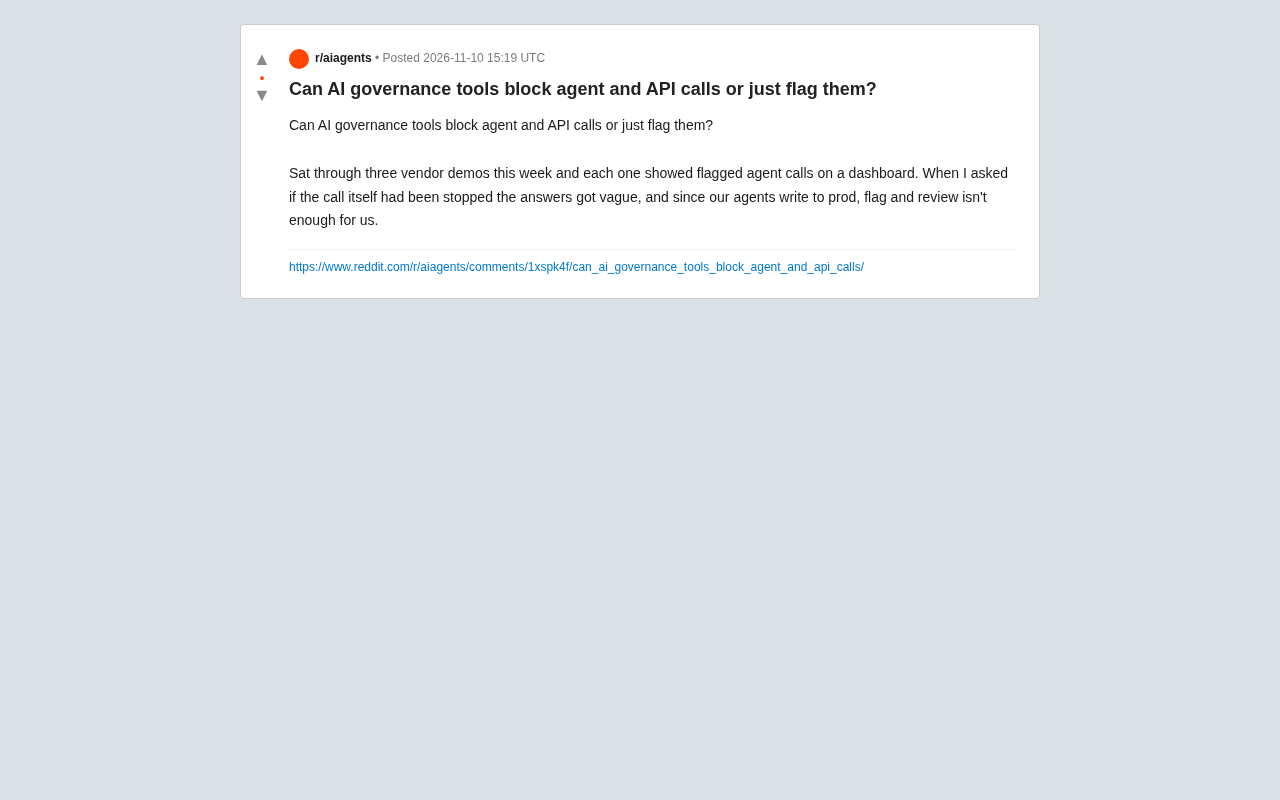
Recently, a developer on Reddit shared his experience of watching three AI governance tool vendor demos in one week. Each vendor showcased flagged Agent calls on their dashboards, but when he pressed on whether the calls were actually blocked, the answers he got were vague. This developer's pain point is concrete: their Agents write directly to production, and "flag and review" alone is far from enough.
This question hits a core contradiction in the AI governance space: there is a massive capability gap between visualized alerts and real-time blocking.
The Mismatch Between Vendor Demos and Real Requirements
According to the original Reddit post, the common thread across all three demos was obvious—every vendor focused on showcasing "flagged calls" in their dashboards, i.e., records of flagged calls. But when asked whether the calls themselves were stopped, the responses from sales or technical staff became vague.
There are likely two explanations behind this vagueness:
- The product does have blocking capability, but it's not enabled by default or in the demo scenario, leaving sales unwilling to commit;
- The product actually only does logging and post-hoc analysis, with blocking requiring additional integration or falling outside its feature scope entirely.
For Agents that write to production, the consequences of these two scenarios are completely different. The former is a configuration issue; the latter is an architectural flaw.
Flagging vs. Blocking: The Capability Tiers of AI Governance Tools
From a technical implementation perspective, AI governance tools' control over Agent and API calls can be roughly divided into three tiers:
1. Observability Tier: Logging and Flagging
This is the baseline capability of most tools. Tools capture Agent call requests through proxies or SDKs, record parameters, context, and results, and flag anomalous behavior in dashboards. This tier solves "knowing what happened" but cannot prevent things from happening.
2. Policy Tier: Alerts and Human Intervention
Some tools support rule-based alerts—for example, triggering a notification when an Agent attempts to write to a production database, with a human deciding whether to allow it. But there's a timing window problem here: if the call has already been sent, the delay of human review may mean the data has already been modified.
3. Enforcement Tier: Real-Time Blocking
This is the tier the original poster actually needs. The tool must intercept calls before they reach the target API and return a rejection response. Implementation approaches typically include API gateway plugins, Sidecar proxies, or SDK-level hooks. This tier requires the tool to have sufficient control over the call chain, not just side-channel observation.
Key insight: The "flagged calls" shown in demos most likely remain at the first or second tier. The vague sales responses are very likely because real-time blocking requires deeper integration, or the product simply doesn't have that capability.
A Sidecar proxy is an auxiliary process deployed alongside the main application container, typically running on the same Pod or host. It enforces policies by intercepting all network traffic in and out of the application without requiring code changes. In AI governance scenarios, a Sidecar can serve as a "checkpoint" on the call path: every API request an Agent sends first passes through the Sidecar, which decides whether to allow or deny it based on policies. The advantages of this model are language-agnosticism and transparency to the application; the drawbacks are added network hops and operational complexity, plus the need to integrate with Kubernetes or service mesh infrastructure. By comparison, SDK-level hooks are embedded directly in application code, offering lower latency but with language binding and upgrade coupling issues; API gateway plugins centralize control at the entry point, suitable for unified policies but poor at perceiving an Agent's internal context.
Why "Flagging Only" Is Not Enough for Production Agents
The original poster mentioned "our agents write to prod," which reveals the severity of the problem. Production writes are irreversible:
- A single erroneous database update can contaminate core business data;
- A single misdirected payment API call can cause financial loss;
- A single unauthorized file deletion may be unrecoverable.
In such scenarios, the value of post-hoc flagging and review is limited because the damage has already occurred. Governance tools must be able to make allow-or-deny decisions before calls execute.
Irreversibility is a key criterion for distinguishing the value of "observability" from "blockability." In distributed systems, once a write operation is committed and persisted, rollback often requires additional compensating transactions or data repair processes, at a cost far higher than pre-emptive interception. For AI Agents, the risk is further amplified: Agents may initiate calls based on hallucinations or faulty reasoning, and their behavior is non-deterministic and high-frequency, making it hard for human review to keep pace with call volume. Therefore, the closer a governance tool's control point is to the call origin, the lower the probability of "losses already incurred." The industry's "shift left" philosophy applies here as well—moving governance decisions from post-hoc auditing to before call execution is the basic requirement for production-grade Agent security.
Key Questions to Ask When Choosing AI Governance Tools
If you face similar requirements, you can ask vendors the following questions directly during evaluation to avoid being misled by dashboard demos:
- At which point in the call chain does blocking occur? Is it intercepted before the request is sent, or does it only log the response?
- Is blocking synchronous or asynchronous? Synchronous blocking means the caller receives a rejection response; asynchronous just sends an alert.
- What conditions does the policy engine support? Does it support combined policies based on Agent identity, target API, parameter content, call frequency, and other dimensions?
- What is the degradation behavior when blocking fails? If the governance tool itself is unavailable, are calls allowed or denied?
- What is the relationship with existing API gateways? Does it replace the gateway, or does it run as a gateway plugin?
The answers to these questions reflect the true capability boundaries of a tool far better than any dashboard screenshot.
Multi-Source Perspectives: Consensus and Divergence in Community Discussions
Although the original post provides limited information, public discussions in the AI governance space reveal some commonalities in how the community understands "flagging vs. blocking":
- Consensus: Most AI governance tools start with observability at their core, with blocking capability often coming in later iterations. Vendor demos tend to showcase visually impressive dashboards rather than underlying interception logic.
- Divergence: Some argue that blocking should be handled uniformly by API gateways or service meshes, with AI governance tools only responsible for policy generation; others argue that governance tools need a built-in enforcement layer to ensure policy consistency. Products currently exist on both paths.
A policy engine is the core component of a governance tool that makes allow-or-deny decisions, typically consisting of rule sets, condition expressions, and a decision executor. When evaluating a policy engine, pay attention to whether it supports combining multi-dimensional conditions such as Agent identity, target API, request parameter content, call frequency, and time windows. More mature policy engines also embrace policy-as-code practices, managing governance rules as versioned configuration files for easier auditing and rollback. Additionally, the granularity of policy enforcement matters: are policies globally uniform, or can they be configured per team, per Agent, and per environment (development/staging/production)? The capability boundaries of the policy engine directly determine whether a governance tool can be deployed in complex production environments.
Conclusion: Beyond the Demo, Press on the Enforcement Layer
The original Reddit question seems simple but points to the dimension most easily obscured by demos in AI governance tool selection. For teams whose Agents write to production, "can it block?" is not an optional feature—it's a barrier to entry. Next time you watch a demo, try asking directly: was this flagged call actually stopped at the time?
This article is based on public discussions in the Reddit community; views are for reference only.
Related articles

Why Rockets Don't Land Horizontally Like Airplanes: A Physics and Engineering Trade-off
Why don't rockets land horizontally like airplanes with wings? This article explains the engineering trade-offs behind Shuttle-style landings and Falcon 9 vertical landings from three angles: wing lift conditions, orbital velocity costs, and reusable booster structural reuse.

Perplexity's New Default Setting: The Experience and the Logic Behind It
Exploring the significance and impact of Perplexity's default setting change, analyzing how defaults guide user experience and speculating on model, search scope, or answer style adjustments.

Real or Fake? Gaussian Splatting + Physics Engine Tackles Robot Simulation Challenges
Reddit developer shares a photorealistic robot simulation built with Gaussian Splatting, MuJoCo Warp physics, and mesh models—generating interactive scenes from iPhone scans to tackle sim-to-real.