Real or Fake? Gaussian Splatting + Physics Engine Tackles Robot Simulation Challenges

Developer uses hybrid Gaussian Splatting and mesh simulation to try to bridge the robot sim-to-real gap.
The article covers a Reddit developer's robot simulation solution that uses Gaussian Splatting for photorealistic visuals, mesh models for physics interactions, and MuJoCo Warp to fuse rendering and physics. It generates Splat + Mesh scenes from iPhone scans with hundreds of domain-randomization variants. The approach is logically sound but lacks quantitative data, demos, and code, so actual results remain unverified.
Robot policies trained well in animated simulations often "crash" once deployed on real hardware—a pain point shared by many robot learning teams. Recently, a developer on Reddit shared their solution: building a photorealistic simulation environment with Gaussian Splatting, combined with a physics engine, so robots can train in scenes that look indistinguishable from the real world. They claim this pipeline has been iterated hundreds of times and can generate interactive simulation scenes directly from an iPhone scan. Is this marketing hype or a technical breakthrough? Let's break it down based on the original post and technical context.
The Starting Point: The Gap Between Simulation and Reality
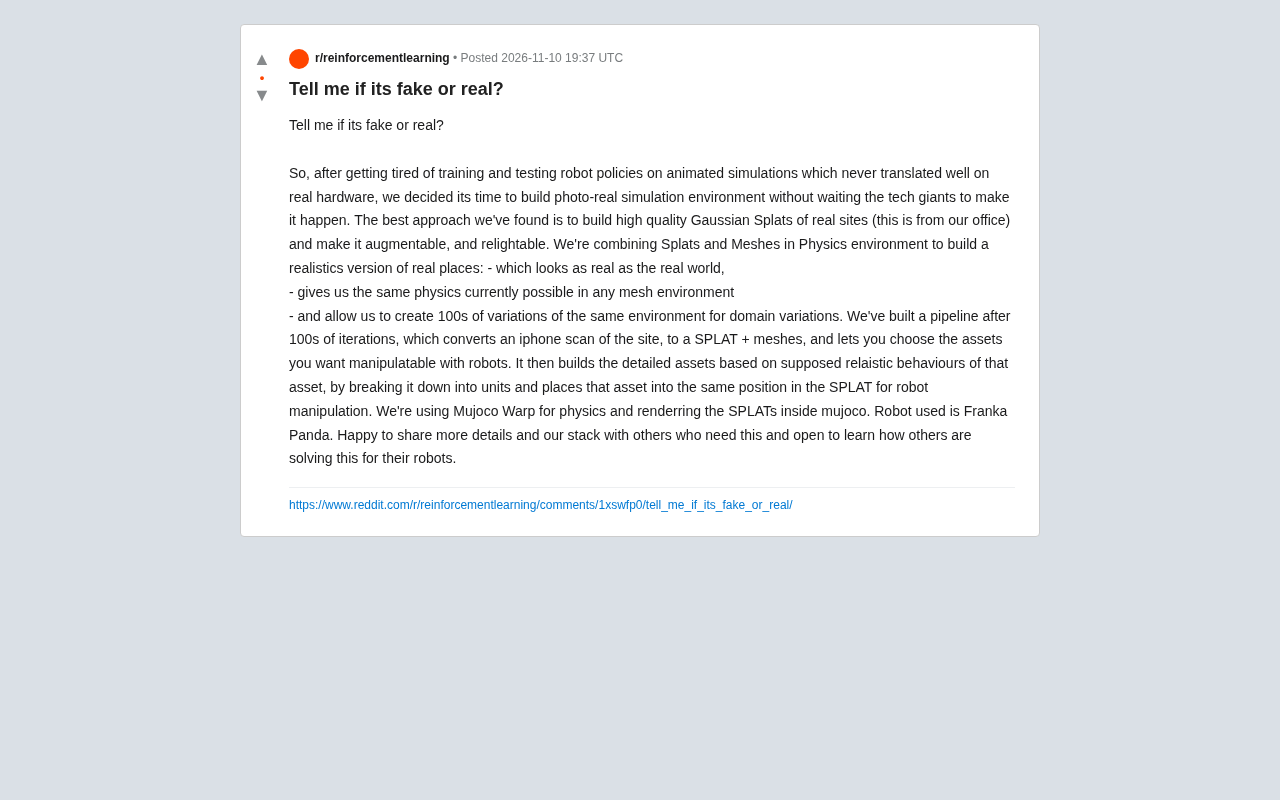
The original poster gets straight to the point: training and testing robot policies in animated simulations has "never transferred well to real hardware." This is the classic sim-to-real gap problem in robotics: lighting, materials, and physical parameters in simulation deviate from the real world, causing policies to overfit.
To bridge this gap, the team decided not to wait for the tech giants and instead build a photorealistic simulation environment themselves. Their core idea: use Gaussian Splatting to reconstruct the visual appearance of real scenes, use mesh models to carry physical interactions, and fuse both within the same physics engine.
Sim-to-real gap refers to the phenomenon where policies trained in simulation show significantly degraded performance when deployed on real hardware. There are three main causes: first, visual differences—the lighting, materials, and textures rendered in simulation differ from the distribution of real camera images; second, physical differences—parameters such as mass, friction coefficients, joint damping, and contact models in simulation deviate from their real counterparts; third, incomplete modeling of sensor and actuator noise. Common mitigation methods include domain randomization (randomizing visual and physical parameters during training), system identification (calibrating simulation parameters with real data), and online adaptation. The essence of this problem is a mismatch between the simulation distribution and the real distribution—it cannot be solved simply by improving rendering fidelity.
Technical Breakdown: How Splat + Mesh Work Together
According to the original post, this solution involves several key components:
- High-quality Gaussian Splatting scans: Reconstructing real sites (e.g., their office) to produce an augmentable, relightable Gaussian Splatting representation that is visually "as real as the real world."
- Hybrid Splat and Mesh: Using both splats and meshes in the physics environment, preserving photorealistic rendering while gaining the same physical capabilities as existing mesh environments (collision, contact, manipulation).
- Domain randomization variants: The same environment can generate hundreds of variations for domain randomization training, improving policy generalization.
The author mentions they scan sites with an iPhone, run them through a pipeline iterated hundreds of times to automatically convert them into Splat + Mesh, and allow users to select which assets need to be manipulated by the robot. The system decomposes assets into units based on their "assumed real behavior" and places them back into their corresponding positions in the Splat.
For physics and rendering, the team uses MuJoCo Warp for physics computation and renders Gaussian splats directly within MuJoCo. The test robot is a Franka Panda arm.
Direct translation of the original post: We use Mujoco Warp for physics and rendering, rendering SPLAT inside mujoco. The robot is Franka Panda.
This combination is noteworthy: MuJoCo is a widely used physics engine in the robot learning community, and Warp is NVIDIA's GPU acceleration framework—combining the two could significantly boost simulation throughput. Meanwhile, the real-time rendering capabilities of Gaussian Splatting precisely compensate for the shortcomings of traditional mesh rendering in visual realism.
Gaussian Splatting is a scene representation and rendering method based on explicit 3D Gaussian primitives. It optimizes a set of Gaussian spheres with position, covariance, opacity, and spherical harmonic color coefficients from multi-view images. During rendering, it rapidly synthesizes images through differentiable splatting and blending operations. Compared to NeRF, which relies on dense ray sampling, Gaussian Splatting can achieve real-time rendering speeds, has more controllable memory usage, and supports relighting and scene editing. These characteristics make it suitable for embedding into physics engines as a visual layer, but the representation itself does not contain collision geometry, so it must be used in conjunction with mesh models.
Domain Randomization is a training technique that improves policy robustness by randomizing simulation environment parameters. Common randomization dimensions include light direction and intensity, material color and roughness, camera pose and noise, object mass and friction coefficients, joint damping, etc. The underlying assumption is: if a policy can succeed across a sufficiently wide parameter distribution, then the real world can be regarded as a sample point within that distribution. The relightable and augmentable properties of Gaussian Splatting greatly reduce the cost of visual-level randomization—hundreds of appearance variants can be generated in batch from the same scene, thereby mitigating visual overfitting.
Real or Fake? Technical Feasibility Analysis
The original post's title directly asks "Tell me if it's fake or real," indicating the author anticipated skepticism. From a technical perspective, this solution is no castle in the air:
Gaussian Splatting has precedents in robot simulation. Both academia and industry are exploring the introduction of neural rendering techniques into robot training. Splat has advantages over NeRF in rendering speed and memory efficiency, making it suitable for running alongside physics engines.
The hybrid Splat + Mesh representation is a reasonable compromise. Pure Splat struggles with precise collision detection, while pure Mesh lacks photorealistic quality. Layering the two—Mesh for physics, Splat for visuals—is a pragmatic engineering path at present.
An automated pipeline from iPhone scan to simulation is challenging but feasible. Going from consumer-grade scanning to usable physical assets involves scale alignment, mesh generation, semantic segmentation, physical parameter estimation, and more. The author's mention of "hundreds of iterations" shows this pipeline is not simple, but the direction toward automation is clear.
However, the original post provides no quantitative comparison data (such as policy success rate differences between real and simulated, rendering frame rates, scene reconstruction accuracy, etc.), nor does it show public demo videos or code repositories. Therefore, at present we can only confirm that the technical approach is reasonable; actual results cannot yet be verified. The author states at the end that they are "happy to share more details and the tech stack" and open to discussion—an attitude closer to the open-source collaboration style common in technical communities rather than pure marketing.
MuJoCo Warp is the product of combining the MuJoCo physics engine with NVIDIA Warp (a CUDA-based GPU-accelerated simulation and differentiable programming framework). Its goal is to run large numbers of physics environment instances in parallel on GPUs and to support custom solvers and rendering through Warp's kernel programming capabilities. Its significance for robot learning lies in boosting simulation throughput, making large-scale parallel domain randomization training and reinforcement learning sampling more efficient. Integrating Gaussian Splatting rendering directly into MuJoCo avoids the overhead of synchronizing visual and physical states between external renderers, but it also introduces engineering challenges such as coupling between the rendering pipeline and physics time steps, and GPU memory contention.
What This Means for the Robot Learning Community
If this pipeline works as smoothly as described, its value to the robot learning community is: lowering the barrier to building high-fidelity simulation environments. In the past, photorealistic simulation often relied on large teams and expensive scanning equipment; with an iPhone plus Gaussian Splatting, small and medium-sized teams can quickly build "digital twins" of their own sites.
At the same time, relightable and augmentable properties make domain randomization more flexible—the same scene can generate numerous visual variants, helping policies adapt to changes in lighting and materials. This is especially important for vision-sensitive tasks such as grasping and manipulation.
Of course, the fidelity of physical parameters remains a challenge. No matter how realistic the visuals, if parameters such as mass, friction, and compliance don't match the real objects, sim-to-real will still suffer. The author mentions building manipulable assets based on "assumed real behavior" of assets—the word "assumed" here also suggests that parameter estimation still carries prior assumptions.
Conclusion
The original poster throws the question to the community with a single line: "Tell me if it's fake or real." From a technical standpoint, the hybrid approach of Gaussian Splatting + MuJoCo Warp + Mesh physics is logically coherent and aligned with the current trend of integrating robot simulation with neural rendering. But the lack of verifiable quantitative results and public demos leaves the "real or fake" question at the level of a credible approach with unverified results. For robot teams struggling with sim-to-real, this idea is worth watching and following—but not directly copying. Better to wait and see whether the author releases code and evaluation data before making a judgment.
One-line Summary
Developer uses hybrid Gaussian Splatting and mesh simulation to try to bridge the robot sim-to-real gap.
Paragraph Summary
The article centers on a robot simulation solution shared by a Reddit developer, which uses Gaussian Splatting to reconstruct the visual appearance of real scenes, mesh models to carry physical interactions such as collision and contact, and fuses rendering and physics computation in MuJoCo Warp. The pipeline can automatically generate Splat + Mesh from iPhone scans, allow users to select manipulable assets, and generate hundreds of environment variants for domain randomization training. The author believes this technical approach aligns with the trend of integrating neural rendering with physics engines and is logically coherent, but the original post lacks quantitative comparison data, public demos, and code, so actual results remain to be verified. The article concludes that this idea could lower the barrier to building high-fidelity simulation environments, but the fidelity of physical parameters remains a key challenge for sim-to-real.
Related articles

Why Rockets Don't Land Horizontally Like Airplanes: A Physics and Engineering Trade-off
Why don't rockets land horizontally like airplanes with wings? This article explains the engineering trade-offs behind Shuttle-style landings and Falcon 9 vertical landings from three angles: wing lift conditions, orbital velocity costs, and reusable booster structural reuse.

Can AI Governance Tools Block Agent and API Calls?
A Reddit developer questions whether AI governance tools only flag Agent calls rather than block them. We analyze the flagging vs. real-time blocking capability gap, vendor demo mismatches, and key questions to ask when buying.

Perplexity's New Default Setting: The Experience and the Logic Behind It
Exploring the significance and impact of Perplexity's default setting change, analyzing how defaults guide user experience and speculating on model, search scope, or answer style adjustments.