Fabricated Data in an Accepted AAAI Paper Sparks Doubts About Academic Review

A Reddit tip alleges fabricated data got a paper into AAAI, exposing peer review's blind spot on data authenticity and distorted academic incentives.
Starting from a Reddit tip, the article describes how a researcher fabricated data to inflate metrics and got a paper accepted by AAAI, while the tipster's diligent work was only accepted by ACL, sparking anger over fairness. It analyzes that top-conference peer review relies on manual text evaluation and cannot verify raw data or reproduce experiments, creating a structural blind spot; slight tampering is harder to detect than outright fabrication, making misconduct low-cost and high-reward. The deeper issue is distorted academic incentives—top-conference labels carry excessive weight in PhD applications while data authenticity tracing is absent. The article discusses code open-sourcing, reproducibility checklists, and statistical anomaly detection, but notes these are constrained by review costs and reproducibility, requiring long-term institutional design.
Incident Recap: How a Paper with Fabricated Data Made It Into a Top Conference
According to a Reddit user, a friend working on a gap analysis project found that their experimental results showed only limited improvement over the original paper, so they simply fabricated and inflated the metrics. The paper was ultimately accepted by AAAI. The tipster was furious and disappointed—he and two other collaborators had poured enormous effort into an optimization topic and eventually got their paper accepted at ACL, yet seeing someone else get into a better conference through fabrication left him deeply unsettled.
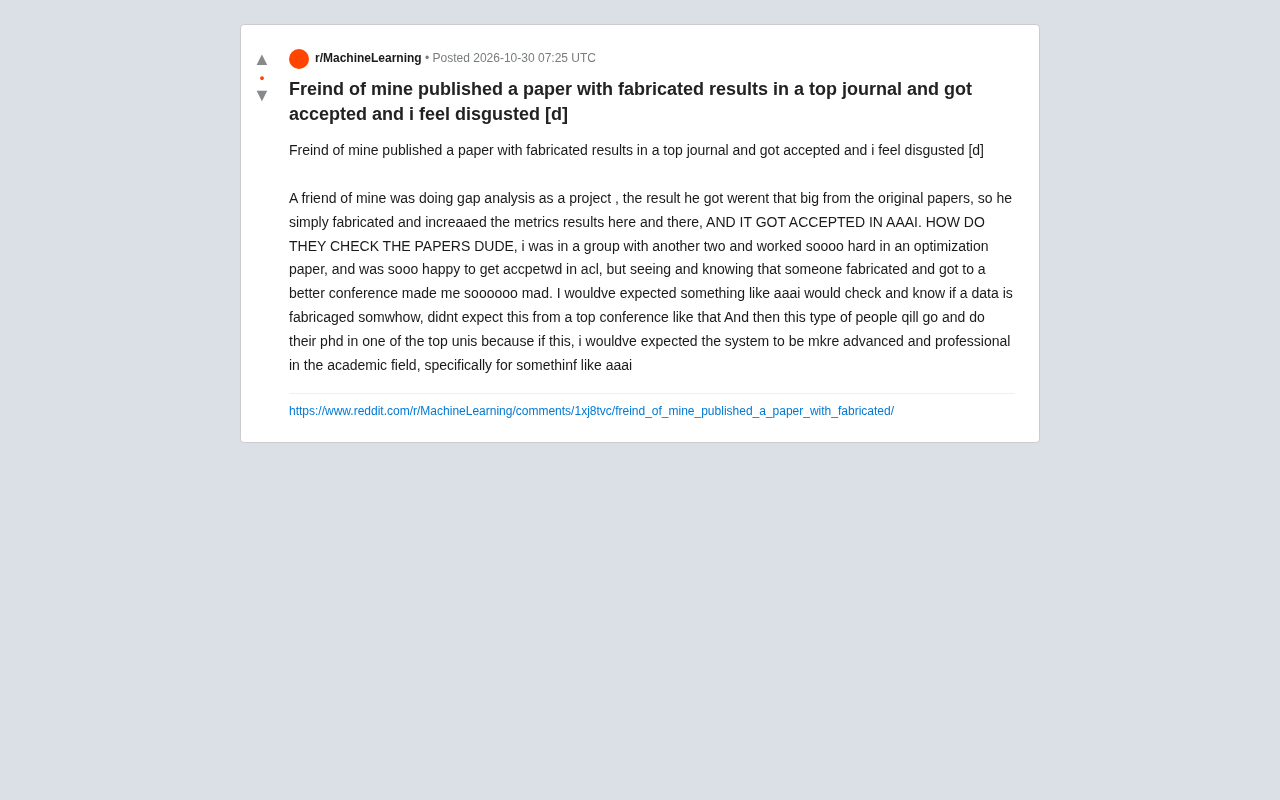
The core contradiction here is: why did the top conference's peer review mechanism fail to catch obvious data fabrication? The tipster had expected that a top venue like AAAI would have some means of verifying data authenticity, but reality clearly disappointed him.
AAAI (Association for the Advancement of Artificial Intelligence) is one of the top international conferences in artificial intelligence, ranked alongside IJCAI, NeurIPS, and ICML in the CCF-A list recommended by the China Computer Federation. It receives a huge volume of submissions each year, with acceptance rates typically around 20% or even lower. ACL (Association for Computational Linguistics) is the top conference in natural language processing and is also CCF-A. Although both are at the top-conference level, they differ in focus: AAAI covers the broad range of AI, while ACL focuses on computational linguistics and NLP. In academic evaluation, the "prestige" of different top conferences is often roughly compared—which is exactly the context for the tipster's sense of unfairness, as he believed the fabricator got into a "better conference."
The Blind Spot of Peer Review: Why Fabrication Is Hard to Detect
The review process at top conferences like AAAI and ACL relies mainly on expert peers manually assessing a paper's novelty, methodology, and experimental logic. Reviewers typically do not—and cannot easily—require authors to provide raw data or reproduce results, unless the paper itself contains obvious logical flaws or data contradictions.
This creates a structural blind spot: if an author merely "makes the metrics look a bit better" without leaving obvious statistical anomalies, reviewers have almost no way to judge from the text alone whether the data is real. The tipster's friend exploited exactly this—he did not fabricate an entire experiment out of thin air, but "slightly adjusted" the numbers based on real results. This degree of tampering is extremely difficult for human reviewers to detect.
More critically, top conferences receive a massive volume of submissions and reviewers have limited time, so requiring them to conduct deep verification of every paper's experimental data is unrealistic. This makes the cost of academic misconduct extremely low while the potential payoff can be very substantial.
Peer review is the core quality-control mechanism in academic publishing, typically conducted in double-blind or single-blind form: reviewers do not know author identities (double-blind), or authors do not know reviewer identities (single-blind). Top-conference review is generally organized by a program committee, with 2–4 reviewers assigned to each paper, scoring based on dimensions such as novelty, technical correctness, and experimental adequacy. However, peer review is in essence an evaluation of a paper's text, not an audit of the experimental process. Reviewers assume authors honestly report results—this "presumption of trust" is the foundation of review efficiency, but it also creates room for abuse. In addition, the reproducibility crisis has drawn increasing attention in AI; multiple surveys show that many papers' experimental results are difficult to reproduce, yet systematic reproducibility checks are still not standard practice.
Distorted Academic Incentives: Why Fabricators Can Get Into Top Programs
The tipster mentioned a disturbing reality: people who obtain top-conference papers through fabrication often use these "achievements" to apply to PhD programs at top universities. This exposes a deep problem in the academic evaluation system—the number of papers and the tier of conferences carry excessive weight in admissions and hiring, while mechanisms for tracing data authenticity are severely lacking.
When publication records become the core metric for measuring research ability and fabrication lacks effective oversight, academic incentives become distorted. Those who do research diligently may need years to accumulate a top-conference paper, while opportunists can obtain the same "label" in a short time by fabricating data. This asymmetric reward structure is eroding the trust foundation of the academic community.
The tipster's anger stems not only from having his personal effort belittled, but also from questioning the fairness of the entire system. He had believed the academic field was "more advanced and professional," but reality gave him the opposite answer.
The academic incentive structure refers to the mechanism by which the academic community allocates resources and reputation through signals such as publications, citations, project funding, and career advancement. In computer science, conference papers (especially at top conferences) are the primary form of output, differing from the journal-centric tradition of many disciplines. PhD admissions committees often treat the number and tier of top-conference papers as a strong signal of research potential, because producing top-conference papers at the undergraduate or master's stage is indeed rare. But the validity of this signal depends on the authenticity of the papers—once the cost of fabrication is lower than the product of detection probability and punishment, the signal becomes distorted, producing the "bad money drives out good" effect in economics. Research misconduct includes fabrication, falsification, and plagiarism, among which fabricated and falsified data are the hardest forms to detect through text-based review.
Possible Directions for Improvement and the Dilemma
The academic community is not without tools to address this problem. Open-sourcing code and data, reproducibility checks, and statistical anomaly detection during review can all increase the probability of detecting fabrication. Some conferences have begun requiring authors to submit reproducibility checklists or code links, but the enforcement and coverage of these measures remain limited.
The dilemma is that mandatory data verification would greatly increase review costs and could also raise privacy and intellectual property concerns. In addition, many experiments involve large-scale computing resources or proprietary data, making full reproduction unrealistic. How to improve data credibility while ensuring review efficiency is a real challenge facing top-conference organizers.
From a broader perspective, governing academic misconduct requires institutional design—including post-publication spot checks of published papers, clear punitive mechanisms for fabrication, and reducing excessive reliance on "top-conference labels" in evaluation systems. These changes will not happen overnight, but every exposure of a similar incident pushes the academic community to confront the issue.
For the tipster, his anger is justified. Someone who got into AAAI by fabricating data not only harms the trust of peers but may also continue this pattern in future PhD research. The professionalism of the academic system is precisely what needs to be tested amid such doubts.
Reproducibility checks have seen initial practice at top conferences in recent years—for example, NeurIPS has implemented a "Reproducibility Checklist" since 2019, the ML Reproducibility Challenge encourages independent teams to reproduce papers, and ACL-series conferences have gradually required code and data availability statements. Statistical anomaly detection is another approach: screening suspicious data through statistical methods such as Benford's law, overly perfect value distributions, or abnormal variance. However, such methods have high false-positive rates in AI experiments with small sample sizes and inherently volatile metrics, making them difficult to use as routine review tools. Post-publication audits and retraction mechanisms are relatively mature in the journal world, but conference papers are hard to audit due to the lack of a continuous editorial process. The fundamental contradiction is that review is voluntary, time-limited labor, while deep verification requires additional time, computing power, and expertise—and there is no consensus on who should bear the cost.
One-line Summary
A Reddit tip alleges someone fabricated data to get a paper into AAAI, exposing peer review's structural blind spot on data authenticity and distorted academic incentives.
Paragraph Summary
The article starts with a Reddit tip: a researcher directly fabricated data to inflate experimental metrics, and the paper was accepted by AAAI, while the tipster's diligently researched paper was only accepted by ACL, sparking anger over review fairness. The article argues that top-conference peer review relies on manual evaluation of paper text, and reviewers usually cannot demand raw data or reproduce experiments, creating a structural blind spot; slight tampering with real results is harder to detect than outright fabrication, leading to low cost and high reward for misconduct. The deeper problem is distorted academic incentives—top-conference paper labels carry excessive weight in PhD applications, while data authenticity tracing mechanisms are absent. The article finally discusses improvement directions such as code open-sourcing, reproducibility checklists, and statistical anomaly detection, but notes that these measures are constrained by review costs and reproducibility, and governance requires long-term institutional design.
Related articles

AI Comic Drama with WorkBuddy from Scratch: A Step-by-Step Skill Pack Installation Guide
Learn how to create AI comic dramas with WorkBuddy from scratch. This guide covers installation, Skill pack import and invocation, plus a script generation demo with manual revision tips to get you through the first step from script to storyboard.

WorkBuddy Agent Runs the Entire GEO Database Mining Pipeline with a Single Prompt
WorkBuddy agent automates GEO database mining: from data search and curation to batch correction, differential analysis, co-expression networks, feature gene screening, and immune infiltration—a single prompt generates a complete bioinformatics report, greatly lowering the barrier to bioinformatics analysis.

PC Memory Wasted? Hacker News Debates Centralized Data Centers
Hacker News users argue that personal computer memory is wasted and should be centralized in data centers, sparking debate on centralized vs. distributed computing resource allocation. This article analyzes the logic behind the claim, the costs of centralization, and new tensions in memory resource allocation in the AI era.