face2social: Using Face Search to Verify Social Identity Authenticity

face2social searches profiles across social platforms using a face photo for business identity verification.
face2social is a Product Hunt product that searches people by face: upload a photo and the system performs reverse face search across Instagram, Facebook, LinkedIn, TikTok, and X, returning matching public profiles to help investors, recruiters, and founders quickly verify strangers' identities. It uses free preview and no-charge-if-no-match to lower barriers and focuses on professional social scenarios. However, face search raises privacy compliance risks, and the product does not clearly state data storage policies or accuracy metrics.
Article Content
On social media, we often need to quickly determine whether a stranger is trustworthy—whether they are an investor, founder, recruiter, or potential partner. Searching by name alone can return thousands of results, making it hard to distinguish. face2social, the second-ranked new product on Product Hunt, proposes a new approach: searching people by face. Upload a photo, and it searches for matching faces across Instagram, Facebook, LinkedIn, TikTok, and X, helping you cross-check names against public profiles and uncover inconsistencies.
How Face Search Verifies Identity
face2social's core feature is straightforward and focused: users upload a face photo, and the system performs reverse face search across major social platforms, returning matching public profiles. Users can compare the name, avatar, bio, and other details in the search results against the identity the person claims, thereby spotting potential fraud or identity impersonation.
According to its Product Hunt page, the tool emphasizes a business model of "free preview, no charge if no match." This means users can see whether there are search results before paying, lowering the barrier to trying it. The product's categories span search, social networking, and security, pointing to its core use cases: due diligence and trust-building.
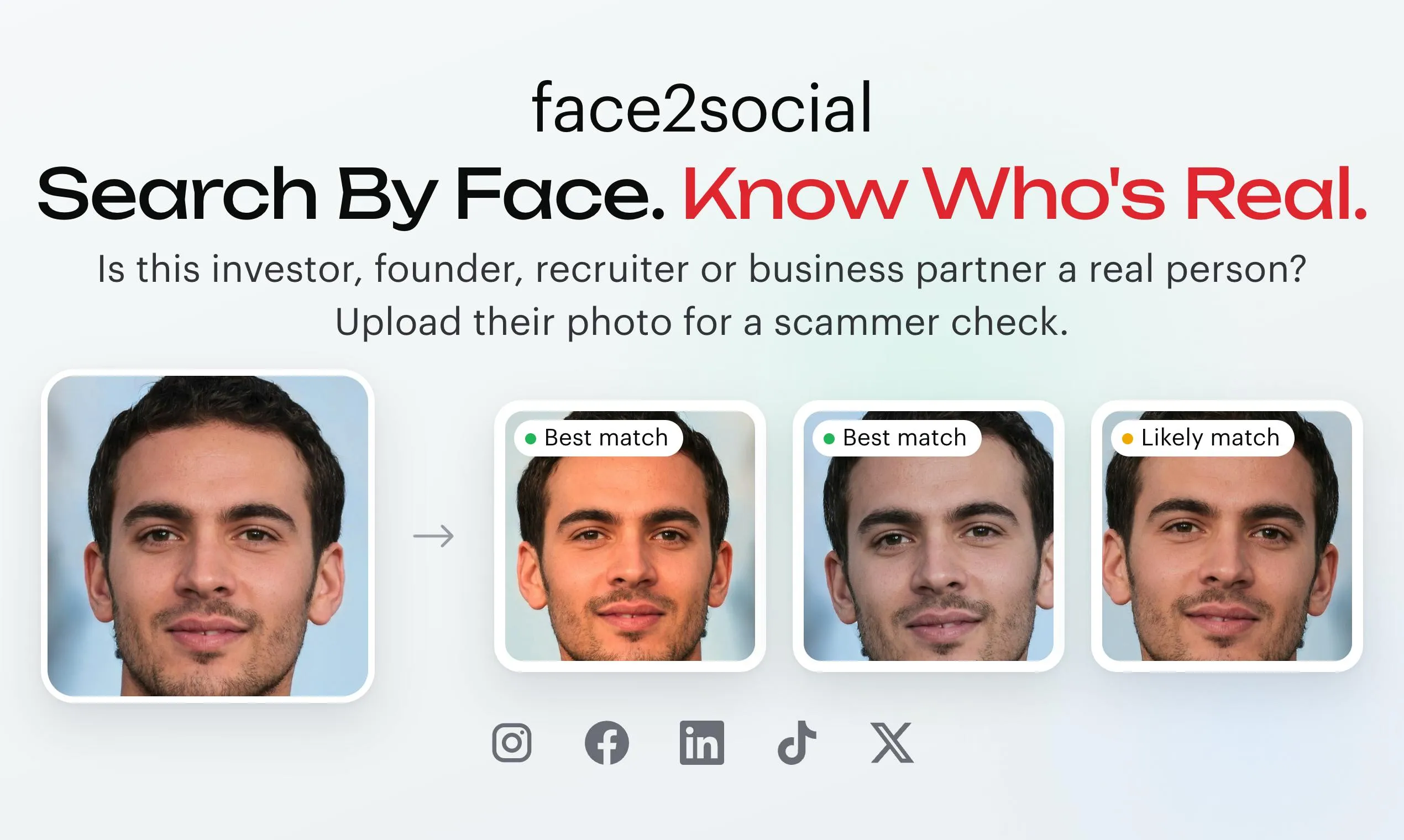
Reverse Face Search differs technically from Face Recognition. Face recognition typically refers to comparing a captured face against a pre-built identity database (such as ID records or access control systems) via 1:1 or 1:N matching to confirm "who this person is"; reverse face search, by contrast, uses a face image as a query to perform similarity retrieval across publicly available images on the internet or data from specific platforms, returning visually similar faces and their associated pages. It relies on face detection, feature extraction (mapping a face to a high-dimensional vector), and vector similarity matching. Because photos across different platforms vary greatly in lighting, angle, resolution, and age, cross-platform matching accuracy drops significantly—which is the root cause of the false positives common to such tools.
Who Needs a Tool Like This
In business social settings, identity verification often relies on mutual trust or third-party referrals. But the anonymity of online communication leaves room for fake identities. face2social targets exactly this pain point:
- Investors can quickly verify whether a stranger entrepreneur's LinkedIn profile matches their real face;
- Recruiters facing a flood of candidates can use cross-referenced face search to uncover resume fraud;
- Founders seeking partners or suppliers can reduce the risk of being deceived by impersonators;
- Ordinary users can also use it in dating or social situations to confirm whether the other person is using fake photos.
The limitation of traditional name searches lies in high name duplication and fragmented information. A face, as a biometric feature, is unique in principle and can theoretically pinpoint the same person's footprint across different platforms more precisely.
The Boundaries of Privacy and Ethics
Although face2social's starting point is to serve business security, face search technology inherently touches privacy red lines. Uploading someone's photo for cross-platform search without their consent may, in many jurisdictions, involve personal information protection regulations. The product page does not detail its data sources, photo storage policies, or compliance with regulations such as GDPR.
Moreover, face recognition algorithms themselves are error-prone, especially under different lighting, angles, and age changes; mismatches may cause unnecessary trouble for the person being searched. face2social's "no charge if no match" strategy lowers user costs but does not address accuracy and false-positive rates. For a security tool, these metrics are precisely the key to credibility.
GDPR (the General Data Protection Regulation) is a personal data protection law that took effect in the EU in 2018. Under this regulation, facial images are biometric data and are classified as "special category personal data"; processing such data generally requires the explicit consent of the data subject or another lawful basis, and obligations such as notification, minimization, and storage limitation must be fulfilled. In addition, GDPR grants individuals rights to access, rectify, and erase their data. Uploading others' photos for cross-platform face search without consent, in many cases, struggles to meet a lawful basis for processing, and thus carries high compliance risk. Beyond the EU, local legislation such as the Illinois Biometric Information Privacy Act (BIPA) in the United States also imposes strict limits on the collection and sharing of facial data.
Market Opportunity and Competitive Landscape
Face search is not an entirely new concept—tools such as Google Image Search and PimEyes have long offered similar capabilities, but mostly for general scenarios. face2social's differentiation lies in focusing on professional social platforms, incorporating business profiles like LinkedIn into its search scope, and designing the product experience around "identity verification." This verticalization approach may attract users with clear due-diligence needs.
However, the field is highly competitive and regulation-sensitive. PimEyes has faced scrutiny in multiple countries over privacy controversies. If face2social wants to establish itself long-term, it needs to make clearer commitments to product transparency, compliance, and ethical standards. Currently, information on its official website is limited, and its actual performance and accuracy remain to be verified by users.
PimEyes is a public-facing face search engine that lets users upload a photo and then search for similar publicly available face images and their source pages on the internet. It has drawn attention for its powerful cross-site retrieval capability, while also sparking widespread controversy over potential use for stalking, harassment, or doxxing; it has been scrutinized by privacy regulators in multiple countries and required to restrict some functions or delete data. The PimEyes case shows that the commercial viability of face search tools is highly dependent on the regulatory environment: on one hand, real demand exists; on the other, product design must build in access controls, abuse prevention, and transparency mechanisms, or it will easily trigger legal and public-opinion risks.
Is It Worth Trying
For businesspeople who frequently need to verify strangers' identities online, face2social offers a lightweight, low-barrier entry point. The free preview mode lets users test its search coverage and match quality first. But given the sensitivity of face search, it is advisable to use it only as an auxiliary reference, not as the sole basis for judgment. As privacy compliance grows stricter, the long-term usability of such tools will also depend on whether they can strike a balance between convenience and responsibility.
One-line Summary
face2social searches for matching profiles across social platforms using a face photo for business identity verification.
Paragraph Summary
face2social is a new product on Product Hunt centered on "searching people by face": after users upload a photo, the system performs reverse face search across platforms such as Instagram, Facebook, LinkedIn, TikTok, and X, returning matching public profiles to help investors, recruiters, founders, and others quickly cross-check the authenticity of strangers' identities. The product lowers the barrier to use with a free preview and no-charge-if-no-match model, and differentiates itself by focusing on professional social scenarios. However, the article also notes that face search involves privacy compliance risks from processing biometric data without consent; the product does not clearly state its data storage policies or accuracy metrics, and mismatches may cause trouble. Overall, the tool can serve as an auxiliary due-diligence method, but its long-term usability depends on how well it improves transparency, compliance, and ethical standards.
Related articles

WebMCP Security Guide: Three Hints That Make AI Agents Safer
The Chrome team demonstrates three security hints for WebMCP tools: readOnlyHint eliminates invalid confirmation dialogs, consequentialHint forces human confirmation for high-risk operations, and untrustedContentHint defends against indirect prompt injection—improving AI agent security with one or two lines of code.

Why Turbulence Is the Hardest Problem in Fluid Mechanics — and How AI Could Crack It
Why is turbulence the hardest problem in fluid mechanics? This article, based on a Lex Fridman podcast conversation, explores turbulence's multi-scale nature, comparisons with classical thermodynamics, and how AI might simplify turbulence description by discovering coordinate transformations — examining the intersection of vortex formation with mathematics and physics.

R.L. Stine Google Talk: How the Master of Horror Ignites Kids' Passion for Reading
At a Google talk, R.L. Stine shares his accidental pivot from comedy to horror, his principles for children's horror, how phones impact storytelling, and how Goosebumps motivates kids to read.