FastAPI Learning Path: From Beginner to AI Project Practice

A Bilibili creator recommends *FastAPI Web Development*, breaking down the audience and six-part learning path.
Based on a Bilibili creator's video, this article outlines the FastAPI learning path and the recommended book *FastAPI Web Development: From Beginner to Advanced with Practical Projects*. It notes two main scenarios for learning FastAPI: web backend development and AI Agent project development, and summarizes the book's three advantages: quick to get started with, project-driven, and more structured than the official docs. The audience includes Python developers moving to backend, developers needing to write API projects quickly, students doing capstone projects, and those shoring up backend fundamentals. The book's 15 chapters are split into six parts, from underlying principles to practical projects, ending with an appointment registration system. It emphasizes project-driven learning and notes that FastAPI plus full project experience is a practical path into AI Agent development.
FastAPI is becoming the mainstream framework for Python backend development and AI Agent projects, but beginners often get stuck at "where do I start?" In a recent video, a Bilibili creator recommended the book FastAPI Web Development: From Beginner to Advanced with Practical Projects and laid out a complete learning path. Drawing on the video's points, this article breaks down who FastAPI is for, the knowledge structure, and practical directions to help you avoid detours.
Why Is FastAPI Worth Learning?
According to the Bilibili creator's analysis, learners want to pick up FastAPI for basically two reasons: one, to do backend development (web development); two, to build AI Agents—many AI Agent projects today are built on FastAPI, a Python framework.
The creator gave three reasons for recommending FastAPI Web Development: From Beginner to Advanced with Practical Projects: it's quick to get started with and beginner-friendly; it's project-driven, which fits today's need to "build things fast"; and it's more structured and easier to read than the official documentation.

Who Is This Book Best For?
The creator identified four groups in the video:
- Python developers transitioning to backend: people doing web scraping or data analysis who want to move into backend work will find this book a good fit.
- Those who want to write API projects quickly: developers who need to ship small projects fast at work.
- Students doing capstone projects or small projects: those who need a complete project reference.
- Those shoring up backend fundamentals: beyond frameworks like Django, FastAPI's API development skills are also worth mastering.

Book Structure: 15 Chapters in Six Parts
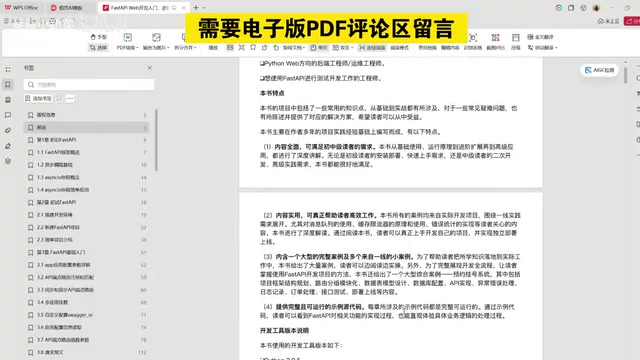
The book has 15 chapters, which the creator divides into six learning parts, covering the full path from basic principles to production-grade components.
Part 1: Fundamentals and Underlying Principles (Chapter 1)
The content covers the background of web frameworks, Python concurrency basics, coroutine mechanisms, and performance comparison cases. The creator notes that FastAPI performs better on performance, and this part helps readers build underlying understanding.
Coroutines and asyncio are the key to understanding FastAPI's high performance. A coroutine is a user-space lightweight thread in Python, defined and scheduled via the async/await syntax and managed uniformly by an event loop. Compared with threads, coroutine switching is controlled by the program itself with minimal overhead, making them suitable for I/O-intensive tasks (such as network requests and database queries). FastAPI is built on Starlette and Pydantic, and its async routes run directly on the event loop of an ASGI server (such as Uvicorn), so a single process can handle a large number of concurrent connections. The "performance comparison cases" mentioned in the original text typically compare the throughput differences between synchronous frameworks (such as Flask + WSGI) and asynchronous frameworks under high-concurrency I/O scenarios. Only by understanding the coroutine mechanism can you understand why you must not call blocking code when writing async def routes in FastAPI—doing so will stall the entire event loop.
Part 2: Environment and Basic Development (Chapter 2)
Setting up the development environment, choosing versions and development tools, analyzing project structure, and configuring the parser. The core goal is to get a FastAPI project up and running smoothly.
Part 3: FastAPI Core Fundamentals (Chapters 3-6)
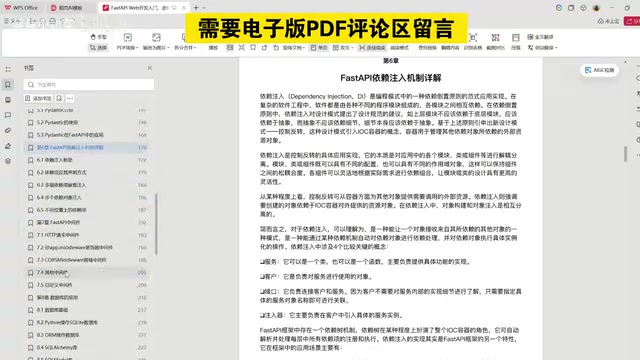
Covers introductory basics, request parameters and data validation, response models and dependency injection, and middleware and extension mechanisms. This is the core skill area for using the framework.
Dependency injection is one of FastAPI's most central designs and a distinctive feature that sets it apart from frameworks like Flask. In FastAPI, dependencies are declared via Depends(), and the framework automatically resolves and injects the required objects on each request. Dependencies can be database sessions, the currently logged-in user, common query parameters, permission-checking functions, and more. Its advantages include: code reuse (multiple routes share the same preparation logic), automatic documentation (parameters in dependencies appear in the OpenAPI docs), and ease of testing (dependency implementations can be swapped out). Dependencies also support nesting and caching—declaring the same dependency multiple times within a single request only executes it once. The original text lists dependency injection alongside response models as core skills precisely because it is the fundamental means of organizing FastAPI project structure and implementing authentication and database session management.
Part 4: Databases and Engineering (Chapters 7-10)
Database fundamentals, user authentication, user systems and authentication, logging and exception handling, and project structure design.
ORM (Object-Relational Mapping) is a common way for FastAPI projects to connect to databases, with SQLAlchemy being the most mainstream choice. ORM maps database tables to Python classes and rows to objects, letting developers perform CRUD operations in an object-oriented way without writing SQL by hand. FastAPI's official tutorial uses SQLAlchemy as the example for demonstrating database integration. Note that SQLAlchemy has both synchronous and asynchronous APIs; in FastAPI's async routes you should use the asynchronous version (with drivers such as asyncpg and aiomysql), otherwise it will block the event loop. The original text's "database fundamentals" and "user systems" chapters typically revolve around ORM model definition, session management, migration tools (such as Alembic), and database-based user authentication.
Part 5: Advanced Capabilities (Chapters 11-13)
Asynchronous and high-concurrency optimization, background task systems, and deployment and go-live.
ASGI and deployment are prerequisites for understanding the go-live phase of FastAPI. ASGI (Asynchronous Server Gateway Interface) is the asynchronous successor to WSGI, defining the standard interface between applications and servers, and supporting WebSocket, HTTP/2, and long-lived connections. A FastAPI application is itself an ASGI application, and in production it is commonly run with Uvicorn or Gunicorn + Uvicorn workers. A typical deployment architecture is Nginx as a reverse proxy + multiple Uvicorn processes, together with Docker containerization. The original text's "deployment and go-live" chapter usually covers process management, environment variable configuration, HTTPS termination, and monitoring logs. Only by understanding the ASGI model can you reasonably set the number of workers, troubleshoot concurrency bottlenecks, and understand why FastAPI is not suited to being deployed directly with traditional WSGI servers (such as uWSGI).
Part 6: Practical Projects (Chapters 14-15)
An enterprise-level comprehensive project—an appointment registration system—of considerable scale; it also includes content on production-grade components and monitoring.
Learning Advice
The creator emphasizes that being project-driven is the book's core advantage. Rather than mastering every knowledge point before starting, it's better to learn the fundamentals while working on projects, which better fits today's fast-paced learning needs. For backend developers who want to build AI applications, FastAPI plus complete project experience is a practical path into AI Agent development.
The creator provided guidance in the video on how to obtain the accompanying PDF and source code; readers who need them can check the original video's comment section.
This article is compiled based on the content of a Bilibili video. The book's chapter structure and audience analysis are all from the creator's views and are for reference only.
One-line Summary
A Bilibili creator recommends FastAPI Web Development: From Beginner to Advanced with Practical Projects, breaking down the target audience and the six-part learning path.
Paragraph Summary
Based on a Bilibili creator's video, this article outlines the FastAPI learning path and the recommended book FastAPI Web Development: From Beginner to Advanced with Practical Projects. It notes two main scenarios for learning FastAPI: web backend development and AI Agent project development, and summarizes the book's three advantages: quick to get started with, project-driven, and more structured than the official documentation. The target audience includes Python developers transitioning to backend, developers who need to write API projects quickly, students doing capstone projects, and those wanting to shore up backend fundamentals. The book's 15 chapters are divided into six parts, from underlying principles, environment setup, core fundamentals, databases and engineering, and advanced capabilities to practical projects, ending with an appointment registration system. The article emphasizes a project-driven learning approach, suggesting learning while building, and notes that FastAPI plus complete project experience is a practical path into AI Agent development.
Related articles
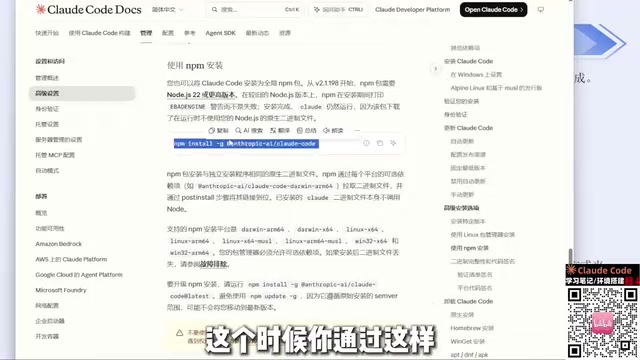
Claude Code in Practice: Installation, MCP, Skills, and SubAgent Techniques
From npm installation and CC Switch login bypass to permission modes, MCP, Skills, SubAgent, and CLAUDE.md configuration—a systematic guide to practical Claude Code techniques.

Reverse-Engineering Taobao's sign Signature Parameter with AI in 10 Minutes: A Practical Walkthrough
Based on a Bilibili hands-on demo, this article explains how to combine DeepSeek with vision models to automatically reverse-engineer Taobao's sign signature parameter, track dynamic titter and token values, and successfully scrape product data within ten minutes—while analyzing the capability boundaries and compliance risks of AI Agents in crawler reverse engineering.

LangChain+MCP from Beginner to Practice: A Deep Dive into the Bilibili Tutorial
A deep dive into a Bilibili LangChain+MCP tutorial: framework positioning, agent abstraction, and MCP protocol basics. Why not hand-build frameworks, and how beginners can follow the code-practice path.