fheroes2: An Open-Source Engine Remake of Heroes of Might and Magic II
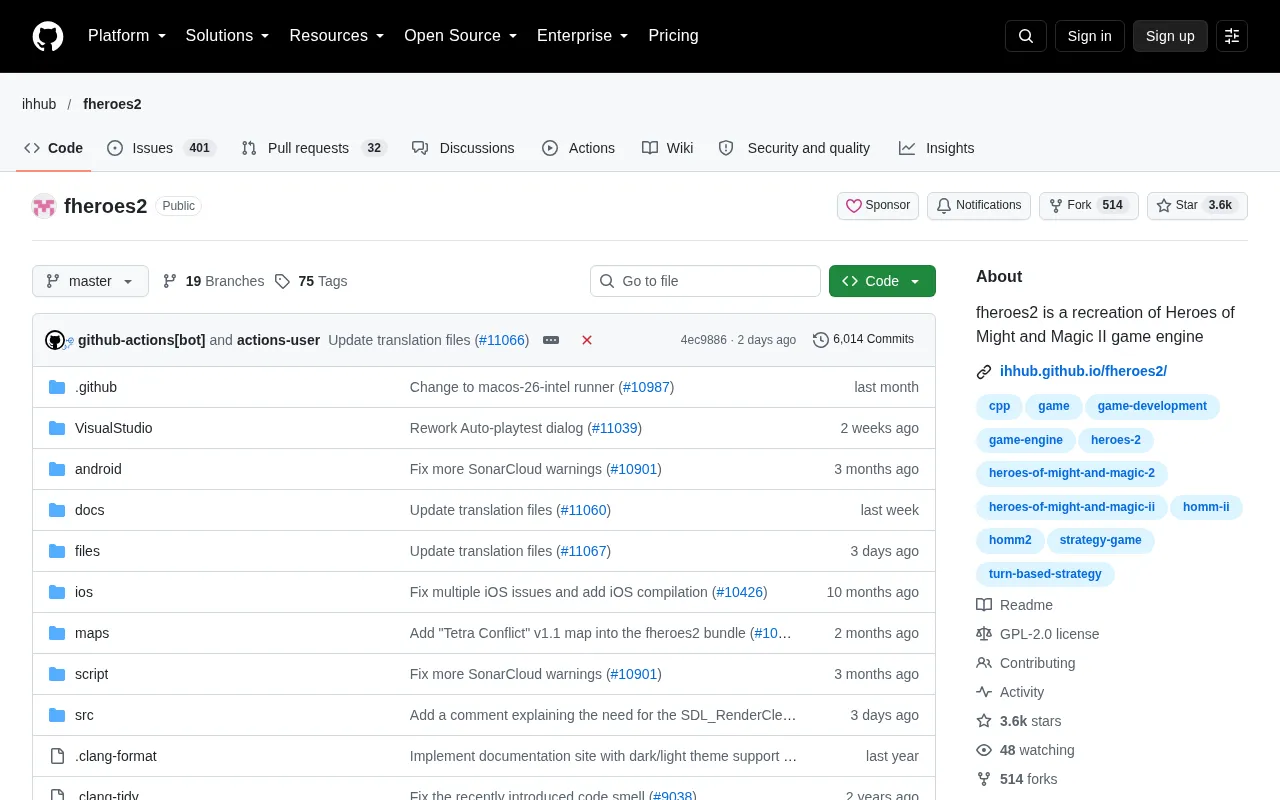
fheroes2 rewrites the Heroes of Might and Magic II engine in modern C++, giving the classic new life in the open-source community.
fheroes2 is an open-source project that rewrites the Heroes of Might and Magic II game engine from scratch in modern C++, earning 193 upvotes and 67 comments on Hacker News. It is not a DOSBox-style emulator but directly reads the original .AGG data files and uses SDL2 for cross-platform support on Windows, macOS, Linux, and some mobile devices. The project requires users to provide their own legal original resources and follows the "engine remake" model, in the same lineage as OpenTTD and OpenRA. Its value lies in fixing original resolution and AI pathfinding issues while keeping the rules authentic, along with a clear code structure and active maintenance process. The article argues that this model both extends the life of classic software and offers a "behavior compatibility layer" approach for modernizing legacy systems.
When a Classic Meets Open Source: fheroes2 Relights Heroes of Might and Magic II
On Hacker News, a project called fheroes2 received 193 upvotes and 67 comments. This project is not a simple game MOD, but a from-scratch rewrite of the game engine for Heroes of Might and Magic II in modern C++. It requires users to supply their own original game resource files, but the engine code is fully open source, meaning developers can freely modify, port, and enhance this turn-based strategy classic born in the 1990s.
For players who once stayed up late in front of CRT monitors managing towns and commanding heroes, fheroes2 offers not just nostalgia, but a technical resurrection. And from the intersection of AI and open-source tools, this project also demonstrates how community-driven reverse engineering and compatibility layer design can extend the life of software.
Gameplay and Technology: What Engine Reconstruction Actually Does
Not an Emulator, but a Native Rebuild
fheroes2 does not run the original executable like DOSBox does. Instead, by rewriting the game logic and rendering pipeline, it directly reads the images, sound effects, and map resources from the original data files (.AGG and other formats). The project uses SDL2 as its cross-platform foundation, supporting Windows, macOS, Linux, and even some mobile environments. The benefits of this approach are obvious: clearer scaling algorithms on modern high-resolution screens, fixes for the original's AI pathfinding bugs, added windowed mode, and interfaces reserved for future MOD expansion.
From community feedback, many commenters mention exactly this "authentic but more modern" experience—the maddening wait animations from the original are accelerated, the map editor is enhanced, while the game rules remain unchanged.
SDL2 (Simple DirectMedia Layer 2) is a cross-platform low-level multimedia development library that provides a unified abstraction for audio, keyboard, mouse, gamepad, and OpenGL/Vulkan contexts. It does not handle game logic; it only solves platform differences such as "how to open a window, play sound, and receive input on different operating systems," so it is often used as a porting layer for indie games and emulators. Compared to calling each platform's native APIs directly, SDL2 allows the same C++ code to compile and run on Windows, macOS, Linux, and mobile, at the cost of having to handle rendering details and performance tuning yourself. fheroes2 uses SDL2 to achieve windowing, scaling, and input abstraction, thereby focusing its efforts on faithfully reproducing the game logic.
Collaboration Between Reverse Engineering and the Open-Source Toolchain
Another highlight of the project is how it handles copyright boundaries with the original assets. fheroes2 itself does not include any commercial game resources; users must legally own the original game to use it. This model is known in the open-source community as an "engine remake," in the same lineage as projects like OpenTTD and OpenRA. It relies on the community's reverse analysis of the game's data formats and solidifies this knowledge in code. For AI coding assistants, such projects are also excellent training material—large amounts of clear data structure parsing code, state machine implementations, and graphics rendering logic demonstrate engineering approaches to complex real-world systems.
According to discussions on Hacker News, some developers mentioned that fheroes2's codebase is well-structured and suitable as a reference for learning SDL game development. Others pointed out that the project team has been quite meticulous in reproducing the original AI behavior, including hero movement path calculation and unit priorities in combat.
"Engine remake" is a special form of open-source project: developers do not copy the original executable but reimplement its game logic, reusing only the user's local data resources. Its legal basis lies in the fact that the copyrights of code and assets such as art/audio are independent of each other; rewriting an engine is generally considered independent creation, but distributing original resource files constitutes infringement. Therefore, such projects universally require users to supply their own legitimate copies of the game. Since the original data formats are mostly undisclosed, developers must reverse-engineer file structures and behavior rules through hex analysis, memory capture, and trial and error, then solidify the conclusions into code and documentation. OpenTTD, OpenRA, devilutionX, and others are representatives of this model, and together they form an important path for preserving digital game heritage.
Why an Old Game Engine Attracts Attention
The Irreplaceable Depth of Classic Gameplay
Heroes of Might and Magic II's turn-based strategic depth still has few rivals today. The combination of resource management, hero development, map exploration, and turn-based combat forms a highly replayable system. fheroes2 keeps this game playable on 4K monitors while fixing compatibility issues that have plagued players for years. Many in the comments say that it was through this project that they first ran this childhood game smoothly on Mac or Linux.
The Long-Term Maintenance Value of the Open-Source Community
The project is continuously updated on GitHub, with contributors from multiple countries. Unlike many one-off open-source remakes, fheroes2 has a clear version roadmap and bug tracking process. Some commenters noted that the maintainers respond quickly to issues and have even accepted PRs improving the map editor experience. This level of activity is key to the long-term survival of community projects and has earned it recognition from the technical community on Hacker News.
Lessons for Developers: From Player to Contributor
For game developers interested in contributing to open source, fheroes2 offers a low-barrier entry point. The project is written in C++, but its modules are relatively clearly divided, so beginners can start by fixing UI bugs or improving documentation. More importantly, it demonstrates how to bring classic software back to life on modern hardware through engine remakes without infringing copyright. This model is also instructive for developers of AI tools—many legacy enterprise internal systems can be modernized through a similar "behavior compatibility layer" approach without rewriting all business logic.
If you still have the original CD image or GOG version on hand, you might as well clone the repository, compile the engine, and experience Heroes of Might and Magic II once again, polished anew by the open-source community.
One-line Summary
fheroes2 rewrites the Heroes of Might and Magic II engine in modern C++, giving the classic new life in the open-source community.
Paragraph Summary
fheroes2 is an open-source project that rewrites the Heroes of Might and Magic II game engine from scratch in modern C++, earning 193 upvotes and 67 comments on Hacker News. It is not a DOSBox-style emulator but directly reads the original .AGG data files and uses SDL2 for cross-platform support on Windows, macOS, Linux, and some mobile devices. The project requires users to provide their own legal original resources and follows the "engine remake" model, in the same lineage as OpenTTD and OpenRA. Its value lies in fixing original resolution and AI pathfinding issues while keeping the rules authentic, along with a clear code structure and active maintenance process. The article argues that this model both extends the life of classic software and offers a "behavior compatibility layer" approach for modernizing legacy systems.
Related articles

Cursor AI in Practice: Weighing Efficiency Gains Against Costs in an AI IDE
An in-depth look at Cursor AI IDE's interface layout, four modes (Agent/Plan/Debug/Ask), model selection, and Git context integration, with hands-on demos weighing subscription costs against going direct to Claude.
Free Landing Page Design Rules Library: A Practical Guide for Claude Code and Cursor
A free landing page design skill for Claude Code and Cursor: MIT licensed, nearly 9,000 stars, asks about offer/audience/action before planning 12 sections with hard font and spacing constraints.
Cursor Keeps Writing Wrong Code? The Problem May Be Context, Not Prompts
Cursor keeps writing wrong code? The problem may be context, not prompts. Learn how to supply relevant files, full error messages, and expected results, plus a plan-first, small-step, test-driven workflow to reduce AI coding errors—while remembering code review remains the developer's job.