Fireworks AI Is Hiring Across All Teams: What One Recruitment Tweet Says About the Industry

Fireworks AI's all-teams hiring push signals growing demand in the open-source model inference market.
AI inference infrastructure company Fireworks AI recently posted a light-hearted social media announcement signaling company-wide expansion. Fireworks helps developers and enterprises run open-source LLMs at lower cost and higher efficiency, competing in the same space as Together AI and Anyscale. A full-team hiring push typically marks a transition from technical validation to scaled commercial growth, reflecting a broader industry shift in focus from model capability to deployment efficiency and inference cost. The article also cautions that a single tweet offers limited insight — funding progress and customer scale are needed to fully assess the company's health.
What a Single Recruitment Tweet Reveals
AI infrastructure company Fireworks recently posted a brief job announcement on social media, kicking things off with a tongue-in-cheek line — "We're going to need a bigger park." The post then announced that the company is hiring across all teams and invited interested candidates to check out their careers page to "help shape the future of AI."
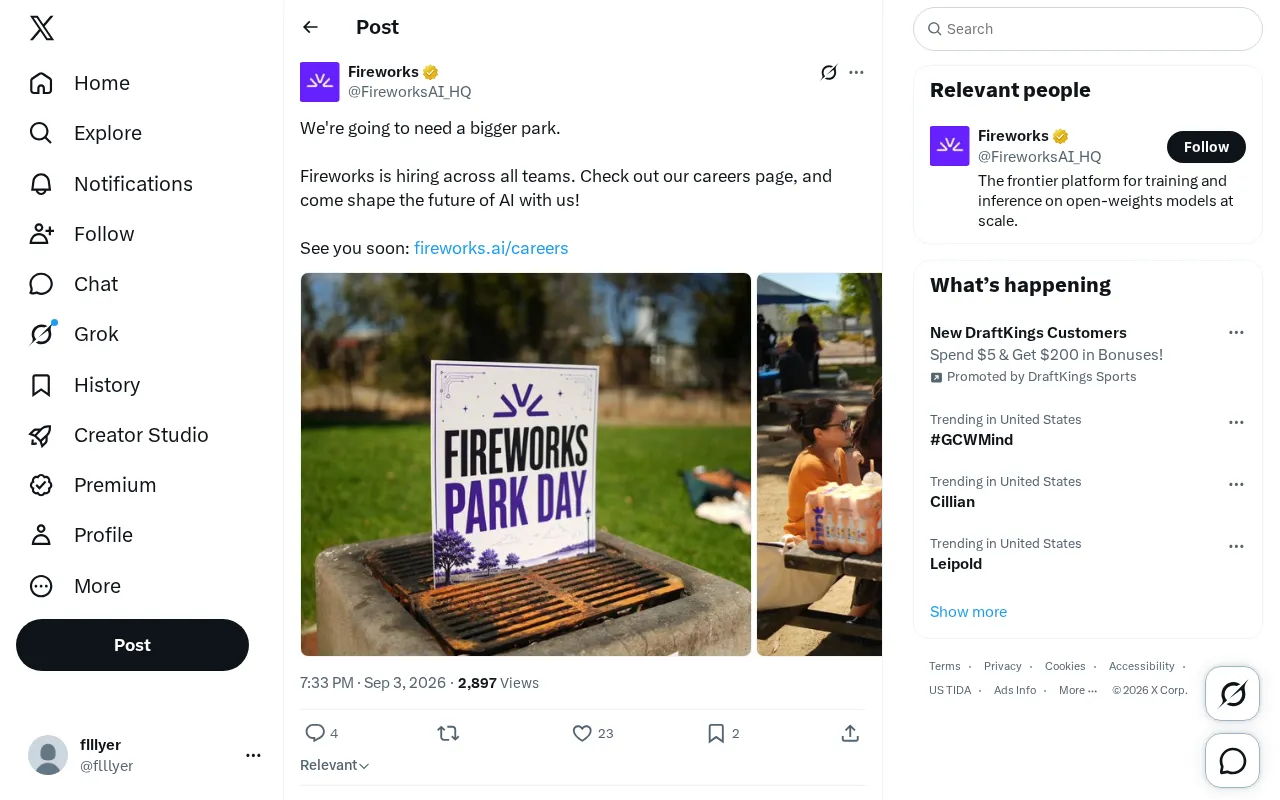
The post itself is light on details, but the phrase "across all teams" is worth paying attention to. At a time when much of the AI industry is focused on cutting costs and some companies are still laying off workers, a public announcement of company-wide hiring typically signals that a business is in a growth phase — or that it's been backed by a fresh round of funding or new contracts.
Who Is Fireworks AI?
Fireworks AI is an infrastructure provider focused on generative AI inference and deployment. Its core business is helping developers and enterprises run open-source large language models faster and at lower cost. In the areas of inference optimization and model-serving APIs, it competes in the same space as Together AI, Anyscale, Modal, and similar companies.
The business logic for these companies goes like this: as more enterprises want to use open-source models (like the Llama series, Mistral, etc.) rather than relying solely on closed-source APIs, they need an intermediary layer that can efficiently host models and optimize inference performance. Fireworks is squarely targeting that need. A company-wide hiring push, to some degree, reflects the continued growth in demand for open-source model deployment.
The Industry Logic Behind a Full-Team Expansion
Reading industry trends from hiring signals is a common way to gauge the health of a tech company. "Across all teams" suggests the hiring isn't limited to engineering and R&D — it likely extends to sales, marketing, and operations as well. That kind of broad expansion is typically a sign that a company is moving from the technical validation stage into scaled commercial growth.
For the AI infrastructure sector, the period around 2025–2026 represents a critical inflection point: model capabilities are maturing, and the competitive focus is gradually shifting from "who has the best model" to "who can run models more cheaply, faster, and more reliably." Inference cost, deployment efficiency, and multi-model support are becoming the core competencies at this layer of the stack. Fireworks choosing to expand its team right now aligns with the broader trend in the industry toward application and real-world deployment.
What This Means for Job Seekers and Developers
For professionals looking for opportunities in AI, infrastructure companies are often an underrated option. Compared to the headline-grabbing labs building frontier models, these companies offer solid technical growth in engineering practice, systems optimization, and large-scale service deployment — and their work is closer to commercial viability.
For developers, Fireworks' expansion is also a positive signal: more team investment means platform capabilities, model coverage, and service reliability are likely to keep improving. For small and mid-sized teams that rely on third-party inference services, having a vendor that is actively investing and financially stable is itself an important factor in reducing technical risk.
The Strategy Behind a Casual Hiring Post
It's worth noting that this kind of breezy, informal job announcement is becoming a common brand communication tactic for tech companies. Using a metaphor like "a bigger park" instead of the blunt "we're hiring" conveys a growth narrative while also projecting a vibrant company culture — and it's far more likely to get shared and discussed on social media.
That said, it's worth keeping perspective: a single recruitment tweet doesn't paint a complete picture of a company's actual operations. Specifics around funding progress, customer scale, and profitability still require more public data to substantiate. This post is best treated as a window for observation, not a definitive conclusion.
Related articles
Microsoft Fabric Database Agent in Action: From Reactive Firefighting to Intelligent Detective
A deep dive into the Microsoft Fabric Database Agent: how to enable it, supported monitoring scenarios, a blocking-issue demo, and the roadmap from reactive to autonomous operations.

Zendesk Uses ChatGPT Enterprise to Build a Sales Agent with 1,000 Daily Active Users
Zendesk opened ChatGPT Enterprise to all employees, who built about 600 apps themselves, including a sales expansion agent with about 1,000 daily active users. This article analyzes how it turns internal data into sales opportunities and its "don't wait" implementation strategy.

Google Releases Gemini 4 Carbon: Its Strongest Model Yet, Debuting with a Cybersecurity Focus
Google releases Gemini 4 Carbon, calling it its strongest model, with a cybersecurity focus. It tops the third-party composite ranking at 59 points but leads by only one or two. This article analyzes its security test results, staged rollout, token pricing, and the divergence between self-reported and third-party tests on hallucinations.