Fireworks AI Security Incident: Unauthorized Access to Certain Customer Platform Features

Fireworks AI confirms unauthorized access to certain platform features affecting a limited subset of customers.
AI inference platform Fireworks has issued a security advisory confirming unauthorized access to certain platform features, with impact officially described as affecting "a limited subset of customers." Because such platforms centrally host API keys, call logs, and other sensitive data, the real-world impact may exceed what the measured language implies. Affected users should immediately rotate API credentials, review recent call logs for anomalies, and monitor the official security bulletin for updates. The incident underscores a broader industry imperative: as inference platforms become critical AI infrastructure, security posture and incident response transparency must be evaluated alongside model performance.
Incident Overview
AI inference platform Fireworks has published a security advisory confirming that it experienced a security incident involving unauthorized access to certain platform features. According to the official statement, the incident affected "a limited subset of customers" rather than all users.
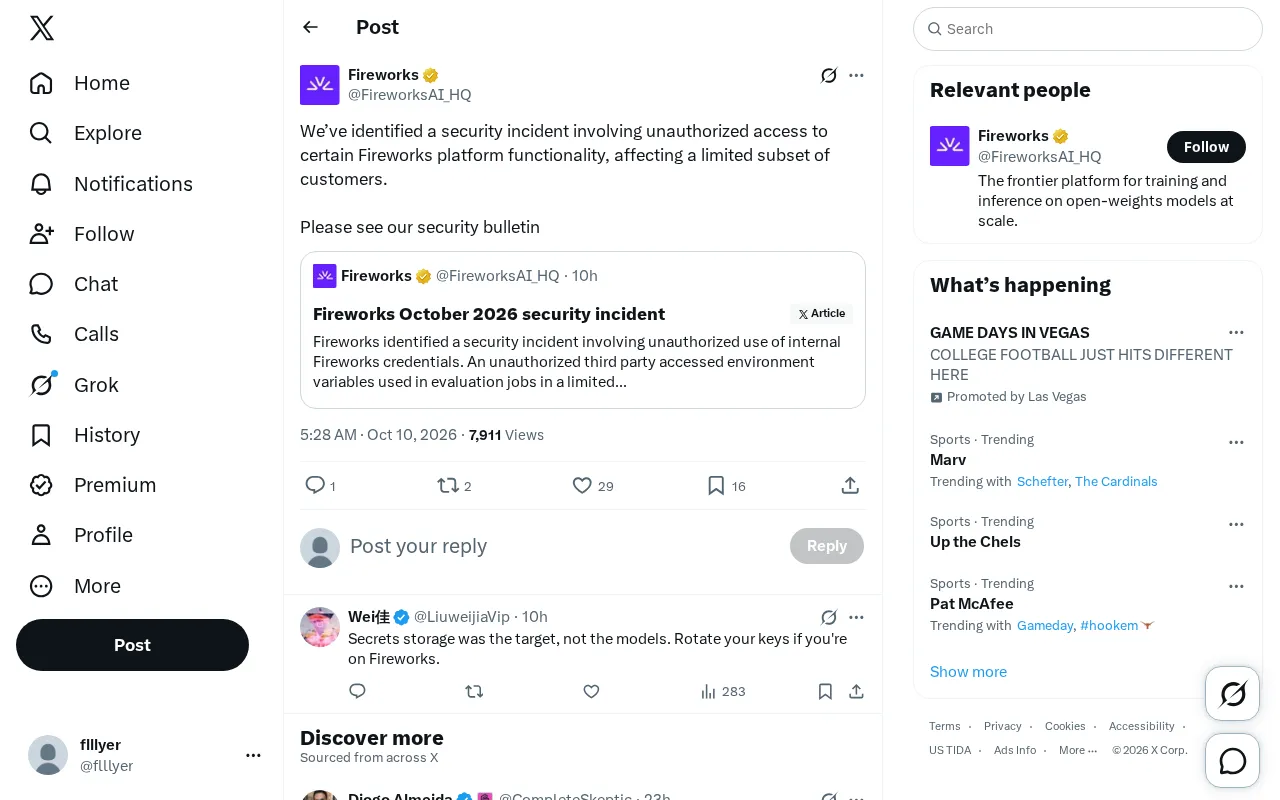
A brief announcement on Twitter pointed users to a formal security bulletin for more details. As of now, publicly available information remains limited — the specific attack vector, the scope of affected data, and the number of impacted customers have not been explicitly disclosed in the statement.
Potential Impact
Fireworks is an AI model inference and deployment platform serving developers and enterprises, offering large language model hosting, API access, and related services. Platforms of this type typically handle customers' API keys, call logs, and portions of business data. Any incident involving "unauthorized access to platform features" therefore warrants serious attention from enterprise users.
Based on the official wording, the incident is characterized as access to "certain platform functionality" — not a large-scale data breach. This suggests attackers may have reached specific interfaces or permissions, with impact contained to a limited scope. That said, until the full official bulletin is published with complete details, affected customers should treat this with the highest level of caution.
Recommended Actions for Developers and Enterprises
While awaiting further clarification from Fireworks, teams using the platform should consider the following standard emergency measures:
- Rotate API keys and access credentials: This is the first line of defense after a platform-level security incident and reduces the risk of credential misuse.
- Review recent call logs: Check for anomalous API calls, unfamiliar source IPs, or unusual traffic spikes.
- Monitor the official security bulletin: Rely on Fireworks' formal security bulletin for authoritative information on affected scope and remediation guidance.
- Assess downstream dependencies: If any services in your stack depend on Fireworks, evaluate the potential cascading risks.
AI inference platforms play a "middleware" role in modern AI application architectures: developers and enterprises connect their business logic to the platform via APIs, while the platform handles model hosting, elastic scaling, and inference acceleration. This architecture brings convenience but also creates a highly concentrated aggregation point for credentials and data. Typical risk exposures include: customer API keys (which, if leaked, can be used to impersonate calls, incur charges, or exfiltrate business data), call history (which may contain sensitive business inputs or prompt templates), billing and usage data, and in some cases fine-tuning datasets uploaded to the platform. Unlike traditional SaaS platforms, AI inference platforms' call data often directly reflects customers' core business logic — meaning even phrasing like "accessed certain platform features" carries potentially significant real-world implications, regardless of how limited it sounds.
Security Concerns for AI Infrastructure
As large model inference platforms become a critical layer in the AI application stack, the security of this infrastructure is drawing increasing scrutiny. These platforms centrally host vast amounts of customers' sensitive credentials and model call data. Any unauthorized access can have ripple effects far beyond a single customer, potentially impacting the entire ecosystem that depends on the platform.
The Fireworks incident is another reminder to the AI industry: beyond the race for model capabilities, the security posture of underlying platforms is equally central to evaluating service reliability. When choosing AI inference vendors, enterprises should factor in security response mechanisms and incident disclosure transparency alongside performance and cost.
Security risks in AI inference platforms also raise an industry-specific concern: an expanded supply chain attack surface. When enterprises outsource model inference to third-party platforms, their security perimeter effectively extends to that platform's entire technology stack — including its cloud infrastructure, identity and authentication systems, and internal access controls. In recent years, there have been multiple attacks targeting developer toolchains and API platforms. Attackers often bypass end-user enterprises entirely, choosing instead to target the trusted intermediary services relied upon by many organizations — achieving "attack once, breach many." This requires enterprises evaluating AI vendors to look beyond self-reported claims and assess SOC 2 compliance status, vulnerability response SLAs, and whether the vendor undergoes regular third-party security audits.
Closing Thoughts
Publicly available information about this incident remains limited. Fireworks has acknowledged the event through official channels and issued a security advisory. Affected customers are advised to consult the official bulletin immediately and follow standard incident response procedures — including credential rotation and log review. We will continue to monitor further developments and any detailed disclosures from the company.
Note: This article is based on Fireworks' official Twitter statement. For the definitive scope of impact, refer to the official formal security bulletin.
Related articles

Tencent WorkBuddy Hands-On: How AI Agents Crush Traditional Chat Assistants
WorkBuddy vs Doubao tested: how AI Agents directly operate computers to convert PPT to PDF, archive files and more. Analysis of WorkBuddy's low barrier, domestic ecosystem, pricing and plugin marketplace, plus AI Agent selection advice.

Azure Cross-Tenant Attack Chain: Root Cause Analysis of Five Paths
Binary Security analyzes five full cross-tenant compromise paths in Azure, trending 271 points on HN. This article interprets their shared root cause perspective and offers defense recommendations for cloud tenant isolation and reflections on responsibility boundaries.

Recreating a Real Bubble Tea Station in Isaac Sim: Script-Driven Unitree G1 Brews Tea
Developers recreated a real self-service tea station in NVIDIA Isaac Sim, using scripts to drive a Unitree G1 through a five-step tea-brewing process, exploring whether physics simulation can be a source of synthetic robot demonstration data and discussing contact stability and imitation learning.