Tencent WorkBuddy Hands-On: How AI Agents Crush Traditional Chat Assistants

WorkBuddy is an AI Agent that directly operates computers, turning AI from advisor to employee with low barriers and domestic ecosystem strengths.
The article compares Doubao and WorkBuddy on a PPT-to-PDF task, showing traditional LLMs only offer suggestions while WorkBuddy as an AI Agent directly operates the computer to complete tasks. WorkBuddy's four advantages: one-click deployment, domestic ecosystem integration with WeCom, 2,700 free credits plus 100 daily, and a Chinese skill marketplace with expert summoning. WorkBuddy suits beginners; Codex suits developers seeking customization.
In today's office landscape swept by the AI wave, what role do the AI assistants we commonly use, like Doubao, actually play—advisor or employee? When you need AI to directly operate a computer to complete tasks, the limitations of traditional chatbots are fully exposed. Tencent's WorkBuddy, however, is trying to redefine the relationship between AI and work—it no longer just answers questions, but directly takes action.
Traditional AI Assistants vs. WorkBuddy: Where's the Fundamental Difference?
According to a demonstration by a Bilibili creator, imagine a realistic work scenario: there's a work folder on the desktop, and all PPT files in it need to be converted to PDF and archived. After entering the prompt into Doubao, it cannot directly access the file system remotely and can only provide operational suggestions—the actual execution still requires the user to do it manually.

Using the same prompt, WorkBuddyAd directly begins executing the task, ultimately generating an archive folder within the work folder and successfully completing the PPT-to-PDF conversion and archiving. The entire process takes only as long as it takes the user to grab a cup of coffee.
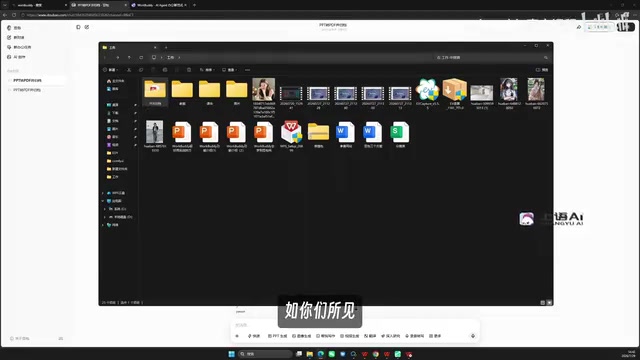
This comparison reveals the core difference: large language models like Doubao are "you ask, I answer" advisors that can only offer suggestions; WorkBuddy is a "digital employee" that can directly operate a computer and solve real problems. This category of software is collectively called AI Agents. AI users in this new era are shifting from managing themselves to managing AI—issuing commands and letting AI do the work.
An AI Agent is an intelligent system capable of perceiving its environment, making autonomous decisions, and taking actions to achieve goals. Unlike traditional large language models that only generate text, AI Agents have tool-calling capabilities—they can access file systems, operate software, execute code, and more, thereby completing end-to-end tasks. Their core architecture typically includes three modules: planning, memory, and tool use. Planning handles task decomposition and step orchestration, memory stores context and historical operations, and tool use enables the Agent to interact with the external environment. WorkBuddy is a typical AI Agent—it combines the reasoning capabilities of large models with local computer operation permissions, achieving the leap from "suggestion" to "execution."
WorkBuddy's Core Advantages: Why Start Learning with It?
There's more than one similar agent on the market—Codex, for example, is also in the same category. But the creator listed four reasons for choosing WorkBuddy:
1. Extremely Low Barrier to Entry
WorkBuddy works right out of the box: open a browser, search for WorkBuddy, click download, and it deploys to your computer with one click. Using Codex, on the other hand, requires "magic" (workarounds), manual environment configuration, and presents a high barrier to entry.
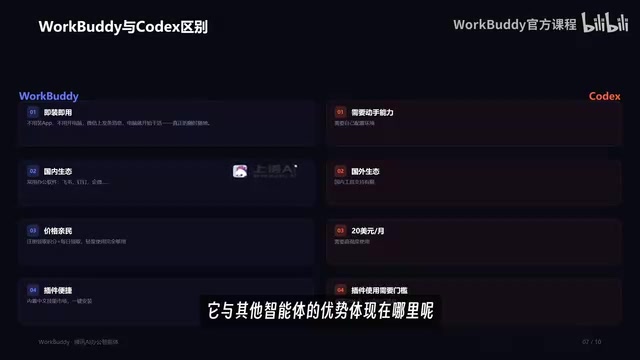
2. Comprehensive Domestic Ecosystem Integration
WorkBuddy has powerful connector functionality, allowing it to be authorized to use commonly used office software. For example, after connecting to WeCom (Enterprise WeChat), it can directly help reply to messages or summarize last week's client conversations into a weekly report. This high compatibility with domestic tools is something foreign ecosystem products like Codex find hard to match.
A Connector is a key component that extends an AI Agent's capabilities, allowing the Agent to access external services and data sources in a standardized way. In WorkBuddy, connectors are like pre-built adapters—after user authorization, the Agent can call the corresponding software's API, such as reading WeCom messages, accessing cloud documents, or querying calendars. This design encapsulates complex API integration into visual toggles, letting users integrate AI into existing workflows without writing code. The richness of connectors directly determines the practical boundaries of an Agent, and deep adaptation to the domestic office ecosystem is an important advantage that distinguishes WorkBuddy from foreign products.
3. User-Friendly Pricing Strategy
Register and get 2,700 credits for free, plus 100 credits available daily. This is completely sufficient for light usage scenarios. By contrast, Codex has a barrier of $20/month and requires intensive use to get your money's worth.
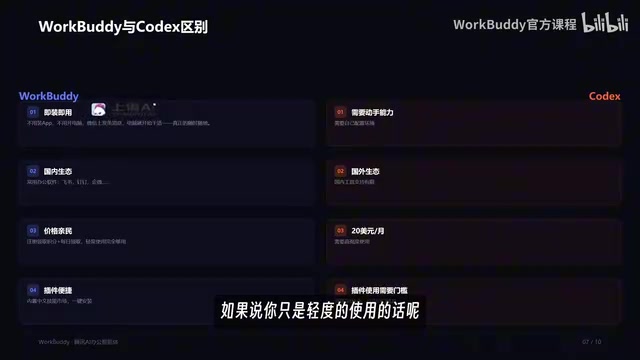
4. Convenient Plugin and Skill Marketplace
WorkBuddy offers a Chinese-language skill marketplace, with plugins deployable to your computer with one click. Its "Expert" feature can summon specific roles with a single click—for example, when you need a Xiaohongshu operations expert, just click and it's there, no recruiting required. Skills are one-click installations of various tools, greatly reducing usage complexity.
In the AI Agent context, a Skill refers to a reusable module that encapsulates specific task logic, typically existing as a plugin. A skill may contain a set of tool-call sequences, prompt templates, and configuration parameters, enabling the Agent to quickly acquire new capabilities such as "PPT to PDF" or "generate weekly report." The skill marketplace provides a platform for discovering and installing these modules—users take what they need, avoiding development from scratch. WorkBuddy's Chinese skill marketplace lowers the barrier to entry, letting non-technical users expand their AI employee's capabilities just like installing a mobile app.
AI Agent Applicability Boundaries and Selection Advice
WorkBuddy represents the evolution of AI applications from "Q&A style" to "management style." It lets users hire a digital employee at low cost, directly empowering work through a simple onboarding threshold and high compatibility with domestic office software.
Note, however, that Codex, as an open-source agent backed by the GitHub ecosystem, offers high freedom but requires programming skills. For users with zero foundation, WorkBuddy is clearly a friendlier starting point; for users with development capabilities who pursue customization, Codex still has its value.
As the AI Agent category grows increasingly rich, choosing the right tool will become key to office efficiency. WorkBuddy's positioning is clear: lower the barrier, integrate into the domestic office ecosystem, and turn AI from advisor into executor. This may well be an important step in popularizing AI in the workplace.
One-line Summary
WorkBuddy is an AI Agent that can directly operate a computer, turning AI from advisor into employee through low barriers and domestic ecosystem advantages.
Paragraph Summary
The article compares Doubao and WorkBuddy on a PPT-to-PDF task, revealing that traditional large language models can only offer suggestions, while WorkBuddy as an AI Agent can directly operate a computer to complete tasks. WorkBuddy has four major advantages: one-click deployment with an extremely low barrier to entry, comprehensive ecosystem integration with domestic office software like WeCom, user-friendly pricing with 2,700 free credits on registration plus 100 daily, and a Chinese skill marketplace with one-click expert summoning. The article concludes that WorkBuddy suits zero-foundation users looking to quickly deploy a digital employee, while open-source agents like Codex suit users with development capabilities who pursue customization—choosing the right AI Agent will be key to boosting office efficiency.
Related articles

Anthropic Files S-1: The Truth Behind $16.3B Revenue and $80.7B Loss
Anthropic's S-1 reveals $16.3B revenue and $80.7B net loss in H1 2026, with $72.4B from accounting effects. The filing also discloses $265.6B compute commitments, cloud deal details, and a 50.1% founder voting control structure, while IPO pricing remains blank.

Anthropic Financials Leaked: Revenue Far Exceeds Compute Costs, Claude Inference Gross Margin Hits 68%
Leaked Anthropic financials show revenue roughly twice total compute costs, Claude inference gross margin at 68%, while frontier training burns $2.8B per quarter. This article breaks down the two accounts and analyzes shifts in AI company valuation logic.

JetBrains Open-Sources ThinkRail: A Visual AI Coding Workbench
JetBrains' open-source ThinkRail embeds an AI coding assistant into a visual dev environment with isolated workspaces, side-by-side chat and code diffs, and requirements docs alongside code.