FlowAlign: A Flow Matching-Driven Approach for Target-Space Alignment

FlowAlign turns conditional flow matching from an inference tool into a training signal to jointly optimize instance correspondence and global structure for multimodal alignment.
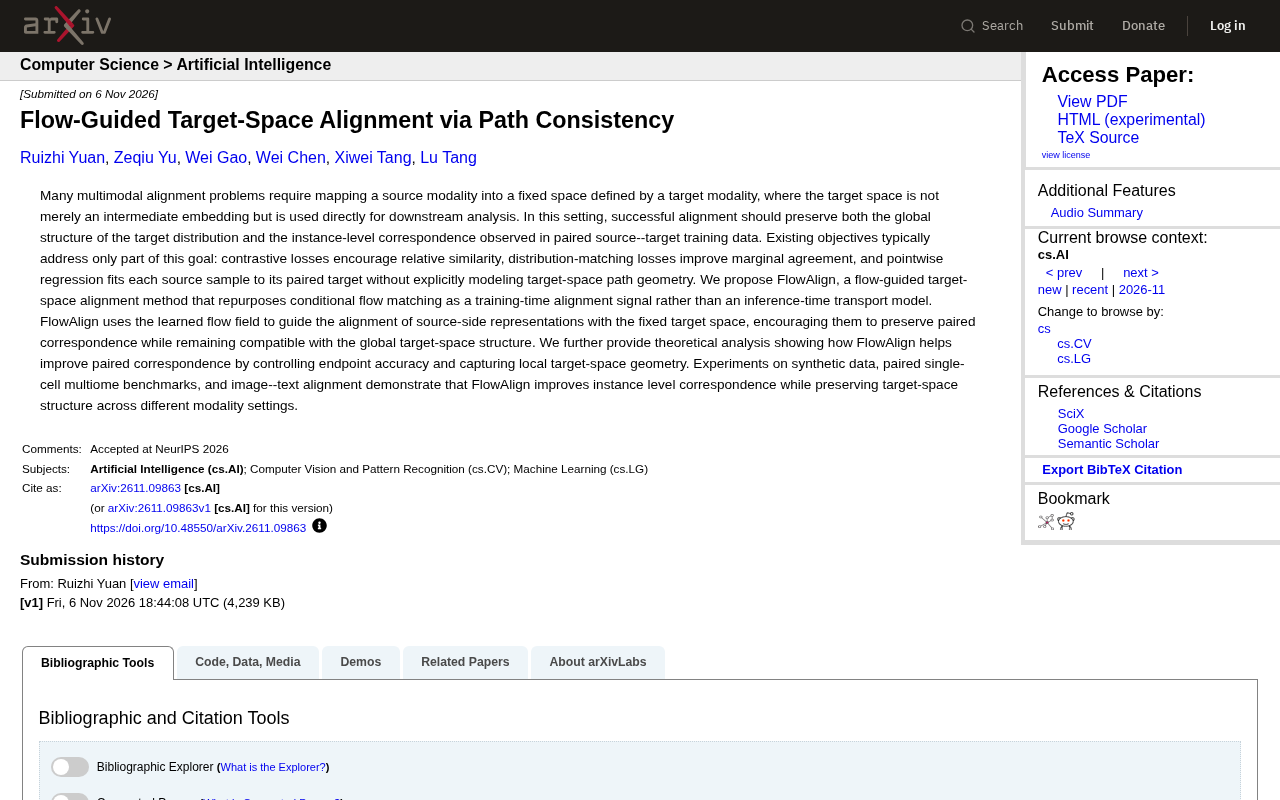
FlowAlign proposes a new framework for multimodal target-space alignment. Existing contrastive learning, distribution matching, and pointwise regression methods each solve only part of the problem: contrastive losses focus on relative similarity but may破坏 global structure, distribution matching improves marginal distributions but ignores fine-grained instance-level correspondence, and pointwise regression fits paired targets but cannot model the path geometry of the target space. FlowAlign's core innovation is to turn conditional flow matching from an inference-time transport model into a training-time alignment signal, using the learned flow field to constrain both endpoint accuracy and local geometry, thereby preserving paired correspondences while remaining compatible with the global structure of the target space. Theoretical analysis shows that the method improves paired correspondence by controlling endpoint accuracy and capturing local target geometry; experiments on synthetic data, paired single-cell multi-omics, and image-text alignment tasks validate its effectiveness.
Multimodal alignment is a core problem in multimodal learning, where the goal is to map a source modality into a fixed space defined by a target modality. This space is typically not an intermediate embedding but is used directly for downstream analysis. For example, in single-cell multi-omics, data from different omics modalities must be mapped into a unified cell embedding space to enable joint clustering and annotation. Traditional methods such as contrastive learning, distribution matching, and pointwise regression often address only part of the problem: contrastive losses focus on relative similarity, distribution matching losses improve the consistency of marginal distributions, and pointwise regression fits source samples to paired targets but ignores the path geometry of the target space.
Limitations of Existing Alignment Methods
In the target-space alignment problem, a successful alignment must satisfy two conditions simultaneously: preserving the global structure of the target distribution, and preserving the instance-level correspondences observed in paired training data. Contrastive losses learn representations by pulling positive pairs closer and pushing negative pairs apart, but may破坏 global structure; distribution matching losses (such as MMD and adversarial losses) force the source distribution to match the target distribution, but may ignore fine-grained correspondences between instances; pointwise regression directly minimizes the distance from source samples to paired targets, but cannot explicitly model the path geometry of the target space, so the alignment result may deviate from the target manifold.
Each of these methods addresses a different aspect and lacks a unified framework to simultaneously optimize global structure and instance correspondence. FlowAlign was proposed precisely to fill this gap.
Maximum Mean Discrepancy (MMD) is a nonparametric two-sample test statistic based on kernel functions, used to measure the distance between the mean embeddings of two distributions in a reproducing kernel Hilbert space (RKHS). In representation learning, MMD is often used as a distribution matching loss: minimizing the distance between the mean embeddings of source and target representations in the RKHS, thereby bringing their marginal distributions closer. Its advantages are a closed-form estimate, stable training, and no dependence on an adversarial discriminator; however, it is sensitive to kernel bandwidth and only constrains the overall moment information of the distributions, so it cannot guarantee instance-level correspondences between samples. Adversarial losses implicitly match distributions by using a discriminator to distinguish source/target representations and a generator to fool the discriminator; they are more flexible but suffer from unstable training and mode collapse. The common limitation of these methods and pointwise regression is that they constrain distribution-level statistics or pairwise distances rather than the path geometry in the target space, and thus may map source samples outside the target manifold or破坏 local neighborhood structure.
FlowAlign: Flow Matching as a Training Signal
The core innovation of FlowAlign is to repurpose conditional flow matching. Traditionally, flow matching is used as an inference-time transport model, i.e., to learn a continuous transformation from the source distribution to the target distribution. FlowAlign instead uses it as a training-time alignment signal: the learned flow field guides the alignment of source-side representations with a fixed target space, encouraging source representations to be compatible with the global structure of the target space while preserving paired correspondences.
Specifically, FlowAlign introduces a conditional flow matching objective during training, which learns a flow field from source representations to target representations. This flow field not only provides path information from source to target but also regularizes the alignment process through path consistency constraints. In this way, FlowAlign can simultaneously optimize instance-level correspondence and global structure preservation.
Theoretical Analysis
The authors provide a theoretical analysis showing that FlowAlign improves paired correspondence by controlling endpoint accuracy and capturing local target-space geometry. Endpoint accuracy ensures that source representations transformed by the flow field accurately reach the paired targets, while local geometry preserves the local structure of the target space through the continuity of the flow field. This analysis provides theoretical support for the effectiveness of FlowAlign.
Conditional Flow Matching (CFM) is a training objective within the Flow Matching framework. Its core idea is to construct a continuous probability path (usually a straight-line interpolation path) from samples of the source distribution to samples of the target distribution, and to learn a time-dependent vector field that fits the instantaneous velocity along that path. Unlike diffusion models, which rely on stochastic differential equations and noise schedules, CFM directly regresses the conditional velocity field; the training objective is simple and does not require simulating the sampling process, making training stable and efficient. At inference time, the learned velocity field can transport source samples to target samples via numerical integration (e.g., Euler or Runge-Kutta methods). The innovation of FlowAlign is that it does not treat CFM merely as a generation/transport tool but instead views its velocity field as a geometric regularizer: the continuity of the flow field in the target space naturally encodes local path geometry, thereby constraining both endpoint accuracy and structure preservation when training representations.
Experimental Validation
The paper conducts experiments on synthetic data, paired single-cell multi-omics benchmarks, and image-text alignment tasks. The results show that FlowAlign improves instance-level correspondence under different modality settings while preserving the target-space structure. In single-cell multi-omics data, FlowAlign better aligns cell representations across omics modalities, aiding downstream cell-type annotation and trajectory inference. In image-text alignment, FlowAlign improves cross-modal retrieval performance.
These experimental results validate the effectiveness of FlowAlign as a general alignment framework. Compared with existing methods, FlowAlign achieves a better balance between instance-level correspondence and global structure preservation.
Single-cell multi-omics refers to technologies that simultaneously measure multiple molecular modalities in the same cell, such as paired measurements of scRNA-seq (transcriptome) and scATAC-seq (chromatin accessibility), or CITE-seq, which captures both the transcriptome and surface proteins. The core analytical challenge is that different omics data lie in heterogeneous feature spaces with large differences in dimensionality and noise characteristics, requiring a shared cell embedding space to support joint clustering, cell-type annotation, and trajectory inference. Common benchmarks include paired datasets such as PBMC and bone marrow, and evaluation metrics include clustering consistency (e.g., ARI, NMI), label transfer accuracy, and local neighborhood preservation in the embedding space. Image-text alignment is represented by CLIP-style contrastive learning, with evaluation metrics including cross-modal retrieval Recall@K and zero-shot classification accuracy. The gains of FlowAlign on these two types of tasks indicate that path-geometry regularization has general value for shared-space learning across heterogeneous modalities.
Conclusion and Outlook
By turning flow matching from an inference-time tool into a training-time signal, FlowAlign offers a new approach to multimodal target-space alignment. Its theoretical analysis and experimental validation both demonstrate the potential of the method. In the future, FlowAlign is expected to extend to more modalities and more complex downstream tasks, such as multimodal generation and cross-modal reasoning. As multimodal data become increasingly abundant, how to align information across modalities efficiently and accurately will remain a持续 research hotspot, and FlowAlign provides a valuable exploration in this direction.
Related articles

Andrew Ng Teaches Python: The Programming Course Everyone Should Take in the AI Era
Andrew Ng's complete 35-lesson Python course, from zero base to hands-on AI automation. It emphasizes a new way of programming by collaborating with chatbots, ideal for knowledge workers and AI beginners who want to use code to boost efficiency.

From Frontend to AI: A Rapid Hands-On Introduction to Python and FastAPI
A hands-on Python-to-AI guide for frontend developers: use UV for isolated environments, learn Python syntax and type hints by comparing with JS, then get APIs and API Router working with FastAPI to build a complete path from functions to HTTP requests.

PyTorch Tensors from Beginner to Practice: A Complete Guide to Core Concepts and Operations
A systematic breakdown of PyTorch tensor core concepts: scalars, vectors, matrices, and higher-dimensional tensors; device management and CPU/GPU switching; broadcasting, reshape, matrix multiplication rules, and transpose/permute axis swapping, with hands-on code explanations.