Free Deep Learning Textbook + 68 Python Notebooks: From Fundamentals to Transformers and Diffusion Models

A free deep learning textbook with 68 Python notebooks covering everything from fundamentals to Transformers and diffusion models.
This free resource that gained attention on Reddit consists of a deep learning textbook and 68 accompanying Python notebooks, with content extending from neural network fundamentals all the way to Transformers and diffusion models. Its value lies in using the "textbook + notebooks" combination to fill the gap between theoretical understanding and getting code to run, allowing self-learners to read and practice side by side and form a closed loop. The article analyzes its progressive path design—from basic mechanisms to sequence modeling and attention, and then to diffusion models—and points out that this arrangement, which avoids abrupt jumps, is key to judging textbook quality. The target audience includes self-learners with Python foundations and developers who want to strengthen their understanding of principles, and it is recommended to practice hands-on with the notebooks. At the same time, readers are reminded to verify mathematical rigor and runnability themselves, and the diffusion model part also requires consideration of compute.
Deep learning learning resources are not scarce, but resources that truly pair a "systematic textbook" with "runnable code" are few. A free resource set that recently gained attention on Reddit attempts to cover a complete path from neural network fundamentals to Transformers and diffusion models with one textbook plus 68 Python notebooks.
What exactly does this resource set include
According to the original post, the resource consists of two parts: a free deep learning textbook and 68 accompanying Python notebooks. The content ranges from the basic concepts of neural networks all the way to the current mainstream Transformer architecture and diffusion models.
This "textbook + notebooks" combination is not new, but the number of 68 notebooks means the coverage is quite granular. For self-learners, the biggest pain point is often not the lack of theoretical explanations, but not knowing how to write the code after reading the formulas, or whether it will run correctly. The accompanying notebooks precisely fill the gap between "understanding" and "getting it to run."
Judging from the reaction of the Reddit community, the core reason this type of resource attracts attention is that it lowers the barrier to hands-on practice: readers can read the theory while modifying parameters and observing outputs in the notebooks, forming a closed loop.
Why the "from fundamentals to frontier" path design is worth noting
A common problem with many deep learning courses is that they jump too abruptly—right after explaining backpropagation, they move straight to attention mechanisms, omitting the intermediate engineering details and intuition-building. This resource explicitly claims to cover "from neural network fundamentals to Transformers and diffusion models," suggesting it adopts a progressive path.
Foundation layer: the core mechanisms of neural networks
The starting point of the path is neural network fundamentals, usually including perceptrons, multilayer networks, activation functions, loss functions, and backpropagation. This part is the foundation for all subsequent content, and the accompanying notebooks allow readers to personally implement a minimally usable network rather than just calling existing APIs.
Intermediate layer: sequence modeling and attention
Transformer is the technical foundation of current large models. If the resource indeed goes from fundamentals all the way to Transformer, then the middle likely involves the evolution logic of sequence modeling—the motivation from RNN to attention mechanisms. Understanding "why attention is needed" is more important than memorizing formulas, and this is also a key dividing line for judging the quality of a textbook.
RNN (Recurrent Neural Network) is a classic architecture for processing sequence data, passing information between time steps through hidden states. But it has two fundamental limitations: first, it is difficult to parallelize computation because each time step depends on the output of the previous step; second, the long-range dependency problem—as sequences grow longer, early information tends to suffer from vanishing gradients during backpropagation. LSTM and GRU alleviate the latter through gating mechanisms, but do not solve the parallelization challenge. The core idea of attention mechanisms is to let the model directly establish associations between any two positions in a sequence, no longer relying on step-by-step transmission, thereby achieving both parallel computation and effective capture of long-distance dependencies. Transformer is precisely an architecture built entirely on self-attention, which is also the key to understanding why it has become the foundation of large models.
Frontier layer: diffusion models
Diffusion models are an important branch of generative AI, and their principles involve forward noising and reverse denoising processes. Including diffusion models in the coverage of a free textbook shows that the content of this resource keeps up with the technological frontier rather than staying on classic content from several years ago.
The core idea of diffusion models draws on the diffusion process in thermodynamics: the forward stage gradually adds Gaussian noise to real images until they become pure noise; the reverse stage trains a neural network to learn to recover the original image step by step from noise. Compared with GANs (Generative Adversarial Networks), diffusion models are more stable to train because their objective is a simple denoising regression task rather than an adversarial game. The cost is slower inference speed, requiring multiple iterative denoising steps. Models such as Stable Diffusion have greatly improved practicality through latent space diffusion and conditional guidance techniques, making them the mainstream solution for current text-to-image applications.
Who it is suitable for, and how to use it
This type of resource is best suited for two groups: self-learners with some Python foundation who want a systematic introduction to deep learning; and developers who already know how to use frameworks and call libraries but want to fill in their understanding of underlying principles.
As for usage suggestions, rather than reading from beginning to end in order, it is better to adopt a "theory + notebook cross-reference" approach: after reading each section of the textbook, immediately open the corresponding notebook and run it once, then try modifying hyperparameters and observe how the results change. The 68 notebooks themselves form a practice curve; skipping the exercises and only reading the theory will greatly reduce the benefits.
It should be noted that there is no necessary equality between "free" and "high quality." Recommendations on Reddit can only serve as clues; the mathematical rigor of the textbook and the runnability of the notebooks (dependency versions, data acquisition methods) all need to be verified by readers themselves. The diffusion model part in particular has certain compute requirements, and when it cannot run locally, cloud environments need to be considered.
The long-term value of free resources
High-quality free textbooks in the deep learning field are forming a virtuous ecosystem: authors release content in an open-source way, the community helps improve it through feedback, and learners acquire systematic knowledge at zero cost. The value of this "textbook + 68 notebooks" combination lies not in being better than paid courses, but in providing a complete, hands-on-verifiable learning loop.
For those looking for a path into deep learning, it is worth adding to the shortlist—but remember to open the first notebook rather than just bookmarking the link.
Background supplement
A Python notebook (Jupyter Notebook) is an interactive document format that integrates code, textual explanations, formulas, and visualization outputs into the same file, supporting block-by-block code execution with immediate viewing of results. In deep learning study, this format is especially suitable for experimenting while reading theory: readers can modify a parameter and immediately rerun that code block to observe changes in output without having to execute the entire script from scratch. However, the reproducibility of notebooks depends on environment configuration, including the Python version, deep learning framework version, and dependency libraries. Readers may need to adjust installations based on error messages when running for the first time.
Related articles

Last Week Tonight Exposé: The Dangerous Ties Between Politicians and White Supremacy
Last Week Tonight investigates Georgia Senate candidate Mike Collins and Florida candidate Marshall Rawson, exposing their multiple ties to white supremacists and the Republican Party's silent response.
AI Buzz Weekly: GPT-6.5 Leak, New Claude Model, and MiniMax's Cost-Effectiveness
This week's AI buzz roundup: suspected GPT-6.5 leak, Microsoft configs showing GPT-6.1 Tera, Anthropic's new model that can identify entire classes of bugs, disappointing early Gemini 4 Carbon results, and MiniMax M3.1 Flash beating Claude Opus 5 and GPT-5.6 Sol in benchmarks at extremely low cost.
AI Briefing: Gemini 4 Carbon Released, Ant Open-Sources Ling-3.1
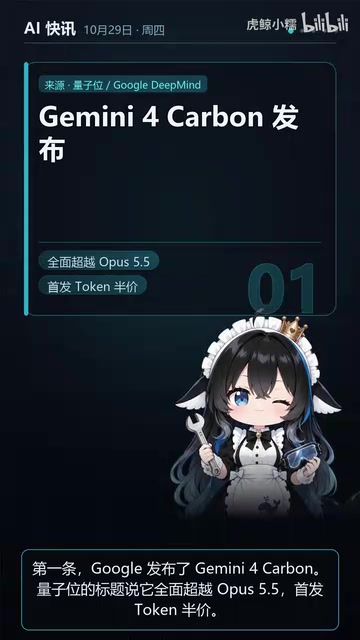
AI Briefing: Google releases Gemini 4 Carbon qubit model, claiming to surpass Opus 5.5 with half-price tokens; Ant open-sources Ling-3.1-1019 for real-task Personal Agents; domestic AI drug discovery succeeds in 18 of 19 projects, hitting all 6 GPCR targets; zero-revenue company valued at $20B raises another $1B; Sichuan convenience store robot sales fail.