Free Lunch: How Particle Decoding Quantifies LLM Inference Uncertainty at Zero Cost

Zero-cost extraction of sequence-level Rényi entropy from SMC decoding normalization constants enables selective prediction and adaptive computation.
This paper proposes a "free lunch" uncertainty quantification method that reads sequence-level Rényi entropy (SRE) directly from normalization constants already computed during sequential Monte Carlo (SMC) decoding, requiring no extra computation. A Rényi chain rule decomposes sequence-level entropy into a stepwise entropy family; 1/2-order SRE is the best zero-cost selective prediction signal in 10 of 13 settings, with AUROC 0.022–0.044 above log-probability on MATH500. An 8-particle probe and two-pass strategy cut particle usage by 34.2% on MATH500 while matching 64-particle accuracy.
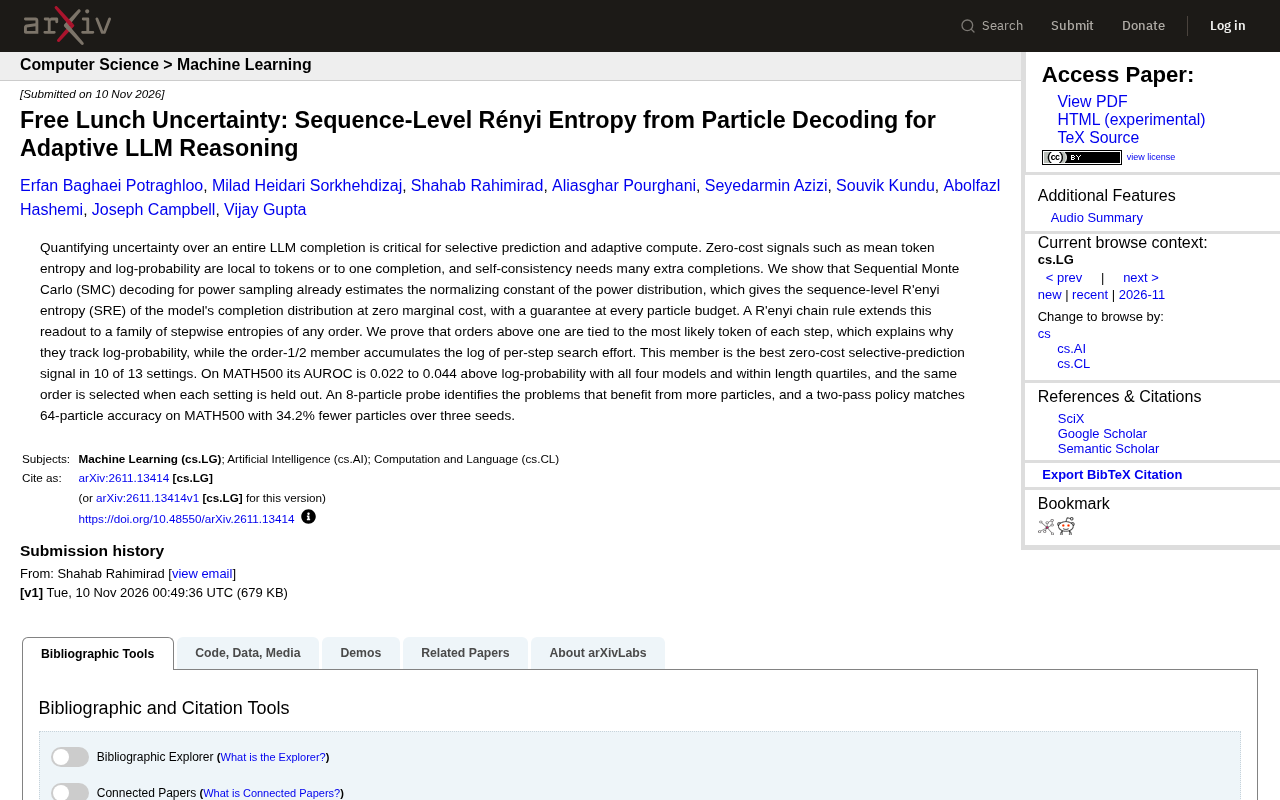
Large language models (LLMs) often "don't know what they don't know" during inference, which poses a fundamental challenge for selective prediction and adaptive computation. Existing methods either rely on local signals (such as average token entropy or log-probability) or require multiple additional samples (such as self-consistency)—the former offers a narrow view, while the latter is costly. A paper from arXiv titled Free Lunch Uncertainty: Sequence-Level Rényi Entropy from Particle Decoding for Adaptive LLM Reasoning proposes a "free lunch"-style solution: using the normalization constants already available in the sequential Monte Carlo (SMC) decoding process to directly read out sequence-level Rényi entropy (SRE) at zero marginal cost.
Where Zero-Cost Uncertainty Comes From: A Byproduct of SMC Decoding
SMC decoding (particularly the variant used for power sampling) inherently estimates the normalization constant of the power distribution. This constant happens to encode the sequence-level Rényi entropy of the model's completion distribution. In other words, as long as you are using SMC for decoding, the sequence-level uncertainty has already been computed—it's just that no one had read it out before. The authors prove that this readout is exact at any particle budget, with no approximation error. This stands in sharp contrast to other methods that require additional forward passes—those methods treat "uncertainty" as an extra cost, whereas SRE is a free byproduct of the decoding process.
Sequential Monte Carlo (SMC) is a class of sampling methods that approximate complex probability distributions by maintaining a set of weighted particles. In LLM decoding, particles are partially generated sequences, each carrying a weight that is updated based on the model's probability of the generated tokens. The core advantage of SMC is that it simultaneously provides an estimate of the normalization constant of the target distribution (here, the power distribution). This normalization constant is mathematically equal to the integral (or sum) of the unnormalized probability function over all possible sequences, and its logarithm is directly related to Rényi entropy. Therefore, as long as SMC decoding is running, the normalization constant is a natural byproduct of particle weight updates, requiring no additional computation.
Power sampling is a technique that adjusts the original model distribution via a temperature parameter, commonly used to control generation diversity and quality. When SMC is used for power sampling, the target distribution is p(x)^β (where β is the inverse temperature), and its normalization constant is Z(β) = Σ_x p(x)^β. The order α of Rényi entropy is related to β via α = 1/(1-β) (or a similar transformation, depending on the definition). Therefore, Z(β) obtained from SMC can be directly converted into sequence-level Rényi entropy.
The Rényi Chain Rule: From a Single Entropy to a Family of Stepwise Entropies
A single entropy value is insufficient to characterize the generation process. Through a Rényi chain rule, the authors decompose the sequence-level entropy into stepwise entropies of arbitrary order. This is analogous to the entropy chain rule in information theory, but for the Rényi entropy family. The order α is a key parameter: the authors prove that when α>1, the stepwise entropies are tightly related to the most likely token at each step, which explains why these orders "track" log-probability—they essentially measure the model's confidence in each step's choice. The α=1/2 member, however, is different: it accumulates the log of the search effort at each step. This distinction makes different orders suitable for different scenarios.
Rényi entropy is a generalization of Shannon entropy, proposed by Alfréd Rényi in 1961, defined as H_α(X) = (1/(1-α)) log Σ_x p(x)^α, where α ≥ 0 and α ≠ 1. As α→1, Rényi entropy reduces to Shannon entropy; when α=0, it is the maximum entropy (log |X|); when α=∞, it is the minimum entropy (-log max p(x)). Different orders α capture different features of the distribution: low orders (α<1) are more sensitive to tail events, while high orders (α>1) are more sensitive to high-probability regions. In LLM decoding, stepwise Rényi entropy measures the model's uncertainty at each generation step, while sequence-level Rényi entropy reflects the joint uncertainty of the entire sequence.
The Rényi chain rule decomposes sequence-level Rényi entropy into a sum of conditional Rényi entropies at each step, but note that the chain rule for Rényi entropy differs from that for Shannon entropy and typically requires additional correction terms or a specific definition. The decomposition adopted in the paper allows the entropy contribution of each step to be derived from the sequence-level entropy, thereby obtaining a stepwise entropy family. The practicality of this decomposition lies in the fact that it enables fine-grained stepwise uncertainty to be extracted from a single sequence-level signal, providing richer decision-making information for adaptive computation.
Order 1/2: The Best Zero-Cost Selective Prediction Signal
Across 13 test settings, the 1/2-order SRE emerged as the best zero-cost selective prediction signal in 10 settings. On the MATH500 dataset, its AUROC is 0.022 to 0.044 higher than log-probability across all four models, and this holds even after grouping by length quartiles. More importantly, when each setting is held out in turn, the 1/2 order is still selected, indicating that this choice is not overfitting. This means that without any additional computation, the 1/2-order SRE can identify which responses are more likely to be correct better than traditional log-probability—a plug-and-play improvement for selective prediction (i.e., deciding when to trust model outputs).
Selective prediction refers to a model choosing to abstain when uncertain, making predictions only on high-confidence samples to strike a trade-off between coverage and accuracy. A commonly used metric for evaluating selective prediction performance is AUROC (Area Under the Receiver Operating Characteristic curve), which measures the ability of an uncertainty signal to distinguish correct from incorrect predictions: the higher the AUROC, the more effectively the signal identifies potentially incorrect answers. Log-probability is a traditional baseline uncertainty signal, i.e., the average token log-probability of the model's generated sequence.
The 1/2-order Rényi entropy (α=1/2) has special properties within the Rényi entropy family: it corresponds to the Hellinger distance-related entropy, is relatively sensitive to the tails of the distribution, and can capture the model's search effort during generation. In selective prediction, the AUROC of the 1/2-order SRE is 0.022–0.044 higher than log-probability. Although the absolute improvement is modest, it is practically meaningful under the constraint of zero additional computational cost. Moreover, it still holds after grouping by length quartiles, indicating that the signal is not confounded by sequence length.
Adaptive Particle Budget: 8-Particle Probe and Two-Pass Strategy
The value of an uncertainty signal ultimately manifests in adaptive computation. The authors design an 8-particle probe: first run with a small number of particles, and use the SRE signal to determine which problems require more particles. Then they adopt a two-pass strategy: the first pass uses the 8-particle probe to identify "hard" problems, and the second pass increases particles only for these hard problems. On MATH500, this two-pass strategy reduces particle usage by an average of 34.2% across three random seeds while matching the accuracy of 64-particle decoding. This means computational cost is significantly reduced while maintaining accuracy. For teams deploying LLM inference services, this is a directly usable optimization.
Adaptive computation refers to strategies that dynamically adjust the allocation of computational resources based on input difficulty. In LLM inference, this typically manifests as using fewer samples or shorter decoding steps for easy problems and investing more resources in hard problems. The particle budget is a key hyperparameter in SMC decoding: more particles yield a more accurate approximation of the target distribution, but computational cost also increases linearly.
The 8-particle probe is a lightweight pre-run strategy: first run SMC decoding with 8 particles and use the resulting sequence-level Rényi entropy signal to assess problem difficulty. The two-pass strategy builds on this: the first pass uses the 8-particle probe to identify "hard" problems (i.e., samples with high SRE), and the second pass increases the number of particles only for these hard problems (e.g., to 64 particles), while keeping a low budget for easy problems. This strategy reduces particle usage by an average of 34.2% on MATH500 while matching the accuracy of 64-particle decoding, demonstrating that adaptive allocation can significantly reduce computational overhead without sacrificing performance.
Multi-Source Perspectives and Limitations
According to the paper's authors and community discussion (such as summaries from the rss source), this work transforms uncertainty quantification from an "extra overhead" into a "decoding byproduct"—conceptually elegant and practical. However, current validation is mainly focused on mathematical reasoning tasks (MATH500) and four models; whether the 1/2-order SRE still leads in open-domain generation, long-form writing, and other scenarios remains to be tested. In addition, SMC decoding itself requires particle management; although the paper claims zero marginal cost, practical implementations still involve engineering overhead for resampling and weight computation among particles. Nevertheless, considering that it simultaneously provides an uncertainty signal and an adaptive computation strategy, the overall benefit remains substantial.
For researchers, the Rényi chain rule opens a new direction: extracting uncertainties with different semantics through different orders. For engineers, the 8-particle probe and two-pass strategy can be directly integrated into existing inference pipelines to achieve the same accuracy with fewer particles. The free lunch may not be entirely free, but it is certainly cheap enough to be worth trying.
One-line Summary
Zero-cost extraction of sequence-level Rényi entropy from SMC decoding normalization constants enables selective prediction and adaptive computation.
Paragraph Summary
This paper proposes a "free lunch"-style uncertainty quantification method: using the normalization constants already available in the sequential Monte Carlo (SMC) decoding process to directly read out sequence-level Rényi entropy (SRE) without any additional computation. Through a Rényi chain rule, the authors decompose the sequence-level entropy into a stepwise entropy family and find that the 1/2-order SRE becomes the best zero-cost selective prediction signal in 10 of 13 test settings, with AUROC 0.022–0.044 higher than log-probability on MATH500. Based on this, the authors design an 8-particle probe and a two-pass adaptive strategy that reduces particle usage by an average of 34.2% on MATH500 while matching the accuracy of 64-particle decoding. The method is conceptually elegant, transforming uncertainty quantification from extra overhead into a decoding byproduct, and provides a practical optimization tool for LLM inference services.
Related articles

Open Source Movement Petitions for Jensen Huang's Return to NVIDIA: A Battle Over AI Control
The open source community petitions to reinstate Jensen Huang as NVIDIA CEO, with signatures from Elon Musk and others. This analysis examines the anxiety over AI computing power control behind the petition and its implications for the industry.
Qwen4-Max Launches: Price Cut and Benchmark Analysis
Qwen4-Max is live on QwenCloud with input at $1.50 and output at $4.50 per million tokens—25% cheaper than Qwen3.8-Max. We break down vendor benchmark limits and testing plans.
Major macOS Permission Overhaul: Device Control and Full Disk Access Become More Transparent
macOS 27.3 beta 2 overhauls Device Control and Data Access and Full Disk Access permissions: splitting them into System & App Protection Override and Accessibility, unifying authorization entry points, adding per-request prompts and runtime indicators, and retaining an entitlement compatibility channel.