Freshman Year: Install Codex and Claude Code First? An AI Skills Starter Guide

Freshmen should install Codex and Claude Code early and plan their Agent development path with a three-layer tech stack.
The article targets college freshmen, recommending early installation of Codex and Claude Code—not just for coding but as general AI assistants for competitions, papers, projects, and research. It notes AI can boost all four college activities and that CS students especially need to self-learn AI tools. For non-elite undergrads, it breaks down the Agent development path in three dimensions: education (lower barrier than algorithm roles, with universities lagging so starting lines are similar); tech stack in three layers (Python/async/FastAPI/LLM basics and prompt engineering, full RAG pipeline and memory/planning, vector databases and local deployment/quantization); and projects, emphasizing real business scenarios and a complete retrieval-generation-traceability loop. Companies value implementation ability over training large models or grinding algorithm problems—solid projects are the breakthrough for non-elite students.
Just starting freshman year—what's worth installing on your computer beyond the essentials? A Bilibili creator suggests: install Codex and Claude Code first. This isn't just for writing code—with AI permeating campuses, they can become your general-purpose assistants for competitions, papers, projects, and research.
1. Why Codex and Claude Code?
The creator points out that four things are unavoidable in college: competing, writing papers, doing projects, and doing research. AI can help with all four.
- Competitions: Mathematical modeling contests are called "easy wins" by some; last year someone easily won a national award with AI. Electronics competitions are increasingly penetrated by agents like Codex; business plans and PPTs for innovation projects are well within AI's reach.
- Papers: AI plagiarism checks are stricter, but AI-assisted writing is already widespread.
- Projects: Courses require students to build products, and everyone sees the importance of AI coding.
- Research: Literature reviews and code implementation in research projects can be significantly sped up by AI.
Computer science students especially need to master AI skills early—schools teach data structures and operating systems, but no one teaches you how to use AI to get work done. You have to fill that gap yourself.
Codex was originally a series of code-generation models from OpenAI, later evolving into a coding agent that can autonomously execute tasks in the terminal or IDE; Claude Code is Anthropic's command-line AI programming assistant that can read and write files, run commands, and debug projects. Both are "agent-type" tools: they don't just complete code—they understand goals, break down steps, call tools, and iterate. That's why they extend to competitions, papers, projects, and research—essentially operating your computer to complete tasks rather than just answering questions.
2. How Can Non-Elite Undergrads Break into Agent Development?
The creator breaks down the path into three dimensions: education, tech stack, and projects.
Education: Lower barrier than algorithm roles
Agent development is so new that many universities don't offer courses. Even if you're an AI major, you're still learning machine learning basics.

So everyone starts roughly at the same line—non-elite students shouldn't limit themselves. The creator compiled a systematic learning path and tutorials for LLMs + Agents for those interested.
Tech Stack: Three layers, each more critical than the last
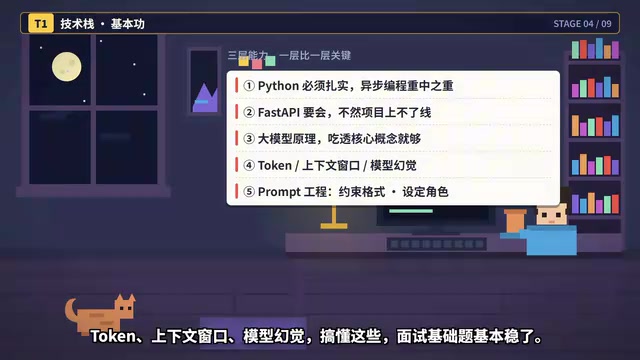
Layer 1: Fundamentals
- Python must be solid; asynchronous programming is crucial.
- Know interface frameworks like FastAPI, or your project can only run locally.
- You don't need to read papers on LLM principles—grasping core concepts like tokens, context windows, and hallucinations is enough for interviews.
- Practice prompt engineering: constraining formats and setting roles are project necessities.
Layer 2: Core job skills
Build the entire RAG (Retrieval-Augmented Generation) pipeline yourself: document parsing, text chunking, vectorization, retrieval, answer generation—end to end. Be familiar with calling models, tools, and APIs. Advanced: understand memory mechanisms and task planning; breaking down complex tasks is a plus.
Layer 3: Engineering implementation
Master at least one vector database. Know how to deploy local models and understand quantization. The creator emphasizes: most Agent jobs don't require training large models or grinding algorithm problems.

Companies care about one thing: can you apply LLM capabilities to real business scenarios?
3. Projects: The Breakthrough for Non-Elite Degrees
A non-elite degree won't catch the interviewer's eye, but solid projects will. Don't just run demos from tutorials—you'll stumble when asked for details.
High-quality projects must tie to real business scenarios—education, legal, e-commerce. Use real data to complete the full loop of retrieval, generation, citation, and traceability. One project you truly understand, with clear pain points and optimizations, beats three copy-pasted demos.
4. Conclusion
Education matters for Agent development, but solid skills and real projects weigh much more. For freshmen, installing tools like Codex and Claude Code early, making AI a daily work partner, and planning your learning path along the three-layer stack while accumulating real project experience may be a more critical start than just chasing GPA.
Background
RAG (Retrieval-Augmented Generation) retrieves relevant snippets from an external knowledge base before generation, then feeds them as context to the model. It solves outdated knowledge, hallucinations, and inability to access private data. Typical pipeline: document parsing (PDF/web to text), text chunking (semantic or length-based), vectorization (embedding models), storing in a vector database, retrieving top-K snippets for the user's question, inserting into the prompt, and generating answers with citations. Enterprise knowledge-base Q&A, customer service, and document assistants almost always rely on this.
"Memory mechanisms" in agents let models retain and reuse historical information across multi-turn tasks—common approaches include short-term dialogue buffers, long-term vector memory, and summary compression. "Task planning" means breaking complex goals into executable subtasks and ordering them—common paradigms include ReAct (interleaving reasoning and action), Plan-and-Execute (plan then execute), and tool-call orchestration. These two capabilities determine whether an agent can handle multi-step, cross-tool tasks—a key differentiator between "can call APIs" and "can build systems" in interviews.
Vector databases store and retrieve high-dimensional vectors—common ones include Milvus, Qdrant, Weaviate, pgvector—with core capability of approximate nearest neighbor (ANN) search using cosine similarity to quickly find relevant snippets. Local model deployment and quantization mean running open-source models locally or on private servers using Ollama, vLLM, llama.cpp, and compressing memory usage with INT8/INT4 quantization to speed up inference. Mastering these turns demos into deployable, cost-controlled real systems.
Related articles

Skykea Showdown: A Hilarious Variety Show Experience of a Minecraft Airship Building Competition
Skykea Showdown is a Minecraft airship building racing variety show. This article analyzes its two-phase build + hole race format, airship mod lift physics, secret mission design, and team confrontation dynamics—ideal for game content creators.

Did the US Midterms Vote No to AI Data Centers? A Map Reveals the Truth
After the US midterms, media claimed voters rejected AI data centers, but a map shows restrictive votes are concentrated in a few Ohio townships, affecting less than 1% of US towns—the national anti-AI wave is exaggerated.
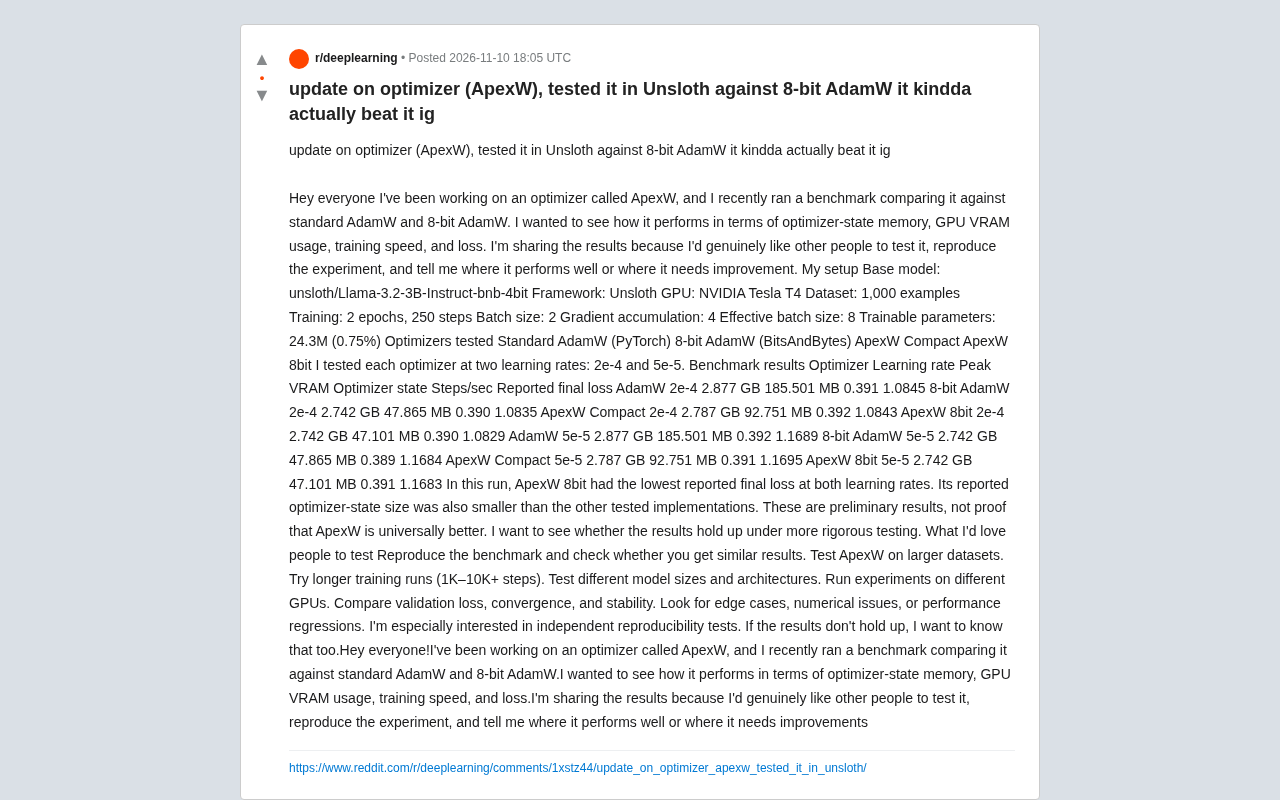
ApexW Optimizer Benchmark: Matches 8-bit AdamW in Unsloth with Lower Memory Usage
Developer shares benchmark of ApexW optimizer in Unsloth: ApexW 8bit has lower optimizer state memory (47.101 MB) and slightly better final loss than 8-bit AdamW, but similar speed. Needs independent reproduction.