From Berkeley Lab to a New San Francisco HQ: The Expansion Path of an AI Research Team

An AI company moves from a Berkeley lab to a 235,000 sq ft San Francisco global HQ, betting over $1 billion on the city.
The article reports that an AI company originating from a small Berkeley research lab has officially opened its new global headquarters, One Sansome, in San Francisco. The office spans over 235,000 square feet and houses teams advancing AI research and building products such as Genie, Lakebase, and Unity Gateway. Positioned as a common hub for research and productization, the new HQ is part of the company's over $1 billion commitment to San Francisco. The article analyzes that this counter-trend expansion reflects AI teams' need for high-density offline collaboration and marks a shift from exploration by a few researchers to an operating system requiring processes, products, and scaled delivery, with actual effects still to be observed through product deployment and team growth.
From Lab to Global Headquarters: A Leap in Space
An AI company that originated from a small research lab in Berkeley has officially opened its new global headquarters, One Sansome, in San Francisco. The office space spans over 235,000 square feet, marking a key turning point for the team from academic research to scaled product deployment. According to its official social media disclosure, the new headquarters will house teams advancing AI research and building products such as Genie, Lakebase, and Unity Gateway.
Behind the spatial expansion is an upgrade in organizational capacity. Moving from a research lab to a global headquarters means the team must simultaneously support frontier exploration and product delivery, and One Sansome is positioned as the common hub for both lines.
Berkeley Research Lab Ecosystem: Berkeley and its surroundings—UC Berkeley and Lawrence Berkeley National Laboratory—have long been major centers for AI and machine learning research, spawning numerous teams that transition from academic labs to industrialization. Such "lab-origin" companies typically start with a few researchers, open-source results, or papers, and seek productization after validating technical feasibility. Moving from Berkeley to San Francisco also aligns with the common Bay Area AI company path of "research around campus, scaling in San Francisco," as San Francisco offers easier access to capital, customers, and engineering talent.
Billion-Dollar Commitment: Betting on San Francisco
The company describes this move as part of a commitment of over $1 billion to San Francisco. Although official details on the specific allocation of these funds have not been disclosed, the term "commitment" suggests it covers more than office space—likely including long-term investments in talent recruitment, infrastructure, and ecosystem partnerships.
For San Francisco, against the backdrop of widespread adjustments in tech companies' office strategies, an AI company choosing to expand its physical office footprint against the trend carries symbolic significance. It indicates that AI research and engineering teams, which require high-density collaboration, still value the clustering effect of physical space.
Background of Tech Companies' Office Strategy Adjustments: After 2020, remote and hybrid work became widespread in the tech industry, leading many companies to reduce or terminate office leases in San Francisco, driving up downtown office vacancy rates. Against this backdrop, AI companies expanding physical offices against the trend are seen as a bet on "the irreplaceability of high-density collaboration." AI research and engineering involve large-scale experiments, model debugging, and rapid cross-functional iteration, where face-to-face collaboration often offers higher bandwidth than purely remote work—a practical reason some AI teams require employees to return to the office.
Product Matrix: Genie, Lakebase, and Unity Gateway
The three products officially named—Genie, Lakebase, and Unity Gateway—form the core business housed in the new headquarters. Although the source material does not elaborate on their technical details, the naming and context suggest they correspond to different directions of translating AI research into products. The significance of the new headquarters lies in placing these product teams and research teams in the same space, shortening the path from experiment to delivery.
This "research + product" co-location layout is not uncommon in the AI industry, but positioning the global headquarters directly as the common hub for both indicates the company wants its organizational structure to serve rapid iteration rather than isolating research in a separate department.
Organizational Logic of "Research + Product" Co-location: In the AI industry, separating research and product teams can delay the translation of results; co-location shortens feedback loops, allowing researchers direct access to product requirements and user data. Positioning the global headquarters as the common hub for both research and product typically means the company adopts an integrated organizational structure rather than an independent research institute model, which facilitates rapid iteration but also places higher demands on management coordination.
Space as Strategy: The Physical Office Logic of AI Companies
An office area of 235,000 square feet is not small for an AI company centered on software and models. Such investment typically points to several practical needs: housing large-scale computing and experimental equipment, intensive cross-team collaboration, and accommodating staff after recruitment expansion.
From a small lab in Berkeley to a large headquarters in San Francisco, the change in space itself signals a shift in organizational stage—from exploration by a few researchers to an operating system requiring processes, products, and scaled delivery.
An Observation on the Industry
The expansion pace of AI research institutions is often closely related to their productization progress. When a company begins to describe itself with "global headquarters" and "multi-year commitment," it faces not only research questions but also talent competition, urban ecosystem, and long-term capital allocation. The opening of One Sansome is a node on this path, and its actual effects still need to be observed through subsequent product deployment and team growth.
Related articles
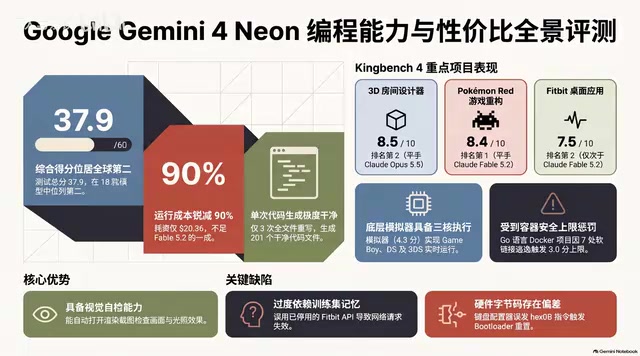
Gemini 4 Neon Hands-On: Value King or Confident Catastrophe?
Gemini 4 Neon review: 1M-token context, four thinking levels, 201 files in one KingBench4 pass at one-tenth Fable 5.2's cost—but it hallucinates fake data, leaves 7 symlink escapes, and bricks keyboards.

Google Gemini 4 Neon Hands-On: 6 3D Works That Impress and Fail
Hands-on with Google Gemini 4 Neon on a 3060 laptop: 6 3D works tested. Sunshower Fishing Harbor and mechanical keyboard impress; soft-body physics and faces fall short.

Gemini 4 Neo Web Novel Writing Test: Faint AI Flavor, Textured Dialogue
Bilibili creator's first-look review of Gemini 4 Neo for Chinese web novel writing: testing a Three Kingdoms transmigration opening with faint AI flavor, emotionally textured dialogue, and strong crisis building, plus comparison of 4A/4H/4C models and full workflow demos.