From Zero to AI Engineer: A Real Growth Path from a Student's Resume
How a CS student built a credible AI portfolio from zero in 3-4 months through real deployed projects.
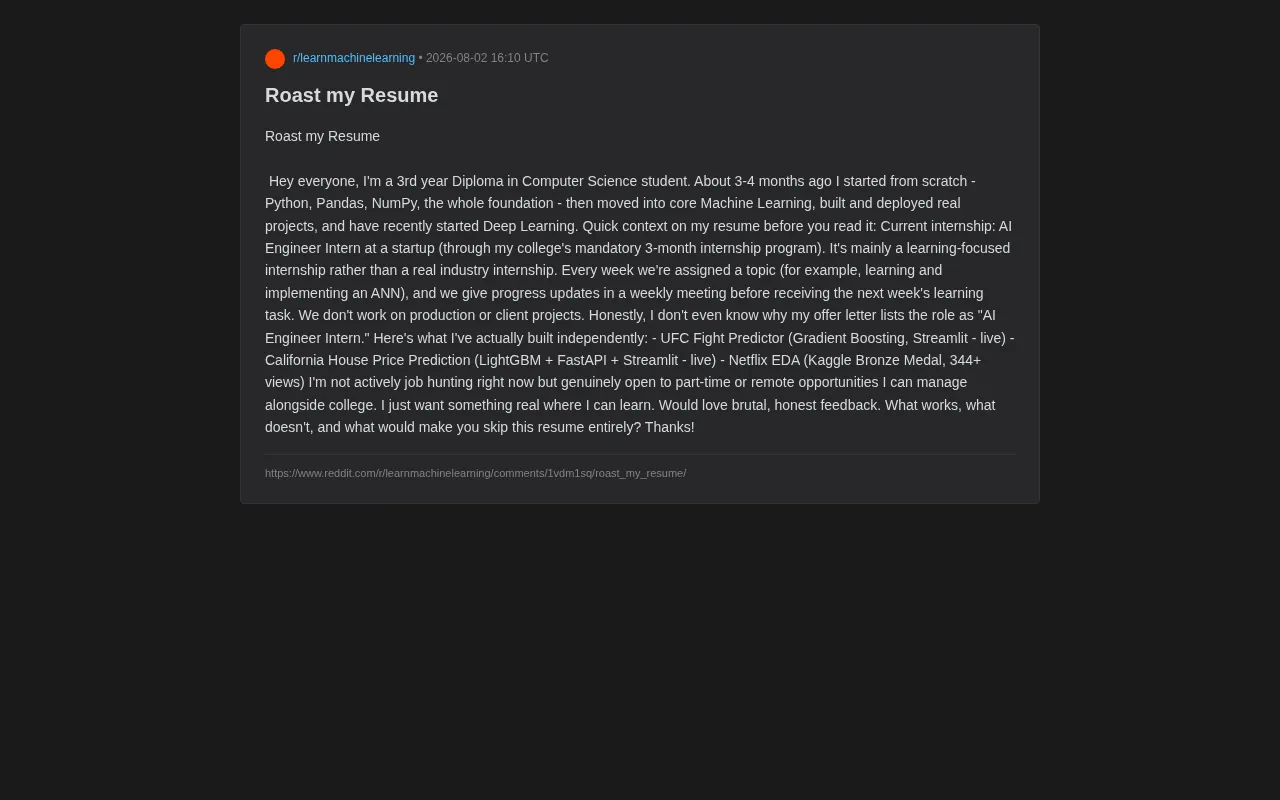
A third-year CS student posted their resume for feedback on Reddit, revealing a 3-4 month journey from Python basics to deployed ML models. This article analyzes their learning path (Python → Pandas/NumPy → ML → Deep Learning), three portfolio projects (UFC predictor, housing price model with FastAPI, Netflix EDA), and offers actionable advice on quantifying results, honest self-presentation, and resume optimization for AI beginners.
Introduction: A Resume That Asked to Be "Roasted"
In Reddit's tech community, a third-year computer science student posted a "Roast my Resume" thread. These posts are essentially requests for genuine feedback—no pleasantries, just criticism that helps you improve. Behind this resume lies a more universal topic: In an era of exploding AI skills, how can a student starting from zero build a demonstrable skill portfolio in just a few months?
This student's journey is quite representative: starting from Python basics 3-4 months ago, progressing through data processing tools like Pandas and NumPy, then to core machine learning, and recently beginning to explore deep learning. This path is almost the most typical self-study AI growth curve today. This article uses this resume as an entry point to analyze what's worth learning from and what still needs improvement.
Breaking Down the Learning Path: Why This Route Makes Sense
A Progressive Skill Stack
From the post description, this student's learning sequence is very clear:
- Foundation Layer: Python, Pandas, NumPy—the bedrock of data science
- Core Layer: Machine learning algorithms and project practice
- Advanced Layer: Deep learning (just getting started)
This sequence aligns with what most senior practitioners recommend. A common mistake many beginners make is rushing into deep learning and large models while having only a superficial understanding of underlying data processing and classical machine learning. Solid Pandas/NumPy skills are precisely the key to handling real data and doing feature engineering later on.
It's worth elaborating that Pandas provides the DataFrame data structure for efficiently cleaning, transforming, and aggregating tabular data, while NumPy is the cornerstone of scientific computing, providing high-performance multidimensional array objects and mathematical tools—virtually all machine learning frameworks depend on NumPy's array operations under the hood. Mastering these two libraries means a student can independently build data preprocessing pipelines—and in real industrial settings, data scientists often spend 60%-80% of their time on data cleaning and feature engineering rather than model tuning. This explains why the "foundation layer" seems simple but cannot be skipped.
A Complete Loop from Learning to Deployment
What's commendable is that this student didn't stop at "getting a Jupyter Notebook to run" but completed the full loop from modeling to deployment. This is quite rare among beginners—many people stop at model training and never turn a model into a product others can access.
In today's AI talent market, "being able to train a model" and "being able to put a model online" are two fundamentally different capabilities. The former proves you understand algorithms; the latter proves you have engineering thinking. What companies actually need is the latter—if a model can't be accessed by users, can't handle real requests, and can't be continuously iterated, it has zero business value.
Project Analysis: The Value of Three Portfolio Pieces
The Project Portfolio
The resume lists three independently completed projects. Let's analyze each:
1. UFC Fight Predictor
- Tech stack: Gradient Boosting + Streamlit
- Status: Live
The highlight of this project is its interesting topic and actual live deployment. Gradient Boosting is a class of ensemble learning algorithms that iteratively trains weak learners (usually decision trees), with each new model focusing on correcting the residuals from the previous round. These algorithms have long dominated Kaggle competition leaderboards for structured/tabular data and are considered the "default optimal choice" for non-image, non-text data. Compared to deep learning, gradient boosting is typically more stable, more interpretable, and faster to train on small-to-medium datasets—which is why industrial recommendation systems and risk control systems still widely use XGBoost or LightGBM. Choosing this algorithm reflects pragmatic technical judgment.
Using Streamlit to quickly build an interactive interface also demonstrates engineering awareness. Streamlit is a Python web application framework designed specifically for data scientists, allowing developers to rapidly build interactive data applications using pure Python (no frontend knowledge required). Its core philosophy is "script as application"—every user interaction reruns the entire script, greatly simplifying state management complexity. Streamlit Community Cloud provides free hosting, enabling students and independent developers to deploy projects at zero cost and generate shareable URL links. This "build it and let people see it" immediate feedback loop is extremely important for building portfolios and receiving community feedback.
2. California Housing Price Prediction
- Tech stack: LightGBM + FastAPI + Streamlit
- Status: Live
This is the most technically sophisticated of the three projects. LightGBM is Microsoft's open-source gradient boosting framework that, compared to XGBoost, uses histogram-based decision tree algorithms and a leaf-wise growth strategy, achieving 20x+ faster training speeds on large datasets with lower memory consumption. It also natively supports categorical feature handling without manual one-hot encoding. In industry, LightGBM is widely used in ad click-through rate prediction, credit scoring, recommendation ranking, and other scenarios—it's an almost mandatory tool in data science interviews.
More importantly, introducing FastAPI means he understands the concepts of frontend-backend separation and API-based service architecture, which is close to real production environment thinking. FastAPI is the new-generation high-performance web framework in the Python ecosystem, auto-generating API documentation based on type annotations, supporting asynchronous request processing, with performance approaching Node.js and Go. In machine learning engineering scenarios, FastAPI is commonly used as the model serving layer: the frontend (like a Streamlit interface) calls the backend API via HTTP requests, and the backend loads the trained model for inference and returns results. This frontend-backend separation architecture is standard practice in production environments—it allows models to be updated independently without affecting the user interface, and enables multiple clients (web, mobile, other services) to reuse the same model service. For a student who has been learning for only a few months to understand and practice this architecture shows remarkably sharp engineering intuition.
3. Netflix Exploratory Data Analysis (EDA)
- Results: Kaggle Bronze Medal, 344+ views
This project demonstrates data analysis and visualization capabilities. Kaggle is the world's largest data science competition and community platform, and its medal system is a community reputation mechanism. For Notebook and Dataset contributions, a bronze medal means receiving at least 5 upvotes from other users, indicating that the work's quality has been recognized by peers. Kaggle's tier system has five levels from Novice to Grandmaster, and accumulating medals allows gradual advancement. For job seeking, a Kaggle Profile serves as a "portfolio" in the data science field—recruiters can directly review a candidate's code quality, analytical thinking, and community contributions, which is more convincing than self-descriptions on a resume. While earning a bronze medal isn't a top-tier achievement, for someone who has been learning for only a few months, it already proves their analytical capabilities can withstand public scrutiny.
Overall Assessment of the Project Portfolio
These three projects form a solid capability matrix: regression modeling, classification prediction, data analysis, and model deployment are all covered. For a student who has been learning for only 3-4 months, this output already exceeds the average level. The key is that every project is accessible and verifiable—this is far more valuable than listing a bunch of "familiar with XXX" adjectives on a resume.
From a recruiter's perspective, accessible means an interviewer can open a link and experience the product firsthand within 30 seconds; verifiable means the code is public and the logic is transparent. This "evidence-based" capability demonstration has overwhelming advantages in the attention-scarce screening process.
Areas for Improvement
About That "AI Engineer Internship"
This student was very honest about his confusion: he currently holds the title "AI Engineer Intern," but in reality, it's a mandatory 3-month learning-oriented internship through school, where he's assigned a weekly learning topic (like implementing an ANN), without participating in real production or client projects.
This type of "learning internship" is very common at universities in the Asia-Pacific and South Asian regions, typically curriculum-mandated internships in partnership with training institutions or small consulting firms. It's fundamentally different from product internships at North American tech companies—the latter requires interns to complete real code commits under mentor guidance, participate in sprint meetings, and deliver measurable business outcomes. Recruiters perceive these two types of internships completely differently, so they need to be handled carefully on a resume.
This self-awareness is commendable, but from a resume strategy perspective, note:
- Don't exaggerate: Since it's not real product experience, the resume shouldn't imply production-level project delivery experience
- Emphasize what you learned: The internship can be framed as a "structured AI skill development program," highlighting the depth of weekly topic-based learning, such as "independently implemented backpropagation for a feedforward neural network" or "built a CNN image classifier from scratch" as concrete outcomes
- Avoid misleading titles: If recruiters dig deeper and find the title doesn't match reality, it will erode trust
Resume Optimization Directions
Based on common community feedback patterns, resumes like this can typically improve in the following areas:
-
Quantify results: Projects should include not just the tech stack but model performance metrics (such as accuracy, RMSE, F1-score). For example, "Housing price prediction model achieved a test set RMSE of $32,000, outperforming the baseline model by 45%" is far more powerful than "Used LightGBM for housing price prediction." Quantification lets recruiters judge that you not only know how to use tools but also understand model evaluation methodology.
-
Highlight problem-solving: Recruiters care more about "what problem did you solve" than "what tools did you use." Use the STAR method (Situation-Task-Action-Result) to organize project descriptions, e.g., "Addressed significant missing values and feature imbalance in UFC historical match data by designing XX strategy, ultimately improving prediction accuracy to XX%."
-
GitHub links: Ensure every project has a clean code repository and README. A good README should include a project overview, technical architecture diagram, installation steps, usage examples, and performance metrics—this itself is a demonstration of professionalism.
-
Cut the adjectives: Use less "proficient in" and more verifiable evidence. "Expert in Python" is empty talk; "Completed 3 end-to-end machine learning projects in Python and deployed them live" is a fact.
Lessons for AI Beginners
Real Output Trumps Everything
The biggest lesson this resume offers all AI beginners is: In this field, real, accessible project output is the most persuasive resume content. You don't need to wait until you've "finished learning everything" to start doing projects. Learning while building, deploying quickly, and showcasing publicly—that's the effective way to build a personal brand.
There's a deeper logic behind this: knowledge in AI/ML updates extremely fast, and no one can "finish learning." The "standard path" before 2023 was from linear regression to transformers, but now LLM application development, RAG architectures, Agent frameworks, and other new paradigms keep emerging. Rather than chasing the illusion of "perfect preparation," it's better to produce a piece of work at each stage that represents your current level. The accumulation of these works is the most irreplaceable competitive advantage over time.
Stay Honest and Self-Aware
This student's clear-eyed understanding of the nature of his internship, and his proactive seeking of "brutal, honest feedback," is itself an extremely valuable professional quality. In a job market flooded with resume padding, honesty might actually become a differentiating advantage.
From a psychological perspective, this behavior embodies a "Growth Mindset"—viewing criticism as a learning opportunity rather than an attack. Research shows that people with growth mindsets recover faster from setbacks and have steeper long-term career trajectories. In the tech field, this mindset is especially important because the rapid pace of technological change means everyone must continuously face states of "not knowing."
From Learner to Contributor
He mentioned that he's not in a rush to find full-time work, but is open to part-time or remote opportunities that can coexist with his studies—"just wanting something real that I can learn from." This growth-oriented rather than title-oriented mindset often goes further than an impatient approach.
From a career development strategy perspective, this positioning is very wise. For students still in school, a real—even small-scale—remote part-time experience, such as building a data pipeline for a startup or contributing a feature to an open-source project, brings far deeper learning and resume value than another "learning internship." Real business constraints (deadlines, user feedback, code reviews) are accelerators that no course can simulate.
Conclusion
A good AI beginner's resume isn't about how impressive the titles are, but whether it can demonstrate a real learning trajectory and verifiable hands-on ability. This third-year student went from Python basics to model deployment in 3-4 months—this path itself is an excellent "resume." For everyone self-studying AI, rather than anxiously wondering "when will I be ready," start building a small project you can put online right now—that's the most valuable door-opener in this era.
Key Takeaways
Related articles

Last Week Tonight Exposé: The Dangerous Ties Between Politicians and White Supremacy
Last Week Tonight investigates Georgia Senate candidate Mike Collins and Florida candidate Marshall Rawson, exposing their multiple ties to white supremacists and the Republican Party's silent response.
AI Buzz Weekly: GPT-6.5 Leak, New Claude Model, and MiniMax's Cost-Effectiveness
This week's AI buzz roundup: suspected GPT-6.5 leak, Microsoft configs showing GPT-6.1 Tera, Anthropic's new model that can identify entire classes of bugs, disappointing early Gemini 4 Carbon results, and MiniMax M3.1 Flash beating Claude Opus 5 and GPT-5.6 Sol in benchmarks at extremely low cost.

AI Briefing: Gemini 4 Carbon Released, Ant Open-Sources Ling-3.1
AI Briefing: Google releases Gemini 4 Carbon qubit model, claiming to surpass Opus 5.5 with half-price tokens; Ant open-sources Ling-3.1-1019 for real-task Personal Agents; domestic AI drug discovery succeeds in 18 of 19 projects, hitting all 6 GPCR targets; zero-revenue company valued at $20B raises another $1B; Sichuan convenience store robot sales fail.