Gemini 4 Carbon Tops Intelligence Index as Grok and OpenAI Roll Out New Moves

Gemini 4 Carbon tops a third-party intelligence index after a two-week iteration as vendors compete for developer entry points.
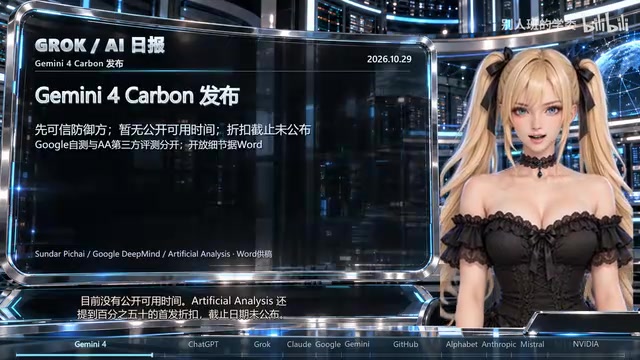
The October 29 AI daily roundup shows Google launching Gemini 4 Carbon just two weeks after Argon and topping the Artificial Analysis Intelligence Index with 59 points, 9 higher than Argon and first in four of nine evaluations; yet in the Coding Agent Index, Carbon with Anti-Gravity CLI scored 59, below Cloud Code with OPUS 5.5 at 62, highlighting toolchain impact. Self-tested exploitation was only 54.8%, prompting a phased rollout. OpenAI offers up to $500 monthly API credits to ChatGPT Pro and Business users and says the merged Chat/Work interface is not yet rolled out. Other updates include Grok's new Guidelines parameter, Claude for Legal templates, Google Connected Apps and immersive exploration, GitHub Copilot Fusion, open Nemotron 3.5 Transcribe weights, and Anthropic's OneGov agreement with the GSA.
Gemini 4 Carbon Tops Intelligence Index as Grok and OpenAI Roll Out New Moves
The October 29 AI daily roundup is dense with news: just two weeks after releasing Argon, Google launched Gemini 4 Carbon and sent it straight to the top of a third-party intelligence index; OpenAI is granting API credits to paying ChatGPT users; Microsoft and Alphabet reported earnings on the same day; and a batch of developer-facing API and platform updates landed. Here's the breakdown by main storyline.
Gemini 4 Carbon: Two-Week Iteration, Straight to the Top Spot
According to the AI daily roundup compiled by Bilibili creator Grok, Google released its next-generation frontier model Gemini 4 Carbon, only two weeks after the previous generation, Argon. Google emphasized two points: further improved long-horizon task capabilities and strengthened frontier safety protections.
What drew more attention was third-party evaluation. On the fifth version of the Artificial Analysis Intelligence Index, Carbon scored 59, ranking first—9 points higher than Argon, and first place in four of nine evaluations. The significance of this score lies in the fact that it is not a vendor self-test but a horizontal comparison on a third-party benchmark.
One detail worth noting on the coding front: in the Coding Agent Index, Carbon paired with the Anti-Gravity CLI scored 59, second only to Cloud Code with OPUS 5.5 at 62. This is an evaluation result for a combination of model and agent tooling, showing that the toolchain's impact on final performance cannot be ignored—a model's standalone lead does not necessarily translate into a lead on agentic coding tasks.
Cybersecurity Capabilities: Self-Test Data and Phased Rollout
Google's self-tested cybersecurity results are: vulnerability discovery 88.2%, vulnerability exploitation 54.8%, and vulnerability patching 71%. Exploitation is noticeably lower in this set, which also explains why Google's rollout strategy is cautious: this week it will first be available to select trusted cyber defense parties, then expand to more partners through the FairWin program, and then broaden further; there is currently no publicly available timeline.
In addition, Artificial Analysis mentioned a 50% launch discount, with no announced deadline. For teams wanting to try it early, this is a time window to watch closely.
The Artificial Analysis Intelligence Index is a comprehensive model capability leaderboard maintained by the third-party evaluation organization Artificial Analysis. It normalizes scores from multiple standardized evaluation sets (reasoning, knowledge, math, coding, etc.) and weights them into a single score for easy cross-vendor comparison. The fifth version means its evaluation sets and weights have undergone an update, so scores are not directly comparable across versions. The value of such third-party benchmarks lies in avoiding the selection bias of vendor self-testing, but they also have limitations: evaluation sets may be contaminated by training data, and a single composite score cannot reflect real performance on specific tasks. That is why the industry usually also cross-checks with sub-indexes (such as coding and long context) and human matchup results (such as LMArena).
Vulnerability discovery, exploitation, and patching are three typical dimensions for evaluating a model's offensive and defensive capabilities today: vulnerability discovery means locating potential flaws in given code or binaries; vulnerability exploitation means constructing inputs that can actually trigger and cause impact (such as a PoC), a step that usually requires deeper reasoning and multi-step planning, so scores are generally lower than discovery; vulnerability patching means generating patches that pass tests without introducing regressions, testing understanding of codebase context. Among the three, "exploitation" attracts the most regulatory attention because it directly corresponds to dual-use risk—which is why frontier model vendors generally adopt trusted access and phased rollouts rather than directly public APIs.
OpenAI: Up to $500 in API Credits per Month, Merged Interface Still Being Polished
OpenAI announced that eligible ChatGPT Pro and Business subscribers can receive up to $500 in API credits per month to build applications and agents. The credits are available starting today, and eligibility is subject to the specific conditions on the official page.
The signal here is clear: channel subscribers toward API and agent development and lower the barrier from "using chat" to "building products." For professional users who already pay, it amounts to an extra layer of development resources.
Tibo responded to the ChatGPT merged interface circulating online, saying the team is integrating capabilities from both Chat and Work but has not started rolling it out yet. The plan is to combine the best capabilities of both sides sometime this year, and the team will proceed cautiously and take time to polish it. In other words, the interface being circulated is not the version about to be released.
Grok and Claude: Content Control and Scenario Templates Fill Gaps
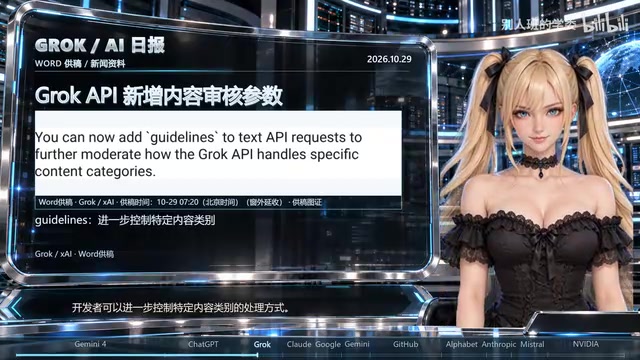
Grok's text API added a Guidelines parameter, allowing developers to further control how specific content categories are handled. Grok will express things in its own words according to the rules when generating responses. This content moderation control is open to all API customers, and the specific parameter documentation is in the Custom Moderation Controls docs.
Claude for Legal launched a ready-made Artifacts template library covering scenarios such as contract review, regulatory tracking, and citation checking. Users can start from built-in examples, add their own documents and connectors, and then share the finished tools with others in the company. This is a step toward embedding general capabilities into vertical workflows.
Google Ecosystem: Connected Apps, Immersive Exploration, and API Throughput
Google launched a preview of the Connected Apps platform, where developers can build and manage apps for Google Search and the Gemini App in one place. A batch of apps from partners such as Adobe.com and Peloton has also gone live.
Gemini App added an immersive exploration feature, with selectable topics such as Silk Road trade routes, the interior of a jet engine, or the physics of lightning. Scenes unfold into interactive layered visuals with guided narration, allowing users to dig deeper layer by layer.

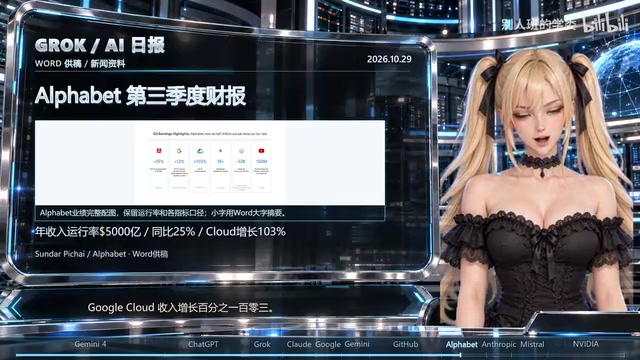
From the earnings report, Alphabet's third-quarter annual revenue run rate reached $500 billion, revenue grew 25% year over year, and Google Cloud revenue grew 103%. Google's own model APIs process nearly 32 billion tokens per minute, up 40% quarter over quarter, and AI-driven year-over-year growth in search query volume reached its highest in nearly five years.
Developer Tools and Enterprise Partnerships: Copilot Fusion, Nemotron 3.5, and the GSA Agreement
At GitHub Universe, Copilot Fusion was announced. The company says it reaches frontier model quality, is 40% faster, and costs up to 77% less. The unified Copilot Harness enters Microsoft Foundry as a managed service for building common-sense running agents; Copilot Projects provides multi-agent orchestration loops across repositories.
On the same day, Microsoft reported first-quarter fiscal 2027 results: revenue of $92.3 billion, Microsoft Cloud revenue of $63.9 billion, and Azure revenue growth of 48%.
NVIDIA open-sourced the weights of the Nemotron 3.5 Transcribe model, a promptable speech transcription model using a mixture-of-experts architecture with 30 billion total parameters and about 4 billion activated per pass. It supports transcription in 40 languages and also includes speaker attribution, translation, contextual prompting, and audio understanding. In a third-party evaluation by Artificial Analysis, its word error rate was 2.8%, tied for first among open-weight speech-to-text models.
On the enterprise partnership side, Anthropic signed a OneGov agreement with the U.S. General Services Administration (GSA), offering Claude to federal, state, local, tribal, and territorial governments at a 40% discount, i.e., 60% of the original price. Mistral launched the public beta of its Responses API, returning the model's answer, reasoning process, and tool calls as separate items per response for easier application handling, supporting all chat models hosted by Mistral, including Large4.
Mixture-of-experts architecture (MoE) means the model consists of multiple "expert" subnetworks plus a gating router, and only a small number of experts are activated in each forward computation. Therefore, "total parameters" and "activated parameters" are two different concepts: Nemotron 3.5 Transcribe has 300 billion total parameters and about 4 billion activated per pass, meaning inference cost is roughly calculated based on activated parameters rather than total parameters—this is the key to how MoE can maintain large-capacity knowledge while controlling latency and compute. The trade-off is that memory usage is still calculated based on total parameters, and routing may be unevenly loaded. In speech transcription tasks, word error rate (WER) is the standard metric, and open-weight models are often ranked horizontally by this metric.
A Few Observations
Looking at this batch of updates, two lines stand out most clearly: first, the model iteration cadence has compressed to "weeks"—only two weeks separate Carbon and Argon; second, vendors are all competing for the "developer entry point"—OpenAI issues credits, Google pushes Connected Apps, Grok adds content control parameters, and Mistral changes the response structure. In essence, all of this makes it easier for developers to embed models into products.
When evaluating releases like these, evaluation results for model-plus-tool combinations (such as the Coding Agent Index) may be more informative than a single model score. Carbon ranks first in model score, but still trails Cloud Code with OPUS 5.5 in the coding agent combination. That gap comes from the toolchain, not the model itself.
One-line Summary
Gemini 4 Carbon tops a third-party intelligence index after a two-week iteration, as multiple vendors scramble for the developer entry point.
Paragraph Summary
The October 29 AI daily roundup shows that Google launched Gemini 4 Carbon just two weeks after Argon, ranking first on the fifth version of the Artificial Analysis Intelligence Index with 59 points, 9 points higher than Argon and first in four of nine evaluations. However, in the Coding Agent Index, Carbon with the Anti-Gravity CLI scored 59, still below Cloud Code with OPUS 5.5 at 62, showing the significant influence of the toolchain. In self-tested cybersecurity capabilities, exploitation was only 54.8%, which is why Google adopted a phased rollout. OpenAI is providing ChatGPT Pro and Business users with up to $500 in API credits per month and says the merged Chat/Work interface has not yet been rolled out. Other updates include a new Guidelines parameter for Grok's text API, the Claude for Legal template library, Google Connected Apps and immersive exploration, GitHub Copilot Fusion, NVIDIA open-sourcing Nemotron 3.5 Transcribe weights, and Anthropic's OneGov agreement with the GSA.
Related articles

LangChain Retry Middleware Configuration: Practices and Selection Guide
Based on Reddit community discussion, this article analyzes LangChain ModelRetryMiddleware retry parameter configuration practices, covering the selection logic and alternatives for key options like max_retries, backoff_factor, and jitter.

Texas Senate Race in Trouble: Why Are Republicans Nervous?
Texas Senate race stirs Republican anxiety. Based on street interviews, this article analyzes the Democratic offensive in funding, organization, and running everywhere, and how Republicans are defending "Texas, Texas" amid the political pendulum effect.

Gemini Chat Now Generates and Edits Google Docs Directly, a New Breakthrough in Office Productivity
Google Gemini's chat interface now generates and edits PDF, Google Docs, Sheets, Slides, Markdown, TXT, and code files. Available to all users; web supports all formats, mobile only PDF for now.