Gemini 4 Hydrogen Hands-On: Can It Beat GPT at Game Development?

Four AI models compared at game dev: GPT most stable, DeepSeek best at art, Gemini's visuals hold it back.
Indie developer Xiao Wang had GPT, Qwen 4 Max, DeepSeek, and Gemini 4 Hydrogen each generate a playable shooter demo from the same requirements, comparing visuals, interaction, logic, and completion. GPT was most complete and visually stable but lacked monster death animations and was too easy; Qwen was logically bug free but visually crude, with Weapon No. 3's key failing; DeepSeek showed the strongest artistic understanding, with the richest monsters, perspective, and hit effects; Gemini 4 Hydrogen had interesting stats and mechanics but crude visuals and a weapon-switching key bug on unlock. The test shows model coding competition shifting from functionality to visual presentation and playability, though single-test results are directional only.
Title
Gemini 4 Hydrogen Hands-On: Can It Beat GPT at Game Development?
Meta Description
An indie developer put Gemini 4 Hydrogen, GPT, Qwen 4 Max, and DeepSeekAd to the test building the same shooter game: GPT had the highest completion, DeepSeek had the best art, Gemini's stats were normal but its visuals were crude, and it had a key-mapping bug. Each of the four models had weaknesses — no clear overall winner.
Article Content
After Google released its new Gemini 4 Hydrogen model, indie developer Xiao Wang used the same set of game development requirements to have GPT, Qwen, DeepSeek, and Gemini 4 Hydrogen each build a small shooter game, comparing them side by side across four dimensions: visuals, interaction, logic, and completion. This hands-on test involved no benchmarks — just four playable game demos. The results were more intuitive than any spec sheet.
Test Method: Same Requirements, Four Models Left to Their Own Devices
The test requirement was to develop a top-down shooter similar to Alien Shooter, including character movement, weapon switching, monster AI, death animations, and interactive map elements. The four models generated code independently in their own environments, and the creator played through each one and recorded the results. It should be noted that this was not a strictly controlled-variable experiment — the prompt details and number of generation rounds were not fully disclosed — so the conclusions are better viewed as directional reference points rather than an absolute ranking.
A controlled-variable experiment is a method used in scientific research to establish causality: by artificially holding all other factors that could affect the result constant and changing only one independent variable, you can observe that variable's independent effect on the dependent variable. In AI model comparison tests, an ideal controlled-variable experiment would require fixing the prompt, generation rounds, temperature parameters, runtime environment, and all other conditions, changing only the model itself. In practice, however, this is often difficult to fully control, because different models have different default parameters, context windows, and sensitivities to prompts, meaning conclusions can only serve as directional references. The author of this article explicitly acknowledges this, showing a clear awareness of the experiment's limitations.
GPT: Highest Completion, Most Stable Visuals and Feel
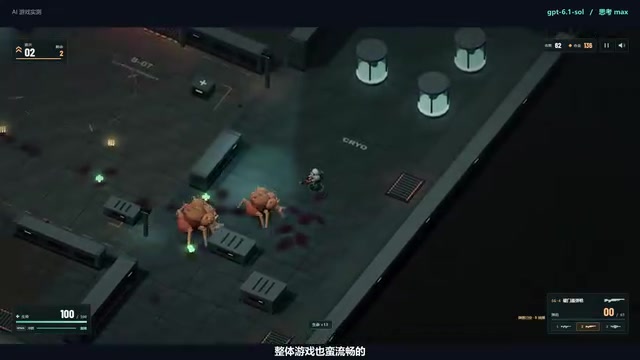
GPT's version was the first to take the stage, and its visual refinement was clearly ahead of the other three, with hit sound effects, weapon switching, and dodge moves all working properly. The creator specifically noted that the "wave effect" was well done — when large numbers of monsters closed in, the sense of pressure was strong — and the overall experience ran smoothly with no performance issues.
The flaws were in the details: the monsters seemed to have no death animation. Also, the difficulty curve was too low — the character got cornered and took repeated hits without dying, and the creator kept muttering, "Normally I should be dead by now, right?" This exposed a stat-balancing problem rather than a coding error. From an engineering perspective, what GPT delivered was a complete, "playable and decent-looking" product.
Qwen: All Logic Correct, but Crude Visuals
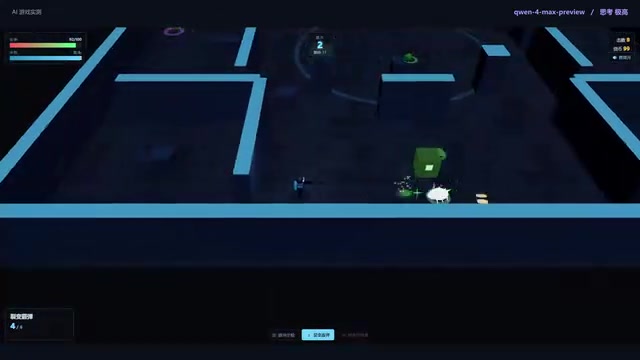
Qwen 4 Max generated its version at the highest thinking level. The visuals were clearly cruder than GPT's, but monsters had death animations after being killed, left liquid effects on the ground, and the map had all its interactive elements. The creator tested each weapon one by one; Weapon No. 3 couldn't be triggered, but the other keys worked normally, and overall it was in a bug-free state.
The boss that appeared in the third wave was likewise crude but logically correct. The creator's summary was accurate: "The logic is all correct, but everything is just very crude." This shows that the model is reliable at implementing functionality but conservative in visual expressiveness.
Bug free is a term from the software testing field, meaning that a program exhibits no errors or abnormal behavior under a given set of test cases. In game development, bug free means the core functions (such as movement, attacks, monster AI, death animations, etc.) all run as expected, with no crashes, freezes, or logic errors. But bug free does not equal high quality — it only guarantees functional correctness and does not cover visual presentation, performance optimization, user experience, or stat balancing. In this article, although the game generated by Qwen was rated as bug free, its visuals were crude and lacked visual polish, showing that the model is reliable at implementing functionality but conservative in artistic presentation and richness of detail. This also reminds developers that functional correctness is only the first step toward productization.
DeepSeek: Outstanding Artistic Understanding, Richest Monster Design
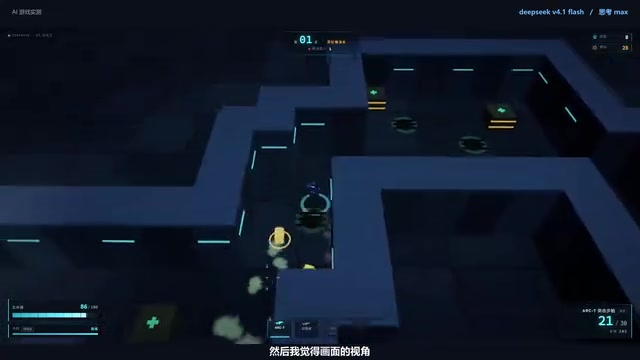
DeepSeek's version earned the creator's assessment that "he understands art." The character and monster details were on point, the visual perspective had a sense of depth, the map's interactive components were complete, and the death animations worked properly.
The variety of monsters was the richest of the four, with different attack methods, and hit effects were also achievable — the creator pointed out that the other two models "had no hit effects." Weapon No. 3 required unlocking, showing that the model went one step further in designing game progression. Overall, DeepSeek stood out in visual aesthetics and gameplay depth.
Perspective is a core concept in painting and visual design, referring to methods of representing three-dimensional spatial depth on a two-dimensional plane. Common types include one-point perspective (parallel perspective), two-point perspective (angular perspective), and three-point perspective (oblique perspective). In top-down shooters, appropriate perspective can enhance the scene's sense of three-dimensionality and immersion — for example, making the ground, walls, and objects appear larger up close and smaller at a distance. The game visuals generated by DeepSeek had a sense of perspective, showing that the model not only understood game logic but also had a certain awareness of spatial composition, which is relatively rare among code-generation models and is one of the important reasons it was praised as "understanding art."
Gemini 4 Hydrogen: Stats Normal, Visuals Hold It Back
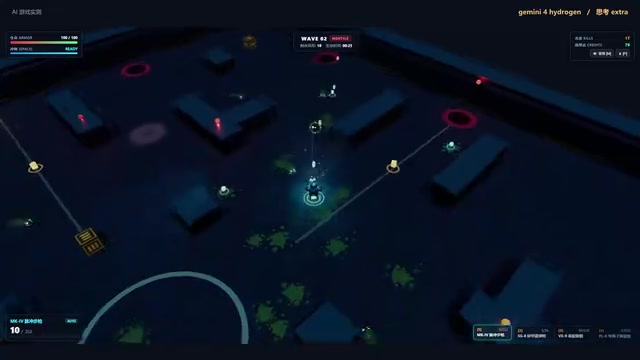
As the finale, Gemini 4 Hydrogen's visuals were rated by the creator as "a bit crude," with a style close to Qwen's. The monster death liquid effects were passable, but the map's richness was average. Weapons had knockback effects, the new weapons performed well after unlocking, and it also introduced a mechanic where ground items disappear if not picked up for a while, accompanied by a flashing visual effect as a reminder, and the variety of weapons was also greater.
The creator felt that Gemini's stats "seemed a bit more normal," but the overall difference was small. The main problem was that the visual presentation did not match the expectations for its launch day. The test also revealed an interaction bug: when a weapon was unlocked, the weapon-switching keys below briefly became confused.
Stat balancing is a key part of game design, referring to adjusting character attributes, enemy strength, weapon damage, drop rates, and other values so that the game's difficulty curve is reasonable and the player experience is smooth. Poor stat balancing can make a game too hard (players die frequently) or too easy (lacking challenge). In this article, GPT's version was noted to have "the character cornered and taking repeated hits without dying," which is a problem of difficulty being too low and enemy damage values being insufficient; while Gemini's version was rated as "stats seeming a bit more normal," indicating that its parameters such as enemy attack power and character health were closer to a reasonable range. Stat balancing usually requires repeated playtesting and tuning, and whether a model can automatically generate balanced stats remains an important dimension for evaluating its game development capabilities.
Side-by-Side Comparison: No Overall Winner — Context Determines the Choice
Each of the four models had weaknesses: GPT had the most stable completion and visuals but lacked death animations; Qwen was logically reliable but had crude visuals; DeepSeek had the strongest art and monster design; Gemini had ideas for stats and mechanics but fell short in visuals and interaction details. Whether it's "a nuke or a dud" depends on the use case — for delivery speed and completion, GPT is more reliable; for visual presentation, DeepSeek understands better; and on the specific task of game development, Gemini 4 Hydrogen has yet to show dominance matching its launch hype.
It's worth noting that a single test is heavily influenced by the prompt, the number of generation rounds, and the subjective feel of playtesting, and the complexity of the four demos may not be fully equivalent. More rigorous conclusions would require multiple rounds of blind testing and a unified scoring standard. But as a quick comparison, it at least shows that the gap in model coding ability is shifting from "can it write it" to "is what it writes good-looking and fun to play."
One-line Summary
A side-by-side comparison of four AI models at game development: GPT is the most stable, DeepSeek understands art best, and Gemini's visuals hold it back.
Paragraph Summary
Indie developer Xiao Wang used the same shooter game requirements to have GPT, Qwen 4 Max, DeepSeek, and Gemini 4 Hydrogen each generate a playable game demo, comparing them side by side across visuals, interaction, logic, and completion. GPT had the highest completion and the most stable visuals, but lacked monster death animations and its stats were too easy; Qwen was logically bug free but had crude visuals, and Weapon No. 3's key didn't work; DeepSeek stood out for artistic understanding, with the richest monster variety, a perspective view, and hit effects; Gemini 4 Hydrogen had ideas for stats and mechanics, but its visuals were crude and the weapon-switching keys briefly became confused when weapons were unlocked. The test shows that the competition in model coding ability is shifting from functional implementation to visual presentation and playability, but a single test is influenced by prompts and subjective impressions, so the conclusions serve only as directional reference.
Related articles
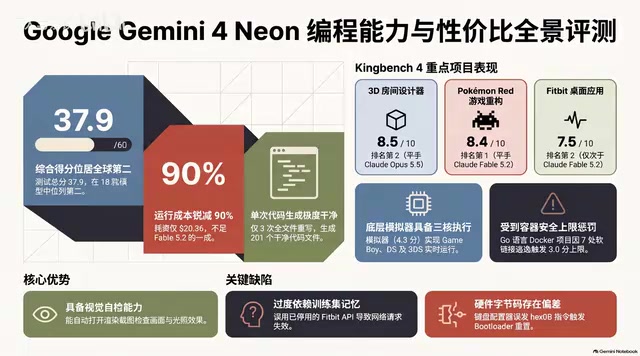
Gemini 4 Neon Hands-On: Value King or Confident Catastrophe?
Gemini 4 Neon review: 1M-token context, four thinking levels, 201 files in one KingBench4 pass at one-tenth Fable 5.2's cost—but it hallucinates fake data, leaves 7 symlink escapes, and bricks keyboards.
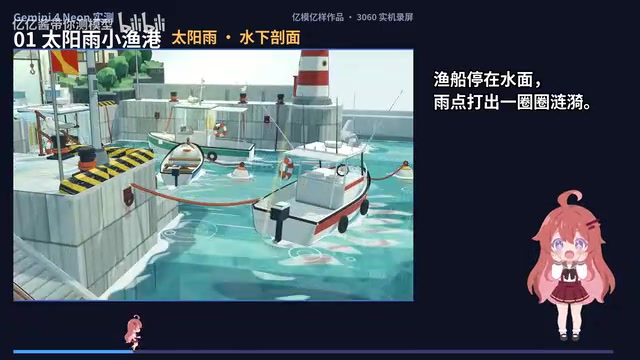
Google Gemini 4 Neon Hands-On: 6 3D Works That Impress and Fail
Hands-on with Google Gemini 4 Neon on a 3060 laptop: 6 3D works tested. Sunshower Fishing Harbor and mechanical keyboard impress; soft-body physics and faces fall short.
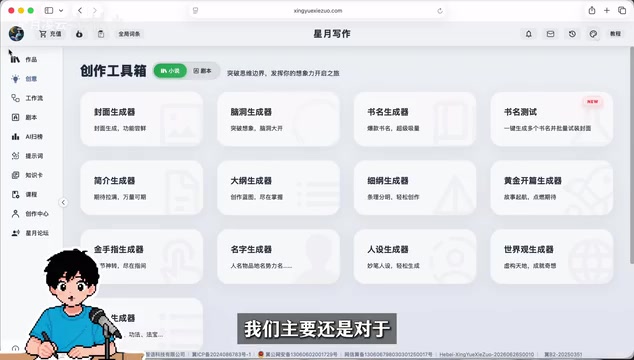
Gemini 4 Neo Web Novel Writing Test: Faint AI Flavor, Textured Dialogue
Bilibili creator's first-look review of Gemini 4 Neo for Chinese web novel writing: testing a Three Kingdoms transmigration opening with faint AI flavor, emotionally textured dialogue, and strong crisis building, plus comparison of 4A/4H/4C models and full workflow demos.