Gemini 4 Hydrogen Released: Cheaper, Faster — AI Daily Roundup

Google releases cost-effective agent Gemini 4 Hydrogen as the AI industry balances efficiency, openness, and risk.
Google releases Gemini 4 Hydrogen, beating flagship Argon with a 51-point Work Intelligence Index at just $1.5 per million input tokens and available to free users, targeting the everyday agent market on value. Meanwhile, Google's first smart glasses open for pre-order at 41g with ~9 hours of battery and real-time translation in 70+ languages. OpenAI open-sources Codex Security tools and SDK to shift security left. Domestic open-source image model MiniMax H3-Image tops both text-to-image and image editing open-weight leaderboards with native 4096-pixel support. On infrastructure, Navies announces a $40 billion data center expansion for 2027, while some Microsoft projects slip to Q2 2027. On safety and regulation, five AI giants face a class-action suit over public safety risks, and METR predicts an intelligence explosion could arrive as early as 2027.
Gemini 4 Hydrogen: Google's New "Everyday Agent" Trump Card
According to Bilibili's AI Daily, Google has officially released Gemini 4 Hydrogen, positioned as a "faster, cheaper everyday agent." Its Work Intelligence Index reached 51 points, surpassing its own flagship Argon's 50 points; on the Terminal Bench 4.1 test it scored 57%, more than three times that of the previous generation. On pricing, input costs just $1.5 per million tokens, and even free users can access it. This means Google is pushing high-performance models down to a broader user base, competing for the everyday agent market on cost-effectiveness.
Google's First Smart Glasses Open for Pre-order: 41g, ~9 Hours of Battery Life
Google's first smart glasses, designed in collaboration with Warby Parker and Gentle Monster, are now open for pre-order. The device weighs just 41g, offers about 9 hours of battery life, features a 12MP ultra-wide camera, is activated with the wake word "Hey Gemini," and supports real-time translation in over 70 languages. Bidding starts at $395, with sales launching December 10 in the US and South Korea.
The significance of this product is that Google is extending Gemini's agent capabilities into wearables, aiming to seize an early lead in the AR glasses race. Lightweight design and long battery life are its main selling points, but real-world experience still needs market validation.
The Optics and Weight Dilemma of AR Glasses: Smart glasses must cram a battery, chip, camera, and wireless module into the temples, and every 10g of added weight significantly degrades wearing comfort. Current mainstream AR glasses (such as Meta Ray-Ban) sit around 48-50g, so 41g is already close to ordinary sunglasses. Nine hours of battery life means it's closer to a "Bluetooth headset with a camera + voice assistant" form factor than a holographic display device. Such products typically use a "no display" or monochrome micro-display approach, trading visual immersion for everyday wearability. Google's choice to partner with Warby Parker and Gentle Monster is precisely about leveraging traditional eyewear channels to solve the "fashionability" gap — the hardest one for consumer electronics to cross.
OpenAI Open-Sources Codex Security: Shifting Security Left
OpenAI has open-sourced Codex Security's command-line tool and SDK. The tool can scan code repositories, check changes before commit, and block CI based on severity level. The new version supports resumable scanning and cost caps, the scanning logic is self-auditable, and code never leaves the local environment.
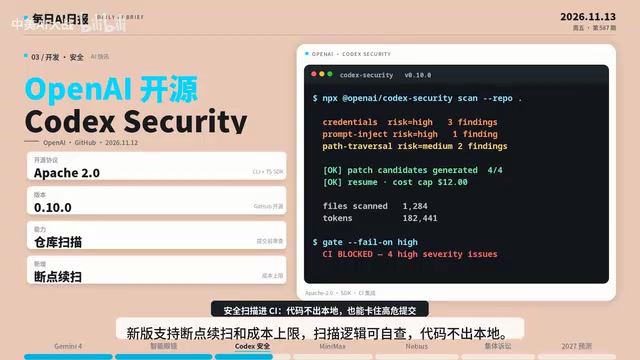
For development teams, this lowers the barrier to integrating security scanning and addresses enterprises' concerns about code privacy. The open-source strategy helps Codex Security become a standard component in CI/CD pipelines.
"Shift Left Security" and CI Gates: Shift Left Security refers to moving security checks from pre-launch penetration testing earlier to the coding and commit stages. Traditional SAST tools have high false-positive rates and complex configuration, and are often bypassed by developers. Codex Security's "block CI by severity level" means setting up quality gates in the continuous integration pipeline: high-severity vulnerabilities directly block merges, while medium- and low-severity issues only trigger warnings. The new "cost cap" addresses the risk of budget overruns from token-based billing of AI scanning; "resumable scanning" allows large repositories to be scanned in batches, avoiding single-run timeouts. Keeping code local is a prerequisite for strongly regulated industries like finance and healthcare to adopt AI security tools.
MiniMax H3-Image Tops the Charts: Domestic Open-Source Image Models Advance Again
The domestic open-source image model MiniMax H3-Image took first place in both text-to-image and image editing on open weights. It natively supports 4096-pixel output, generates an image in 10 seconds, accepts up to 16 reference images, and its model weights are fully open.
This result shows that open-source image models are rapidly approaching closed-source commercial models in generation quality and editing capability, while open weights accelerate community ecosystem building.
Open Weights and Text-to-Image Benchmarks: Open Weights means model parameters can be downloaded, deployed locally, and fine-tuned, in contrast to closed-source models that only offer APIs. Leaderboards for open weights in text-to-image are typically maintained by communities or third-party organizations, evaluating dimensions such as text adherence, aesthetic quality, and generation stability. Native 4096-pixel output means the model supports high resolution during training rather than through post-hoc upscaling, which is crucial for commercial scenarios like e-commerce and design. Sixteen reference image inputs point to "multi-image reference editing" capability — the model can understand multiple visual materials simultaneously while maintaining character or style consistency, which is the frontier of competition among current image editing models.
Compute Buildup and Delays Coexist: Uneven Heat Across AI Infrastructure
AI cloud service provider Navies announced a $40 billion expansion of data centers in 2027, funded mainly by customer prepayments and contract financing.

On the other side, some Microsoft data center projects have been delayed, with compute delivery pushed to Q2 2027. This reflects that while AI compute demand is strong, supply chains and construction schedules still face challenges, and the industry's infrastructure expansion is not smooth sailing.
The AI Safety Debate Goes to Court: Five Giants Sued in Class Action
Five AI giants — OpenAI, Google, Anthropic, Meta, and others — have been hit with a class-action lawsuit. The plaintiffs are asking the court to halt their continued development of more advanced frontier models, citing potential public safety risks.

What are the public safety risks of frontier AI? This has become an unavoidable question for the industry. The lawsuit brings tech ethics disputes into the judicial process and could affect the pace of future frontier model development and compliance costs.
METR Prediction: Intelligence Explosion Could Arrive as Early as 2027
METR's latest forecast shows that an intelligence explosion could occur in 2027, about five months earlier than the original AI 2027 projection. The logic is that AI-assisted development of next-generation AI will form a self-reinforcing loop. If this prediction comes true, it means technology iteration will far exceed current expectations, and regulatory and safety frameworks need to keep pace.
METR and the Measurement Logic of "Intelligence Explosion": METR (Model Evaluation & Threat Research) is a nonprofit focused on AI capability evaluation, known for measuring the time horizon (task-horizon) over which AI can complete real software engineering tasks. The so-called "intelligence explosion" refers to AI systems being able to significantly accelerate the development of the next generation of AI, forming a positive feedback loop of "capability improvement → R&D acceleration → further capability improvement." METR's prediction is not mere speculation but an extrapolation based on AI's capability curve on automated AI research tasks. The difficulty lies in this: if the loop's gain coefficient is slightly greater than 1, it explodes; if slightly less than 1, it levels off. The five-month earlier revision is small in magnitude, but the direction is worth watching — it means the window left for regulation and safety evaluation may be shorter than expected.
Conclusion
From Gemini 4 Hydrogen's cost-effectiveness strategy to breakthroughs in open-source security tools and image models, and to the tug-of-war between compute expansion and safety litigation, the AI industry is seeking balance among efficiency, openness, and risk. Follow AI Daily to keep tracking frontier developments.
Related articles

Java4Shell Vulnerability Analysis: Has Java's Memory Safety Myth Been Shattered?
Computerphile breaks down the Java4Shell vulnerability: OpenJDK's native Base64 decoder mishandles AVX-512 mask calculation, causing out-of-bounds writes and RCE. Covers root cause, Base64 padding mechanics, AI-assisted discovery debate, and fixes.

Controversial US Surveillance Law Section 702 Nears Expiration: Congress Races to Renew
FISA Section 702 surveillance authority is nearing expiration. Congress is urgently pushing reauthorization, possibly attaching it to the NDAA. This article analyzes the controversies, legislative strategy, and future outlook.

iFood Manages 15,000 Repositories with Coding Agents: An Architectural Lesson at 4 Cents per Run
How iFood scaled coding agents to 15,000 repositories with its Remote Agents Platform: REST API-driven, GPT-5.6 Luna selection, structured output acceptance, $0.04 per run, security fixes doubled.