Gemini 4 Neon Released: Outperforms Flagship, 40% Cost Reduction — Is Google's RSI Finally Here?

Google releases Gemini 4 Neon just 6 days after Hydrogen, topping Carbon on three leaderboards and fueling RSI speculation.
Google released Gemini 4 Neon on November 18, just 6 days after Hydrogen. Neon scored 61 on the AA Composite Intelligence Index, beating Carbon's 60, ranked first on the Coding Agent leaderboard and second on the Agent Arena Index. Google claims quality close to Carbon, three times faster and 40% cheaper, with API pricing at $3 per million input tokens and $15 output; Pro and Ultra users get direct access. The article notes four models in two months with intervals shrinking from 28 days to 6, combined with Brin and Pichai's statements about AI agents participating in R&D, fueling RSI discussion — but AI-assisted R&D is still far from fully autonomous RSI, and faster releases don't mean RSI is here. For developers, Neon's per-task cost advantage matters most for long-running Agent tasks.
Google has released another model. On November 18, Gemini 4 Neon was officially launched, just 6 days after the previous Hydrogen release. Hassabis called Neon the "pinnacle of alchemy," but the release cadence itself may be more worth pondering than the model.
First, a complaint about the naming. Google is literally picking random words from the periodic table — Carbon, Hydrogen, Neon taking turns — and users can't tell which is the flagship and which is the lightweight version. According to Google, Carbon handles the hardest tasks, Hydrogen handles everyday quick responses, and Neon is positioned as "high performance with low cost balance," targeting complex coding, enterprise productivity, scientific research, and long-running Agent tasks. Sounds like a sweet spot — except it beat up its own flagship.
What exactly makes Neon strong: topping Carbon on three leaderboards at once
Neon scored 61 on the AA Composite Intelligence Index, beating Carbon's 60 and landing in third place. It took second place on the new Agent Arena Index, behind only Fable 5.2. And on AA's Coding Agent leaderboard, it took first place outright.
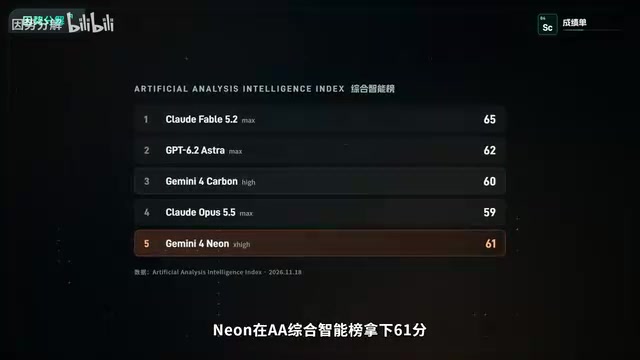
Google's claim: Neon's overall quality is close to or even exceeds Carbon, while being three times faster and 40% cheaper. Carbon is in an awkward spot — it spent barely a few days as the "virtual No. 1" before Fable 5.2 flanked it, and now its own younger sibling is pounding on it.
On pricing, Neon's API is $3 per million tokens for input, $15 for output, and $0.15 for cached input, with the lowest per-task consumption among models in its tier. Pro and Ultra subscribers can use it directly, while Plus users once again find themselves on the losing end.
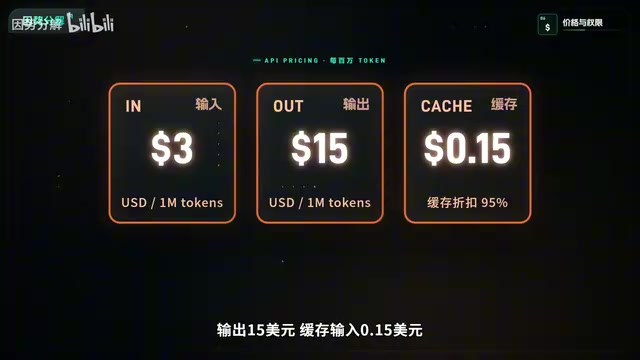
You may not have noticed the shift in product logic here: "cheap" used to mean degraded capability, but Neon takes the "near-flagship capability + lower unit cost" route. For developers building Agent-type applications, lower per-task cost matters more in practice than leaderboard rankings — for long-running Agent tasks, cost scales linearly with the number of calls.
The AA Composite Intelligence Index (Artificial Analysis Intelligence Index) is a model capability leaderboard maintained by the independent evaluation firm Artificial Analysis. It aggregates weighted scores across reasoning, knowledge, coding, math, and other benchmarks, and is often used in the industry as a reference for comparing models across vendors. The Agent Arena Index focuses on evaluating a model's ability to execute multi-step tasks as an agent, including tool calling, planning, and long-horizon task completion. The Coding Agent leaderboard specifically measures model performance on real coding tasks, such as fixing bugs and implementing features. Each leaderboard has its own emphasis, and a single ranking cannot fully represent a model's practical applicability — but ranking near the top on all three usually indicates a relatively balanced model.
Four models in two months: the release cadence is itself a signal
Looking back at the timeline: Argon launched September 30, Carbon 28 days later, Hydrogen 15 days after that, and Neon 6 days after that. Four new models in just two months, with intervals getting shorter and shorter.
Put this timeline alongside public statements from Google executives, and things get more interesting. In September, news about Google achieving RSI (recursive self-improvement) began to spread, though there was no solid evidence at the time. In October, co-founder Brin publicly discussed the company entering an RSI loop; CEO Pichai subsequently acknowledged that AI agents had begun participating in researchers' model development work, but that fully autonomous RSI was still a long way off.

What needs to be distinguished: there is a considerable gap between AI-assisted R&D and fully autonomous RSI. The former means agents helping researchers run experiments, write code, and do screening; the latter means a system that can independently propose improvement directions and close the loop with verification. Google's current public statements only support the former — accelerated model iteration may partly come from AI assistance, but "four models in two months" looks more like mature engineering processes and release strategy, and cannot be directly equated with RSI having been achieved.
RSI (Recursive Self-Improvement) refers to an AI system's ability to autonomously improve itself, forming a positive feedback loop of "improve—verify—improve again." This concept is sensitive because, once established, model capabilities could grow exponentially rather than linearly. RSI as currently discussed in the industry is usually divided into different levels: the most basic is AI-assisted R&D, where agents handle experiment execution, code writing, and other supporting work while humans still make directional decisions; a higher level is a system that can independently propose improvement hypotheses and verify them in a closed loop. Google executives' public statements only support the former, so the accelerated releases more likely reflect improved engineering efficiency rather than RSI having landed.
What it means for developers and users
In the short term, Neon directly changes the price-performance landscape of Google's own product line: if you want near-flagship capability and care about cost, Neon is currently the first choice; for teams running long-duration Agent tasks, the per-task cost advantage is worth validating in practice. On the subscription side, Pro and Ultra users benefit directly, while Plus users need to reassess whether their tier is sufficient.
In the long term, what's really worth tracking is not any single model's score, but whether the release cadence can be sustained. If Google's iteration cycle continues to compress, it means AI-assisted R&D is substantively increasing its share of the production process — that would be the starting point for the RSI discussion to move from rumor to evidence. Until then, take "pinnacle of alchemy" with a grain of salt.
In Agent-type applications, the cost structure is fundamentally different from traditional chat scenarios. Long-running Agent tasks repeatedly call the model for planning, tool calling, and result validation, and a single task's token consumption can be tens or even hundreds of times that of an ordinary conversation — so the per-million-token price difference is amplified linearly by the number of calls. In addition, cached input pricing ($0.15 per million tokens for Neon) is especially critical for Agent scenarios, because system prompts and context are often repeated across multiple calls, and the cache hit rate directly affects the actual bill. When evaluating a model's cost-effectiveness, you should comprehensively calculate based on task complexity, number of call rounds, and caching strategy, rather than just looking at leaderboard scores or list prices.
Related articles
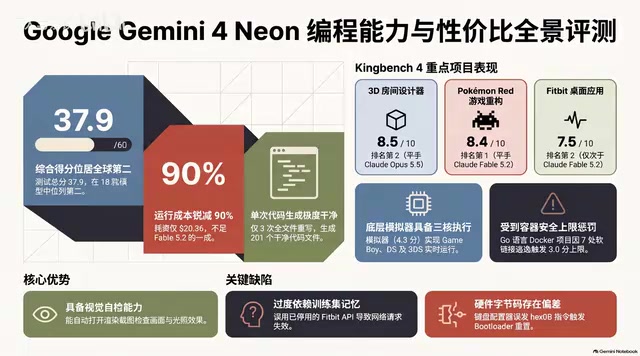
Gemini 4 Neon Hands-On: Value King or Confident Catastrophe?
Gemini 4 Neon review: 1M-token context, four thinking levels, 201 files in one KingBench4 pass at one-tenth Fable 5.2's cost—but it hallucinates fake data, leaves 7 symlink escapes, and bricks keyboards.

Google Gemini 4 Neon Hands-On: 6 3D Works That Impress and Fail
Hands-on with Google Gemini 4 Neon on a 3060 laptop: 6 3D works tested. Sunshower Fishing Harbor and mechanical keyboard impress; soft-body physics and faces fall short.
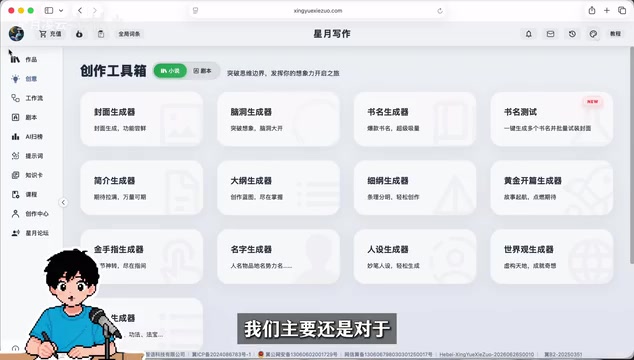
Gemini 4 Neo Web Novel Writing Test: Faint AI Flavor, Textured Dialogue
Bilibili creator's first-look review of Gemini 4 Neo for Chinese web novel writing: testing a Three Kingdoms transmigration opening with faint AI flavor, emotionally textured dialogue, and strong crisis building, plus comparison of 4A/4H/4C models and full workflow demos.