Gemini 4's Three Coding Models Compared: How to Choose Between Neon, Hydrogen, and Argon
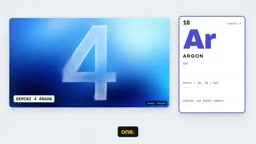
The division of labor, pricing traps, and programming selection advice for Google Gemini 4's four models.
The article outlines the positioning and differences among Google Gemini 4's four models—Carbon, Argon, Neon, and Hydrogen: Carbon handles the hardest long-cycle problems, Hydrogen focuses on fast everyday execution and is the only one with a free tier, Neon balances depth and efficiency and can orchestrate parallel sub-agents, and Argon is positioned as an efficient frontier reasoning model. On pricing, Argon's price increase on December 1 will flip the most expensive model from Neon to Argon. On the coding agent benchmarks from Artificial Analysis and Cursor, Neon ranks first in both and costs about half as much as Claude's top models, followed by Hydrogen, with Argon behind. However, developers' actual hands-on evaluations of Neon are divided. The conclusion is that new projects should prioritize Neon, budget-sensitive users should choose Hydrogen, and Argon is only suitable for teams already deeply tied to it.
Google's Gemini 4 series uses chemical element names, and placing Argon, Neon, and Hydrogen side by side offers almost no functional clues. Add in the earlier Carbon, and many developers are genuinely confused about which model addresses which problem, how much the prices differ, and which one to use for writing code. This article, based on hands-on testing from a YouTube tech channel and combined with independent benchmarks from Artificial Analysis and Cursor, aims to clarify the matter.
The Division of Labor Among the Four Models: The One-Sentence Version
Google's own description can be condensed into three sentences: Carbon handles the hardest, longest-cycle problems; Hydrogen handles fast, everyday execution tasks; Neon strikes a balance between depth and efficiency.
Hydrogen was released on November 12, positioned as "fast and efficient," aimed at everyday programming and agent work. It is the one most ordinary users encounter—it powers the Gemini app, Search, and the free tier of the API. Google claims it completes tasks 2.5 times faster than Gemini 3.8 Flash.
Argon is the oldest of the three, having launched in October. Officially positioned as an "efficient frontier reasoning model," its documentation explicitly states it is suitable for most advanced software engineering and knowledge work. It thinks less per turn than Carbon, so it responds faster.
Neon was released on November 18 and is the newest of the three. In the anti-gravity environment, it can also act as an orchestrator, scheduling parallel Hydrogen sub-agents. All three models support a 1 million token context.
Pricing: Who Is Most Expensive Depends on the Date
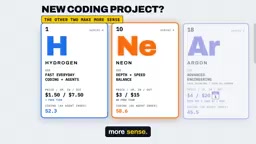
Priced per million tokens on the Gemini API, the input/output prices for the three models are as follows: Hydrogen at $1.50 / $7.50, and it is the only one offering a free tier; Neon at $3 / $15; Argon currently at $2 / $10, but this is introductory pricing.
The key date is December 1: Argon's price doubles to $4 / $20. In other words, before the end of November, Neon is the most expensive per token; after December 1, Argon becomes the most expensive. Simon Willison once publicly remarked that Gemini 4's pricing is "quite confusing," and that judgment is not unfair.
For budget-sensitive teams, this price switchover point is worth marking separately on the calendar—the same model has a completely different cost structure across a single month.
Per-million-token pricing and introductory pricing: Large model APIs generally price input tokens (prompts and context) and output tokens (model-generated content) separately, in dollars per million tokens. Since output is usually more expensive, and agent tasks repeatedly send context back and forth, the actual bill is often determined jointly by the input side and the number of turns—you cannot look at the unit price alone. Introductory pricing is a discount offered by vendors when a new model first launches to attract developers to try it, reverting to the standard price upon expiration. For cost-sensitive teams, such discount deadlines should be treated as hard constraints in procurement decisions, leaving headroom in budget models for post-increase rates rather than doing long-term capacity planning based on current prices.
Programming Capability in Practice: Neon Ranks First, but the Advantage Is Not Overwhelming
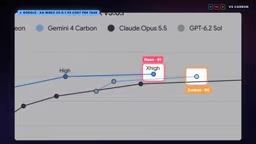
Artificial Analysis ran a coding agent index on real engineering tasks, scored as "model + harness." Under Google's own anti-gravity CLI, Neon scored 58.6, ranking first and essentially tying with Claude Fable 5.2 and Opus 5.2. A more telling detail is cost: Neon costs about $6.86 per task, while Opus is $12.61 and Fable is $15.47.
Hydrogen scored 52.3 on the same benchmark, and Argon scored 45.5. Cursor's own benchmark produced the same ordering: Neon 63.7%, Hydrogen 57.3%.
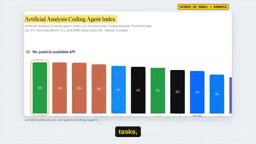
So is Argon bad? Not exactly—it has simply been quickly surpassed by newcomers. On Artificial Analysis's intelligence index, Hydrogen slightly leads Argon 51 to 50, and at a lower price. Argon retains one advantage: when it does not know the answer, it is one of the models that "guesses" the least. But for new programming projects, the other two are clearly more cost-effective.
Coding agent index and "model + harness" scoring: These benchmarks do not simply test the quality of a single code generation; they place the model in a complete agent loop—it reads and writes files, runs commands, examines errors, and modifies again until the task is completed or steps are exhausted. The so-called harness refers to the external framework driving this loop (such as anti-gravity CLI or Cursor's agent environment), which determines the format of tool calls, how context is trimmed, and whether to retry after failure. Therefore, the same model with a different harness may see significantly different scores; this is why the article emphasizes that an ordering is only meaningful if it is consistent across two independent benchmarks. Scoring usually combines task pass rate with consumed tokens/cost, so "cost per task" and score must be viewed together to judge cost-effectiveness.
Intelligence index and "guessing rate": Artificial Analysis's intelligence index is a comprehensive ability score spanning disciplines and difficulty levels, weighting evaluations in mathematics, science, code, instruction following, and more into a single number for easy horizontal comparison of models from different vendors, but it does not reflect performance in a specific engineering scenario. The "least guessing when it does not know the answer" mentioned in the article corresponds to the model's calibration—that is, whether it tends to acknowledge uncertainty rather than fabricate a plausible-sounding answer. A well-calibrated model is more controllable in high-risk tasks requiring human review, but for creative tasks such as "writing a new project from scratch," the benefit of calibration advantage is less obvious than speed and cost, which explains why Argon performs well on this metric yet still loses to Neon and Hydrogen.
Developer Reputation: Benchmarks Tie, Feelings Diverge
Cursor's post about Neon received over 2,000 likes, and Kimonismus, commenting on Hydrogen, said, "Google is in amazing form with this wave, I really like this model."
But actual feedback on Neon is split. One developer used it to make a game and felt it was close to Fable and Opus, though "Fable still does it better." Another bluntly said that in actual use it "feels far from Opus 5.5."
This is the current divergence: benchmarks say it ties, while some people's hands-on experience says it is still a notch behind. Considering that agent benchmark scores are highly dependent on the harness and task distribution, this divergence is not surprising in itself, but if you plan to use Neon in production, it is best to first run a round with your own team's real tasks.
Production validation and harness dependence: Before integrating a new model into production, looking only at public benchmarks is insufficient, because the task distribution of benchmarks often differs greatly from your own business—public benchmarks emphasize algorithm problems and standardized engineering tasks, while real projects contain a large amount of private code conventions, internal libraries, and specific business logic. A reasonable approach is to build a small-scale internal evaluation set: extract 20–50 samples with clear success criteria from the team's historical tasks, run them with the same harness and prompts as production, and record both pass rate and per-task cost. Only the ordering obtained this way is valid for you, and it can also expose model degradation under real conditions such as long context and multi-turn tool calls.
Which to Choose: Conclusions by Scenario
For the best Gemini programming capability: Neon. It has the highest coding agent score and costs about half as much per task as Claude's top models, making it the most outstanding choice for overall cost-effectiveness.
For limited budgets or free usage: Hydrogen. It is fast, low-priced, and built directly into everyone's Gemini app, with almost no barrier to trial.
Argon: only suitable for teams already deeply tied to it. Its position is being squeezed from below by Hydrogen, and you should also note the price increase on December 1.
Carbon: reserved for the hardest problems. It is not part of this comparison, but its positioning is clear—leave long-cycle, high-difficulty deep-thinking tasks to it.
The confusion in model naming is unlikely to improve in the short term, but the selection logic is actually not complicated: first look at the budget range, then see whether the task requires orchestration capability, and finally validate the feel with real tasks. All three models can handle a 1 million token context; the differences lie mainly in speed, depth, and unit price, not in capability boundaries.
One-line Summary
Google Gemini 4's four models: division of labor, pricing traps, and programming selection advice.
Paragraph Summary
The article outlines the positioning and differences among Google Gemini 4's four models—Carbon, Argon, Neon, and Hydrogen: Carbon handles the hardest, long-cycle problems; Hydrogen focuses on fast everyday execution and is the only one with a free tier; Neon balances depth and efficiency and can orchestrate parallel sub-agents; Argon is positioned as an efficient frontier reasoning model. On pricing, Argon's price increase on December 1 will flip the most expensive model from Neon to Argon. On the coding agent benchmarks from Artificial Analysis and Cursor, Neon ranks first in both and costs about half as much as Claude's top models, followed by Hydrogen, with Argon behind. However, developers' actual hands-on evaluations of Neon are divided. The conclusion is that new projects should prioritize Neon, budget-sensitive users should choose Hydrogen, and Argon is only suitable for teams already deeply tied to it.
Related articles
Gemini 4 Neon In-Depth: How to Get the Most Out of the Pro Plan's Strongest Model
Gemini 4 Neon replaces Argon on Google AI Pro, outscoring Carbon on several tests while API pricing flips in December. We break down the three models, thinking-level cost strategies, coding and office benchmarks, and selection advice.

Gemini 4 Neon Hands-On: Crushes Opus at Coding, but the Free Agent Hides Three Major Pitfalls
Gemini 4 Neon tops the Coding Agent Index, beating Carbon and Opus 5.5 in four real code battles—but hidden reasoning tokens bill at $15 and free Tasks silently fails.

Gemini 4 Neon Released: Google's Strongest Coding Model Tops the Rankings
Gemini 4 Neon tops the Artificial Analysis Coding Agent Index with 58.6. We break down its coding agent benchmarks, 1M token context, four thinking levels, and pricing below Carbon starting in December.