Gemini Decisions API Launches: Multimodal Decision Models Face Off Against Jev and OpenAI

Google launches Gemini Decision 1, forming a three-way race in decision models among Jev, OpenAI, and Google.
Google has released the Gemini Decisions API with the Gemini Decision 1 model, entering the decision model category alongside Jev and OpenAI. It supports yes/no, choice, and rubric-scoring questions, with an interface highly compatible with Jev—even reusing its "Noul" term. Pricing matches GPT-6 Luna at 10 cents per million input tokens with free output, while Jev stays cheapest at 4.2 cents. Gemini's edge is full modality support (text, images, audio, video, PDF), processing raw files directly. Testing shows Gemini returns probability values instead of 1.0/0.0 for yes/no questions, requiring callers to set thresholds—adding confidence tiering but also engineering burden. The three products' convergence on question types and terminology suggests the category is forming a de facto standard.
A Third Player Enters the Decision Model Race
Google has officially launched the Gemini Decisions API, joining the emerging decision model category with the "Gemini Decision 1" model. According to a blog post by Simon Willison, this release puts Google in a three-way competition with Jev and OpenAI. Decision models differ from general-purpose chat models in their positioning: instead of generating long-form answers, they return judgments on structured questions. Typical use cases include content moderation, data labeling, and automated quality inspection—scenarios that demand stable output.
From an API design perspective, Gemini Decision 1 closely resembles Jev, supporting three question types: yes/no judgments, multiple-choice selection (choice), and rubric-scoring. Interestingly, Google even adopted Jev's terminology "Noul" for yes/no questions, suggesting that the decision model interface spec is becoming a de facto industry convention—later entrants choose compatibility over starting from scratch.
Decision Model refers to a specialized class of models distinct from general-purpose generative models. Their design goal is not to produce long natural-language text but to return structured judgments on structured input, such as booleans, category labels, or scores. These models are typically optimized for specific tasks (moderation, labeling, quality inspection), with constrained output formats and higher reproducibility, making them suitable for embedding in automated pipelines. Compared with general chat models, decision models offer advantages in latency, cost, and output stability, but lower flexibility—they are not suited for open-ended Q&A. The rise of this category reflects an industry trend of decoupling "generation" from "judgment."
Three-Way Comparison of Pricing and Modality Capabilities
The differences among the three products first show up in pricing. Gemini Decision 1 and the GPT-6 Luna decision model are priced identically: 10 cents per million input tokens, with output free. Jev remains the cheapest of the three at just 4.2 cents per million tokens. For businesses that need to call decision APIs at large volumes, this price gap gets amplified by call volume, so cost-sensitive scenarios will still favor Jev.
Modality support is where Gemini stands out. Jev supports only text and JSON, OpenAI supports text and images, while Gemini Decision 1 covers text, images, audio, video, and PDF. This means tasks like video content moderation, audio quality inspection, and PDF document classification—which previously required transcription or frame extraction as preprocessing—can now send raw files directly to the decision API.
Token billing is the standard pricing method for LLM APIs: input tokens refer to the prompts and data submitted by the user, while output tokens refer to the content returned by the model. Because decision models produce extremely short outputs (such as a single boolean or category name), output costs are usually negligible, so vendors often adopt pricing strategies of "input-only charges" or "free output." Multimodal means a model can simultaneously process multiple input formats such as text, images, audio, video, and PDF. Traditionally, processing video or audio required preprocessing steps like transcription and frame extraction before handing off to a text model; native multimodal decision models can accept raw files directly, reducing preprocessing steps and lowering engineering complexity and latency.
Hands-On Video Test: Probability Outputs Instead of Hard Binary
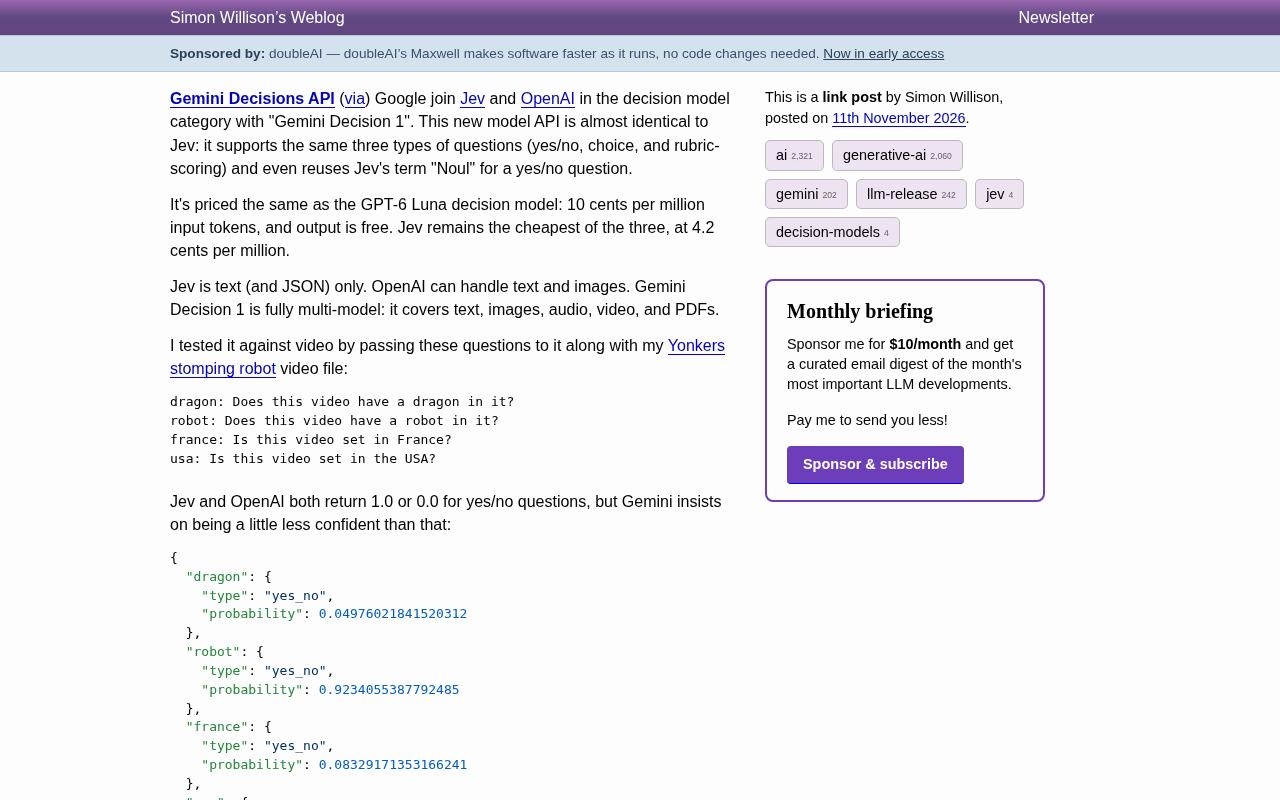
Simon Willison tested the model with a "Yonkers stomping robot" video, asking four yes/no questions: Does the video contain a dragon? Does it contain a robot? Was it filmed in France? Was it filmed in the US?
Jev and OpenAI return 1.0 or 0.0 directly for yes/no questions, whereas Gemini returns probability values: 0.0498 for dragon, 0.0833 for France, 0.9234 for robot, and 0.9230 for US. The judgment direction matches the facts—the video contains a robot, the location is the US, there is no dragon and it's not in France—but Gemini chooses to preserve confidence information rather than collapsing it into a binary result.
This design has trade-offs. The upside is that downstream systems can set their own thresholds—for example, automatically approving only when probability exceeds 0.9, and routing intermediate ranges to human review—enabling more fine-grained automation flows. The cost is that callers need to handle threshold logic themselves and cannot use the 0/1 result directly as a boolean like they can with Jev. For pipelines that prioritize determinism, this is an added engineering burden; for scenarios that need confidence tiering, it's a valuable signal.
Probability Outputs and Threshold Decisions: In classification tasks, a model can output the confidence level (a probability between 0 and 1) that a given judgment holds, rather than directly giving a hard binary label. Callers control the balance between automation and misjudgment risk by setting thresholds (e.g., >0.9 as positive, <0.1 as negative, with the intermediate range routed to human review). This design is especially common in content moderation, medical decision support, and similar scenarios, because preserving confidence information helps build tiered processing flows. In contrast, forced binarization loses uncertainty information but simplifies downstream logic. Each approach has its trade-offs, depending on the business's need for determinism versus fine-grained control.
The Decision Model Category Is Taking Shape
Within a short period, products from three independent sources have converged on the same set of question types and API forms, indicating that decision models are no longer an experimental feature of any single vendor but a category with clearly defined demand boundaries. Its core value lies in separating "judgment" from "generation": using specialized models for specialized tasks, with stable output formats, controllable costs, and easy batch invocation.
The main variable Gemini introduces is multimodality. When decision APIs can directly ingest video and PDF, content platforms' moderation pipelines and enterprises' document processing workflows may both be simplified. But whether developers will accept the probability output design remains to be seen from ecosystem feedback. According to Simon Willison's account, this difference is currently the most notable API behavior divergence among the three products.
One-line Summary
Google launches Gemini Decision 1, forming a three-way race in the decision model category among Jev, OpenAI, and Google.
Paragraph Summary
Google has officially launched the Gemini Decisions API, entering the decision model category with the Gemini Decision 1 model and forming a three-way competition with Jev and OpenAI. The model supports three question types—yes/no judgments, multiple-choice selection, and rubric scoring—with an API design highly compatible with Jev, even adopting its "Noul" terminology. Pricing matches GPT-6 Luna (10 cents per million input tokens, free output), while Jev remains the cheapest at 4.2 cents. Gemini's differentiation lies in full modality support (text, images, audio, video, PDF), handling raw files directly. Tests show that Gemini returns probability values rather than 1.0/0.0 binary results for yes/no questions, requiring callers to set their own thresholds—offering confidence tiering but adding engineering burden. The convergence of the three products on question types and API terminology indicates that the decision model category is forming a de facto standard.
Related articles

AI Could Overthrow Governments in Six Months? ARC Head Issues His Starkest Warning Yet
ARC head Paul Christiano warns AI capable of overthrowing governments may arrive in 6-12 months, with ~one-third odds of superintelligence within a year. He urges frontier labs to pause algorithmic efficiency gains and fix safety first, and reveals how the Hugging Face incident foreshadowed AI taking over evaluation.

How Do Spies Infiltrate Nvidia? A CIA Agent Reveals a Honeypot Operation
A former CIA agent reveals in a YouTube interview that intelligence agencies ran a honeypot seduction operation against Nvidia CEO Jensen Huang, exposing the hidden spy risks facing tech executives.

How NVIDIA Cosmos Helps Delivery Robots Rehearse Unexpected Situations in Advance
NVIDIA Cosmos World Foundation Model expands a small amount of real input into large-scale synthetic scenarios, enabling delivery robots to train for unexpected situations in simulation in advance. Cocoa Robotics uses it to cover unexpected events and combines Isaac Sim and Isaac Lab to evaluate perception, prediction, and path planning.