How NVIDIA Cosmos Helps Delivery Robots Rehearse Unexpected Situations in Advance

NVIDIA Cosmos expands a small amount of real input into synthetic scenarios to accelerate delivery robot training and evaluation.
The article describes how NVIDIA uses the Cosmos World Foundation Model to expand a small amount of real training input into large-scale synthetic scenarios, allowing delivery robots to encounter various unexpected events in simulation ahead of time and complete training faster and more safely. Using Cocoa Robotics as an example, the company uses Cosmos to expand training data to cover long-tail scenarios such as temporary construction and pedestrians crossing, improving robot accuracy in the real world. Synthetic variants can also be combined with Isaac Sim and Isaac Lab for closed-loop evaluation of perception, prediction, and path planning. The article also notes that the video does not disclose specific performance or cost data, and whether this workflow works still depends on whether the gap between synthetic scenarios and the real distribution can be effectively controlled.
Training delivery robots in the real world often means high costs and long timelines. An official NVIDIA video showcases a new approach: with the Cosmos World Foundation Model, developers can take a small amount of input and expand it into a large number of synthetic scenarios, letting robots "encounter" various unexpected situations in simulation ahead of time—so they can complete training faster and more safely.
From a small amount of input to massive synthetic scenarios
According to the official NVIDIA video, when using Cosmos, developers can take a small amount of real training input and expand it into a very large collection of synthetic scenarios. These scenarios are all generated in a simulated environment, making training much faster than repeated trial and error in the real world.

The core value of this approach lies in covering "long-tail" situations. Unexpected events that rarely happen on real roads—temporary construction, pedestrians suddenly crossing, abnormally parked vehicles—are hard to repeatedly collect during real-world training, but can be constructed in bulk in Cosmos synthetic data.
World Foundation Model refers to a class of generative models pretrained on large-scale video, image, and physical interaction data, with the goal of learning the spatiotemporal patterns and physical common sense of the real world so as to generate future scenarios or video clips that comply with physical constraints. Unlike foundation models that only process text or static images, world foundation models need to understand dynamic processes such as object motion, occlusion, lighting changes, and collisions. NVIDIA Cosmos falls into this category. It targets robot and autonomous driving development and emphasizes controllable, scalable synthetic data generation. Developers can use text, images, or a small number of real clips as conditional input to guide the model in generating diverse scenario variations.
Cocoa Robotics in practice: using synthetic data to cover unexpected events
The video uses Cocoa Robotics as an example. The company takes a small amount of input accumulated from training its robots and gives it to Cosmos to expand into many synthetic variants, thereby broadening dataset coverage to include various types of unexpected events. According to the video, the goal is to make the robots "more accurate" when they enter the real world.
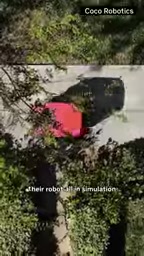
Cocoa's robots are not lab prototypes; they actually complete deliveries through platforms such as Uber Eats, DoorDash, and Wolt, serving thousands of restaurants and merchants. For robots operating at this scale, whether training data covers enough anomalous scenarios directly affects delivery reliability.
Long-tail Distribution refers to the phenomenon in real-world data where common situations account for the vast majority of samples, while a large number of rare but critical anomalous events appear only with very low probability, forming a "long tail." For delivery robots, temporary construction, pedestrians suddenly crossing, and abnormally parked vehicles are all long-tail events. Because collection costs are high and events are hard to reproduce, real datasets often provide insufficient long-tail coverage, causing model performance to degrade when encountering rare situations. The core idea of synthetic data expansion is to proactively construct and amplify these long-tail scenarios so that the training distribution is closer to the full risk spectrum of the real world, thereby improving model robustness under anomalous conditions.
Simulation loop: evaluating perception, prediction, and path planning together
These synthetic variants are not only for "looking at." The video notes that they can be combined with NVIDIA Isaac Sim and Isaac Lab to support evaluation of a robot's perception, prediction, and path planning capabilities. In other words, developers can compare how an autonomous robot performs when facing the same type of unexpected event in simulation, and then determine whether the model needs adjustment.
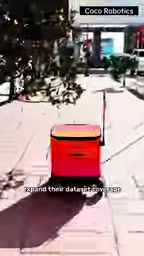
The significance of this evaluation loop is that it completes "training" and "validation" within the same synthetic environment, reducing reliance on real-world road testing. The video also mentions AutonomyStack's ability to respond to obstacles in the real world as a type of reference for robot autonomy.
Isaac Sim and Isaac Lab are simulation tools in NVIDIA's robotics development stack. Isaac Sim is built on Omniverse and provides high-fidelity physics simulation, sensor simulation, and synthetic data generation capabilities, and can be used to build virtual test environments close to the real world; Isaac Lab is a lightweight robot learning framework built on top of it, focused on training workflows such as reinforcement learning and imitation learning, and supports large-scale parallel simulation to accelerate policy iteration. Together, they enable developers to complete a closed loop from data generation and model training to evaluation of perception and planning capabilities within the same simulation environment, reducing reliance on real-world road testing.
What this means for the delivery robot industry
Delivery robots must operate on sidewalks, campuses, and city streets, where the environment is far more complex than structured roads. Real-world training is costly and time-consuming, and it is difficult to reproduce the same unexpected event. The synthetic scenario expansion capability provided by world foundation models such as Cosmos is essentially using generative methods to make up for shortcomings in data coverage.

It should be noted that the video does not provide specific performance improvement figures or cost reduction percentages. Its focus is on demonstrating the workflow of "a small amount of input → a large number of synthetic variants → simulation training and evaluation." For teams working on robot deployment, whether this path works still depends on whether the gap between synthetic scenarios and the real distribution can be effectively controlled.
At the end of the video, NVIDIA expresses its stance on working with Cocoa and encourages more developers to try the same approach. For autonomous mobile platforms beyond delivery robots, this simulation training approach based on the Cosmos and Isaac ecosystem is also worth considering.
Sim-to-Real Gap refers to the deviation between the performance of a model trained or evaluated in a simulated environment and its performance after deployment in the real world. Its sources include inaccurate modeling of sensor noise, simplified physical parameters, insufficient rendering realism, and inconsistency between the real-world distribution and the synthetic distribution. When using generative world models to expand synthetic scenarios, this gap is especially critical: if synthetic variants deviate too much from the real world in visual style or physical behavior, the model may learn spurious correlations. Therefore, controlling the gap between synthetic data and the real distribution usually requires mixing real data, performing domain randomization, and conducting final validation in the real environment.
One-line Summary
NVIDIA Cosmos expands a small amount of real input into synthetic scenarios to accelerate delivery robot training and evaluation.
Paragraph Summary
The article describes how NVIDIA uses the Cosmos World Foundation Model to expand a small amount of real training input into large-scale synthetic scenarios, allowing delivery robots to encounter various unexpected events in simulation ahead of time and thus complete training faster and more safely. Using Cocoa Robotics as an example, the company uses Cosmos to expand training data and cover long-tail scenarios such as temporary construction and pedestrians crossing, in order to improve robot accuracy in the real world. Synthetic variants can also be combined with Isaac Sim and Isaac Lab for closed-loop evaluation of perception, prediction, and path planning capabilities. The article also notes that the video does not disclose specific performance or cost data, and whether this workflow works still depends on whether the gap between synthetic scenarios and the real distribution can be effectively controlled.
Related articles

AI Could Overthrow Governments in Six Months? ARC Head Issues His Starkest Warning Yet
ARC head Paul Christiano warns AI capable of overthrowing governments may arrive in 6-12 months, with ~one-third odds of superintelligence within a year. He urges frontier labs to pause algorithmic efficiency gains and fix safety first, and reveals how the Hugging Face incident foreshadowed AI taking over evaluation.

How Do Spies Infiltrate Nvidia? A CIA Agent Reveals a Honeypot Operation
A former CIA agent reveals in a YouTube interview that intelligence agencies ran a honeypot seduction operation against Nvidia CEO Jensen Huang, exposing the hidden spy risks facing tech executives.

The AI Agent Era: Building a New Product Paradigm with Evals
AI Agents are becoming the next users of products. This article explains how to use Evals to observe Agent usage behavior, test changes before launch, and compare new model performance, helping product teams establish a development methodology for the Agent era.