Gemini Intelligence Expands to More Devices: New Features Explained
Google's Gemini Intelligence expands from select devices to more hardware, pushing AI assistants toward cross-device infrastructure.
Google announced that Gemini Intelligence is no longer limited to Pixel phones and a few flagship devices, but is expanding to more device form factors. The update centers on a dual expansion of "capability set + device coverage," officially described as "expanded capabilities," aimed at lowering device barriers and making AI ubiquitous. Multi-device coverage reduces experience fragmentation, shifting AI assistance from device-exclusive to predictably everyday. Strategically, Google follows its playbook of flagship validation before broader rollout, using scale to gather feedback and boost ecosystem stickiness—though no specific device list, feature details, or timeline has been disclosed.
Google's Gemini Intelligence is breaking free from the confines of Pixel phones and a handful of flagship devices, rolling out to a much wider range of hardware. The official blog announced this expansion and emphasized that the new capabilities will help users accomplish more in more scenarios. For anyone tracking the real-world progress of AI assistants, this sends a clear signal: Google is pushing Gemini from a single-device feature toward a cross-device personal intelligence layer.
What Gemini Intelligence Is Expanding
Based on the official description, the core of this update isn't any single feature—it's a dual expansion of "capability set + device coverage." Gemini Intelligence is no longer limited to specific hardware; it now appears as a suite of intelligent capabilities across more device form factors. This means users can get a more consistent AI experience across different endpoints, rather than having to readjust to a new assistant every time they switch devices.
At the capability level, the official wording is "expanded capabilities"—features that were previously available on some devices now cover a broader device range. While no itemized feature list was provided, the direction is clear: lower the device barrier and make Gemini's intelligence a more ubiquitous presence.
Gemini Intelligence vs. the Gemini Assistant: Gemini is Google's large-model brand, while Gemini Intelligence is closer to a system-level capability wrapper—it embeds model capabilities into the operating system and device interactions, enabling the assistant to execute tasks across apps and understand screen context, not just chat. Understanding this distinction helps clarify what "expansion" means: it's not just about chat entry points, but about the intelligent orchestration layer at the device level. This also explains why device coverage has such a huge impact on experience: system-level capabilities only form a coherent cross-device experience when they're available on enough endpoints.
How Multi-Device Coverage Changes the Experience
The value of an AI assistant largely depends on how often it's "present." If an assistant is only available on phones, then on tablets, laptops, or other endpoints, users are forced back to traditional workflows—a fragmented experience. Gemini Intelligence's expansion to more devices is precisely aimed at reducing that fragmentation.
For users, the more tangible change is this: the capability gap between commonly used devices narrows, and AI assistance shifts from "exclusive to specific devices" to "predictably available every day." This will also reshape user expectations around devices—AI capability is no longer a bonus point at purchase time, but is gradually becoming a baseline configuration.
The technical prerequisites for cross-device consistency: Delivering a consistent experience across endpoints typically depends on a unified account system, context syncing between devices, and a division of labor between on-device and cloud compute. Phones, constrained by power and memory, tend to handle lightweight inference; tablets and laptops can handle more complex tasks. The more device form factors there are, the more this allocation of compute and scenarios requires unified orchestration. So "more devices" isn't just about quantity—it's a test of the maturity of Google's cross-platform framework, and it determines whether users will truly feel seamless continuity rather than each device operating on its own logic.
Google's Strategic Intent in the AI Assistant Race
From an industry perspective, this expansion fits Google's familiar playbook: validate capabilities on flagship devices first, then gradually roll them out to a broader device matrix. The benefit is controlling early experience risk while leveraging device coverage to create scale effects. As Gemini Intelligence appears on more devices, the usage scenarios and feedback it collects will become richer, which in turn drives capability iteration.
Another notable dimension is ecosystem stickiness. Once an AI assistant is available across devices, user switching costs rise—changing devices no longer means just changing hardware, but also abandoning an intelligence layer users have grown accustomed to. This is an important card Google holds when competing with other AI assistants.
The industry convention of flagship validation before rollout: Validating new capabilities on a small number of flagship devices before gradually expanding coverage is a common practice in consumer electronics and system software. It controls early bugs and experience risks while gathering real feedback through flagship models' higher compute power and user tolerance. The cost is slower adoption, making it easier for competitors with more aggressive rollout strategies to capture mindshare. The pace of Google's expansion actually reflects its trade-off between "steady iteration" and "scale competition," and explains why the official announcement emphasizes direction without disclosing a specific list or timeline.
What It Means for Regular Users
In the short term, the most direct impact is that more users can access Gemini Intelligence on devices they already own, without having to switch phones specifically for AI features. For users already accustomed to using AI to assist with daily tasks, consistency across devices will improve noticeably.
It's worth noting that the official announcement did not disclose a specific device list, feature details, or rollout timeline—actual coverage still depends on device-side updates. Checking whether your device is on the supported list and whether your region has access is the more practical next step.
At its core, this expansion of Gemini Intelligence pushes the AI assistant from "selling point" toward "infrastructure." As intelligent capabilities become readily available on more devices, user expectations of AI will rise accordingly—this is both an opportunity and a promise Google needs to keep delivering on.
One-line Summary
Google's Gemini Intelligence expands from select devices to more hardware, pushing the AI assistant toward cross-device infrastructure.
Related articles

Microsoft Open-Sources Token Economizer: Saving 18%-31% on AI Coding Agent Costs
Microsoft's free open-source plugin Token Economizer cuts AI coding agent costs through micro skills, tool pruning, and failure loop intervention. Tests show 18.4% to about 31% average savings with Claude Code, Codex, and more.
Running GLM-5.3 on Two DGX Stations: A vLLM Tensor Parallelism Hands-On
NVIDIA engineers show how to run the 753B-parameter GLM-5.3 locally on two DGX Stations using vLLM tensor parallelism, covering RDMA setup, launch args, NCCL checks, and performance baselines.
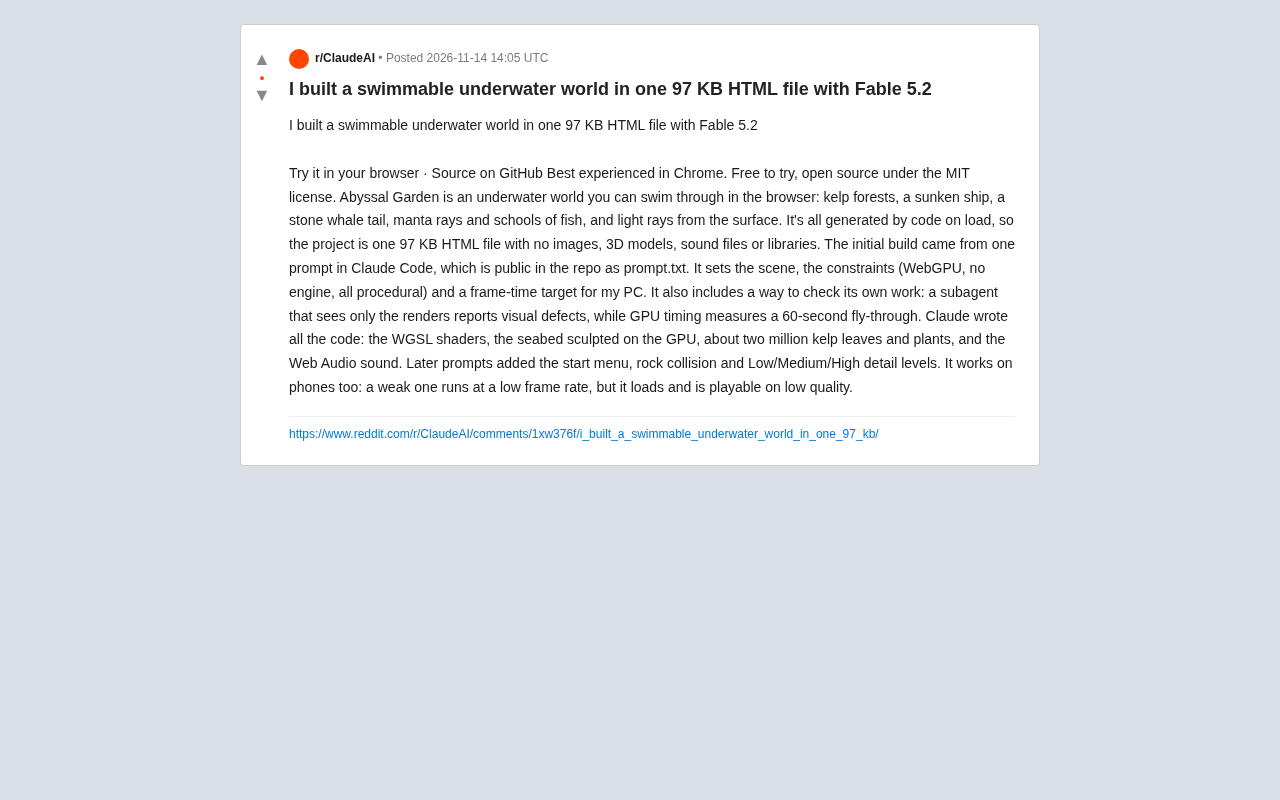
97KB Single-File HTML Underwater World: A WebGPU Experiment in AI Programming
A developer used a single prompt in Claude Code to generate a 97 KB single-file HTML underwater world, fully procedurally generated with WebGPU—kelp forests, a shipwreck, and fish, no images or model libraries, MIT-licensed, playable on mobile.