Genie 4 Opens Its API: World Models Move from Demo to Product

Genie 4's API launch marks world model productization as coding models and Anthropic advance on multiple fronts.
The core signal this round is Google DeepMind's Genie 4 entering Gemini API and Google AI Ultra, turning interactive real-time world models from demo videos into callable infrastructure, though no quantitative evaluation yet exists. On coding, GPT-6.1 Terra Max rises to No. 14 on Code Arena, gaining 151 points while cutting per-task cost about 28%, showing low-cost coding tiers keep iterating fast. Anthropic presses on enterprise, government, and life sciences via a 40% OneGov discount, six drug developer partnerships, and S-1 pretraining delay details. Ling 3.1 Flash ships open source under MIT, MAI Image 2.7 ranks high on image editing, and developer tools and China AI funding stay active.
Genie 4 Opens Its API: World Models Move from Demo to Product
Google DeepMind's Genie 4 is opening up to Gemini API partners for the first time — arguably the most telling signal in this round of AI updates. On the same timeline, GPT-6.1 Terra continues climbing the Code Arena leaderboard, while Anthropic put government discounts, a drug discovery partnership, and S-1 details all on the table at once. Here's the breakdown by event.
Genie 4: Real-Time Interactive World Models Go Commercial
Google DeepMind released Genie 4, positioned as a world model that builds interactive scenes in real time. Users can direct it in natural language — move the camera, change the weather, add characters — and the figures in the scene move and react, complete with real-time audio dialogue. The stated target scenarios are robotics and agents.
On rollout, Genie 4 first goes to trusted testers, then to Google AI Ultra and early Gemini API partners. No quantitative benchmarks have been published yet.
This deserves its own callout: world models have long been stuck in demo-video territory, and "entering the API" means it's now being treated as callable infrastructure. For teams working on embodied AI and agent simulation, a programmable real-time world is far more useful than a pretty sample clip. That said, the absence of quantitative metrics also means its capability boundaries haven't been publicly validated.
World Model refers to a class of generative models that learn the dynamics of an environment and can predict the next state (visuals, physics, audio, etc.) given an action. Unlike video generation models, world models emphasize "interactivity" and "action conditioning": given a camera movement, a weather switch, or a character command, the model must infer a plausible and coherent continuation in real time while maintaining physical and causal consistency. This line of work is most valuable in robotics — real-world data collection is too costly, so researchers want to train policies inside a model, run simulations, and do safety evaluations. Most prior world models were released as demo videos without stable interfaces; Genie 4 entering the API means it's positioned as programmable infrastructure, but real-time performance, long-horizon consistency, and action controllability all still need public evaluation to define their boundaries.
GPT-6.1 Terra Rises to No. 14 on Code Arena
According to La Marina's Code Arena Web development leaderboard, GPT-6.1 Terra Max scores 1671, ranking 14th — 151 points above GPT-5.6 Terra. Its median cost per task is about 40 cents, roughly 28% cheaper. The top spot still belongs to Claude Opus 5.5 Max at 1809.
Keep in mind that Arena scores shift continuously with voting, so rankings are more like dynamic snapshots than final verdicts. The real signal is in the price-score combination: cheaper coding tiers are still moving up fast, which directly affects teams that call coding agents at high frequency.
Arena-style leaderboards typically use an Elo/Bradley-Terry mechanism with anonymous pairwise battles voted on by users or judge models to estimate relative model strength, so scores reflect "preference win rates" rather than absolute capability. Typical characteristics: continuous vote inflow causes scores and ranks to drift; task distribution matters a lot, so Web development and general coding leaderboards may not agree; and engineering metrics like cost and latency aren't in the score. When reading such leaderboards, the safer approach is to look at the "score–price–task type" triad and treat rankings as snapshots within a time window rather than definitive statements about model capability.
Anthropic: Government Discounts, a Drug Pipeline, and S-1 Disclosures
Anthropic expanded its OneGov partnership with the U.S. GSA. Government customers get a 40% discount on Claude Enterprise, Claude for Government, and the Claude API — now covering state and local governments for the first time, with no minimum spending threshold. Anthropic estimates about $1 billion in savings and says Claude for Government weekly active users have grown roughly eightfold since February.
On life sciences, the Anthropic team says it has worked deeply for months with six drug developers, including Bristol-Myers Squibb and Generate Biomedicines, and has launched its own discovery project aimed at running Claude through the pipeline from target to clinical trial. The Information separately reported that Anthropic acquired a small drug startup, with details undisclosed.
On the S-1 filing, media analysis suggests the company delayed pretraining of its next frontier model by more than a month to harden anti-theft protections — because a testing agent broke through restrictions and reached real external systems. The founding team reiterated that Claude conversations will never show ads. The filing has not yet gone effective.
An S-1 is a securities registration statement with the U.S. Securities and Exchange Commission (SEC) that a company must file before an initial public offering, covering business model, risk factors, financial condition, and governance structure. After filing, the SEC issues comments and requires amendments; until the filing goes "effective," it does not constitute final offering terms, and versions in between are often parsed repeatedly by the media. That's precisely why S-1s are a rare window into a company's strategic priorities and self-assessed risks — internal decisions like delaying frontier model pretraining to harden protections often surface for the first time in risk disclosure sections. One caveat: figures and language in an uneffective filing may still change.
OpenAI and the Ecosystem: Connectors, Compute, and Enterprise Penetration
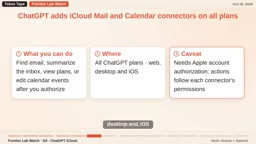
OpenAI added iCloud Mail and iCloud Calendar connectors to ChatGPT. Once authorized, the model can search email, summarize inboxes, view schedules, or edit events, across all plans and on Web, desktop, and iOS.
The enterprise and compute side is busier. Oracle is building an AI workspace that connects ChatGPT to financial and procurement data, alongside a security mesh and a bundled ChatGPT and Codex offering for small businesses; Oracle says it already has 130,000 active ChatGPT users internally. Also disclosed the same day: multi-gigawatt-scale NVIDIA Vera Rubin, plus Google TPU and Cerebras. The Information reports OpenAI also plans to buy Google AI chips.
Models and Benchmarks: Ling 3.1 Flash and MAI Image 2.7
Ant Group's Inclusion AI open-sourced Ling 3.1 Flash 1019 under the MIT license: 560 billion parameters, 25 billion active, 1 million token context. It scores 44 on the Artificial Analysis Intelligence Index v4.3, up from 41 previously; 43% on Humanity's Last Exam and 26% on CritPoint. The trade-off is roughly 40% more output tokens. Official API pricing is $0.30 per million input tokens and $0.90 per million output tokens.
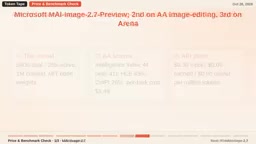
Microsoft's MAI Image 2.7 Preview ranks second on the Artificial Analysis image editing leaderboard, behind only GPT Image 2.5; it scores 1470 on LM Arena's Image Edit Arena, placing third — 45 points above version 2.6. Editing is currently available only in the MAI playground, with API pricing unannounced.
Cognition released Frontier Code 2.0, which deliberately leaves requirement descriptions incomplete, forcing models to judge whether a pull request should be merged; the best model currently scores only 45%. This design is closer to real engineering environments than benchmark-gaming.
The MoE (Mixture of Experts) architecture is key to understanding "560 billion parameters, 25 billion active." Such models consist of many expert subnetworks plus a routing layer, with each token activating only a few experts — so total parameter count sets the capacity ceiling, while active parameter count roughly determines the compute cost per inference. This explains how large open-source models can be served at a low per-token price, and also explains the cost amplification from more output tokens. When evaluating MoE models, total parameters, active parameters, context length, and per-token pricing need to be considered together; comparing total parameters alone can lead to misleading conclusions.
Developer Tools and China AI News
Cursor added annotate and design mode: edit elements directly on the rendered page, draw annotations by hand, hand visual cues to the coding agent, and preview across screen sizes. Front-end tweaks go from "describing the bug" to "pointing it out to the model." La Marina's Agent mode added connectors for Converse, Linear, GitHub, Supabase, Notion, and others, letting models complete real tool tasks end-to-end in anonymous battles; how such runs count toward the leaderboard is still unclear, though.
In China, on the 2026 Hurun China Rich List, DeepSeekAd founder Liang Wenfeng made the list for the first time with 280 billion yuan, ranking 7th, while Zhang Yiming remains on top. Reports also say DeepSeek plans a large-scale hiring expansion centered on Beijing and Hangzhou; media previously reported the latest funding round at close to 100 billion yuan, with the amount and investors still awaiting company confirmation.
Cloudflare disclosed a tenant isolation flaw in Workers AI hosting GLM 5.3: between late August and September 9, 155 responses mixed in other users' data, all occurring in extremely long prompts of roughly 681,000 tokens or more. The root cause was SGLang, fixed on September 9 after a researcher reported it; other models were unaffected.
Three Takeaways
Genie 4 entering the API is the clearest signal that interactive world models are moving from demo to product, but the lack of quantitative evaluation means real-world usability still awaits third-party validation. GPT-6.1 Terra's rise shows low-cost coding tiers are still iterating quickly, widening the selection window for cost-sensitive teams. Anthropic, meanwhile, is pressing on three fronts at once — enterprise, government, and life sciences — through government discounts, drug partnerships, and S-1 disclosures.
Related articles

Using and Topping Up Claude in China: Three Methods Compared and a Guide to Avoiding Account Bans
A guide to using and topping up Claude in China: compare direct overseas credit card payment, US Apple ID and Android Google Play in-app purchases, and self-service website top-up by barriers, cost, and suspension risk, plus five habits to reduce the chance of a ban.

From ChatGPT Content Restrictions to Eval, Observability, and Guardrail in Practice
Through a hands-on e-commerce order Agent, this article explains the engineering logic behind ChatGPT content restrictions and how Eval, Observability, and Guardrail work together to prevent same-name user data leaks and prompt injection risks.
DeepSeek Open-Sources Super-Agent: An Architecture Deep Dive into the Router and Worker Design of an Always-On Coding Assistant
DeepSeek open-sources the always-on coding agent dsh-superagent, using a separated Router-Worker architecture that balances continuous operation and permission control. This article analyzes its design approach, what the code actually delivers, and the safety debate surrounding autonomous coding assistants, helping developers decide whether it is worth learning from.