Get Your Coding Agent Off 2019-Era JavaScript and Onto Modern Web Primitives
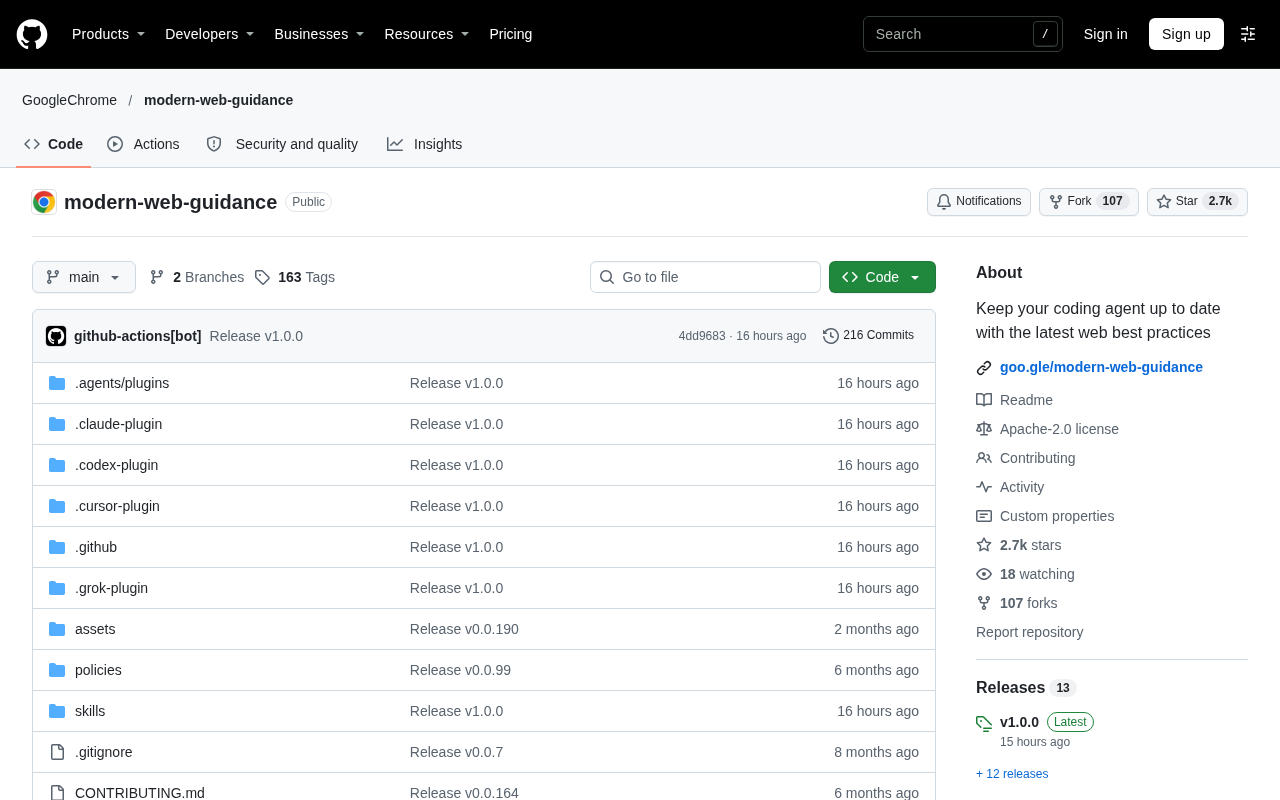
Coding agents output 2019-style JS due to corpus inertia; project advocates modern web primitives.
Based on a Hacker News Show HN project, this article examines how coding agents tend to generate outdated JavaScript resembling a 2019 tech stack due to training corpus inertia. The project advocates guiding agent output toward browser-native modern web primitives to reduce hidden technical debt, and the article suggests writing tech stack preferences into prompts and establishing review mechanisms.
The Knowledge Lag Problem in Coding Agents
As developers increasingly rely on coding agents to generate code, a hidden engineering risk is spreading: the JavaScript in these models' training corpora mostly reflects a tech stack frozen around 2019. A Show HN project on Hacker News targets exactly this pain point, titled "Get your coding agent off ~2019 JavaScript, onto modern web primitives," which earned 38 points and 8 comments in the community—indicating this isn't a niche complaint but a real friction many developers are experiencing.
This article analyzes based on that Show HN post and its discussion. Due to limited source material, some viewpoints are reasonable inferences based on the title and community positioning, which will be clearly noted below.
What Exactly Is "2019 JavaScript"?
The Source of Historical Inertia
A large model's learning of code style depends on the distribution of its training data. The JavaScript ecosystem has evolved significantly over the past few years, but the large volume of tutorials, examples, and legacy projects deposited in the corpus makes models more inclined to output conservative or even outdated patterns. The so-called "2019 JavaScript" typically refers to patterns that were once mainstream but now have better alternatives: verbose callback or Promise chains, manual DOM manipulation, configurations based on older build tools, and module handling lacking standardization.
Training data distribution and code style: The code generation capability of large language models is essentially a statistical mapping of training corpora. During pretraining, models absorb large amounts of open-source code, technical blogs, tutorials, and Q&A community content. These span a wide range of publication dates, but early high-quality examples are often repeatedly cited and indexed, forming a "long-tail advantage" in the corpus. The JavaScript ecosystem updates extremely fast, while corpus updates lag, resulting in insufficient coverage of emerging APIs and paradigms (such as top-level await, Array.prototype.at(), structuredClone(), etc.). Additionally, models tend to choose high-frequency patterns to ensure output stability, which further reinforces the reproduction of conservative patterns. Understanding this helps developers realize that an agent's "outdatedness" is not a bug but the combined result of data distribution and training objectives.
Contrast with Modern Web Primitives
In contrast, "modern web primitives" refer to capabilities the platform itself already provides, requiring no additional abstraction layer: standardized module systems, browser-native async and reactive mechanisms, cleaner API design, and new conventions at the framework and runtime level. The project's core proposition is to have coding agents prioritize this modern baseline when generating code, rather than replicating historical patterns.
Modern web primitives: This concept emphasizes directly leveraging capabilities already standardized in browsers and runtimes, rather than relying on third-party libraries or legacy abstractions. Typical examples include: native ES modules (<script type="module">) replacing bundler-specific module syntax; fetch and AbortController replacing XMLHttpRequest; async/await replacing callbacks and long Promise chains; native UI elements like <dialog> and popover replacing some modal libraries; and new APIs like Promise.allSettled and Object.hasOwn. These primitives reduce dependency complexity and improve portability and performance. The project's advocacy of having coding agents prioritize such patterns essentially makes platform capabilities the "first-class citizens" of code generation, reducing inheritance of historical baggage.
The Problem the Project Addresses
The "Hidden Technical Debt" of Agent Output
Code generated by agents often runs, but the style is outdated. Such code won't throw errors in the short term, but it plants hidden risks in maintainability, composability, and collaboration with existing projects. Developers need to spend extra time on modernization, offsetting the efficiency gains agents bring.
The Absence of Prompts and Constraints
The root of the problem lies not only in the models but also in how they're used. If a project doesn't provide agents with explicit modern-pattern constraints, models default to the older patterns more common in the corpus. This project can be understood as a targeted constraint or guidance solution that narrows the agent's output space to modern web primitives.
Practical Implications for Developers
Write Tech Stack Preferences into the Collaboration Workflow
Regardless of the project's specific form, its signal is clear: when using coding agents, you should explicitly write your team's tech stack preferences, target API versions, and code style into prompts, rules files, or project configurations, rather than expecting the model to align automatically.
Rules files and prompt engineering: In coding agent workflows, rules files (such as .cursorrules, AGENTS.md, or a project's CONTRIBUTING.md) and system prompts are key levers for constraining model output. Developers can explicitly declare the target ECMAScript version, module specifications, whether specific polyfills are allowed, and a list of preferred APIs in these files. Some tools also support anchoring style through example code (few-shot). Making tech stack preferences explicit is equivalent to providing the model with a "project constitution," so that it prioritizes retrieving relevant constraints during generation rather than relying on default corpus statistics. This approach is low-cost and versionable, making it suitable for inclusion in team collaboration workflows.
Establish an Output Review Mechanism
Modernization review of agent-generated code should become a routine step. Focus on whether patterns already replaced by native platform capabilities have been introduced, and whether modules and async handling conform to current engineering conventions.
Hidden technical debt: Refers to code generated by agents that is functionally correct but introduces patterns that don't meet current engineering standards, thereby creating additional costs in subsequent maintenance, refactoring, or integration. Such debt is hard for tests to catch because the code runs; but it reduces readability, increases dependency size, and hinders adoption of modern toolchains. Review mechanisms should focus on: whether deprecated APIs already replaced by native platform capabilities are used, whether module imports and exports conform to ESM specifications, whether async error handling is complete, and whether unnecessary abstraction layers are introduced. Incorporating modernization review into code review checklists, or automating detection with lint rules and static analysis tools, can effectively curb the accumulation of hidden technical debt.
Pay Attention to Community Consensus
The Show HN post received 38 points and 8 comments—a relatively limited number of comments, indicating the discussion is still early. Community feedback has not yet formed a complete consensus, and the project's effectiveness awaits more practical validation. Developers can view it as a direction worth trying rather than a settled solution.
Limitations and Outlook
The source material only provides the title, score, and comment count, lacking project implementation details, the author's notes, and original comments, so this article's description of the technical approach is primarily inference. You may not have noticed that the modernization problem of coding agents won't be solved by a single tool; it involves multiple layers including training data, prompt engineering, and engineering standards. This project represents a pragmatic approach: rather than waiting for model iteration, proactively guide the output.
One-line Summary
Coding agents output outdated 2019-style JS due to corpus inertia; the project advocates guiding them toward modern web primitives.
Paragraph Summary
Based on a Show HN project on Hacker News, this article explores the problem of coding agents tending to generate outdated JavaScript patterns resembling a 2019 tech stack. The author notes that large models depend on training corpus distribution, and the corpus contains large amounts of old tutorials and examples, causing models to output conservative patterns such as verbose Promise chains, manual DOM manipulation, and old build configurations. The project advocates guiding agent output toward browser-native modern web primitives to reduce hidden technical debt. The article suggests developers explicitly write tech stack preferences into prompts and project configurations, and establish output review mechanisms, while noting that the community discussion is still early and the solution's effectiveness remains to be verified.
Related articles

Microsoft Open-Sources Token Economizer: Saving 18%-31% on AI Coding Agent Costs
Microsoft's free open-source plugin Token Economizer cuts AI coding agent costs through micro skills, tool pruning, and failure loop intervention. Tests show 18.4% to about 31% average savings with Claude Code, Codex, and more.
Running GLM-5.3 on Two DGX Stations: A vLLM Tensor Parallelism Hands-On
NVIDIA engineers show how to run the 753B-parameter GLM-5.3 locally on two DGX Stations using vLLM tensor parallelism, covering RDMA setup, launch args, NCCL checks, and performance baselines.
97KB Single-File HTML Underwater World: A WebGPU Experiment in AI Programming
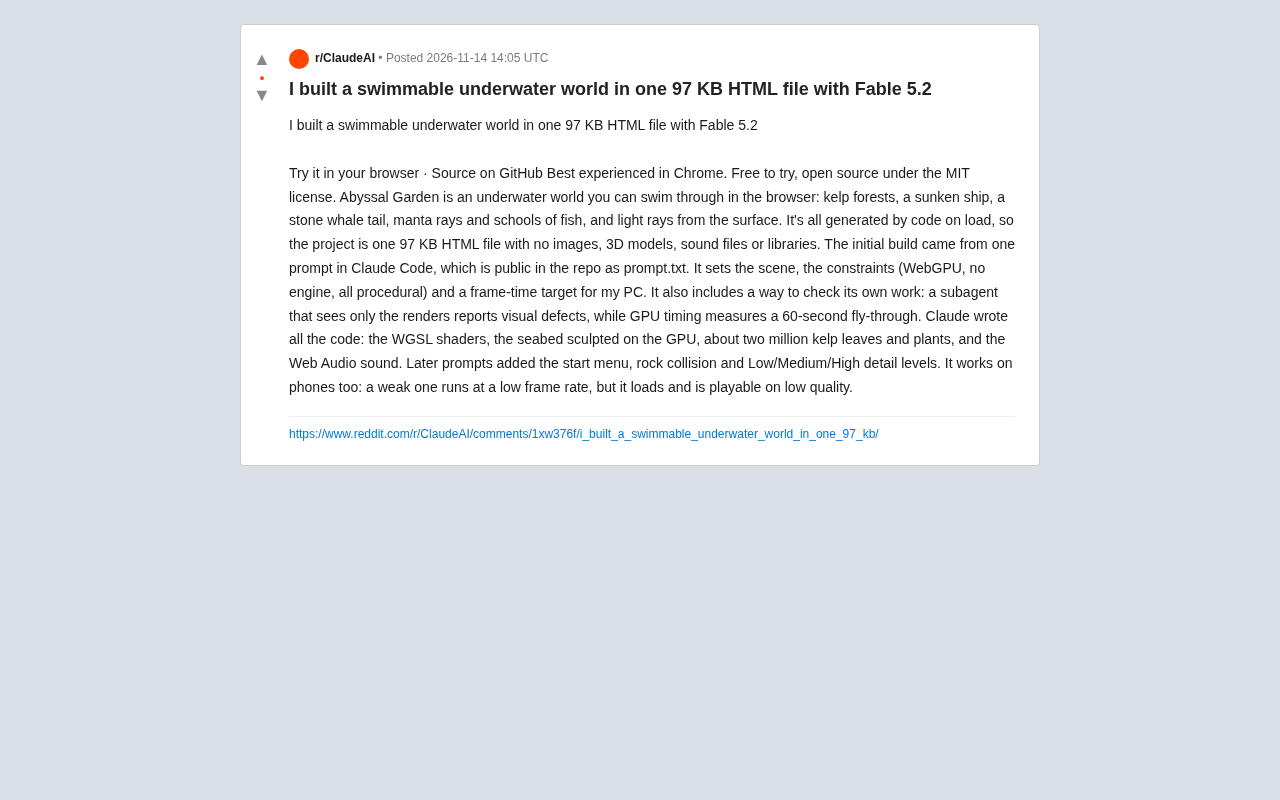
A developer used a single prompt in Claude Code to generate a 97 KB single-file HTML underwater world, fully procedurally generated with WebGPU—kelp forests, a shipwreck, and fish, no images or model libraries, MIT-licensed, playable on mobile.