GitHub Daily · November 13: Those Who Build Workbenches for Agents Win

Today's GitHub ranking centers on post-deployment agent engineering: collaboration interfaces and domain skill packages.
Today's GitHub Daily highlights four projects, two of which support AI agents: plannotator, a workbench for annotating agent output and feeding feedback back in one click, and claude-trading-skills, which packages financial domain knowledge into Claude Code skills. Also featured are the veteran self-hosted monitoring tool uptime-kuma and the compute-heavy Windows video enhancer Veyra-NRVideo, today's biggest gainer.
Today's ranking is rather interesting. Among the four projects, two are building supporting tools for AI agents, one is a veteran self-hosted monitoring tool, and one is a Windows player that squeezes every last drop out of GPU compute. On the surface they seem completely unrelated, but put together, the main thread is clear: people are no longer just training models—they're solving a pile of engineering problems that surface once agents land in the real world. How to make agent output visible to humans, how to feed human feedback accurately back to the agent, and how to get the agent to handle those repetitive financial analysis tasks for you.
There's another signal worth noting. Today's biggest gainer isn't an AI project—it's that video player, up 245 stars in a day. This shows that hardware enthusiasts and AI tool users are two different crowds, but both are looking for solutions within the same trend: trading compute for experience. Let's go through them one by one.
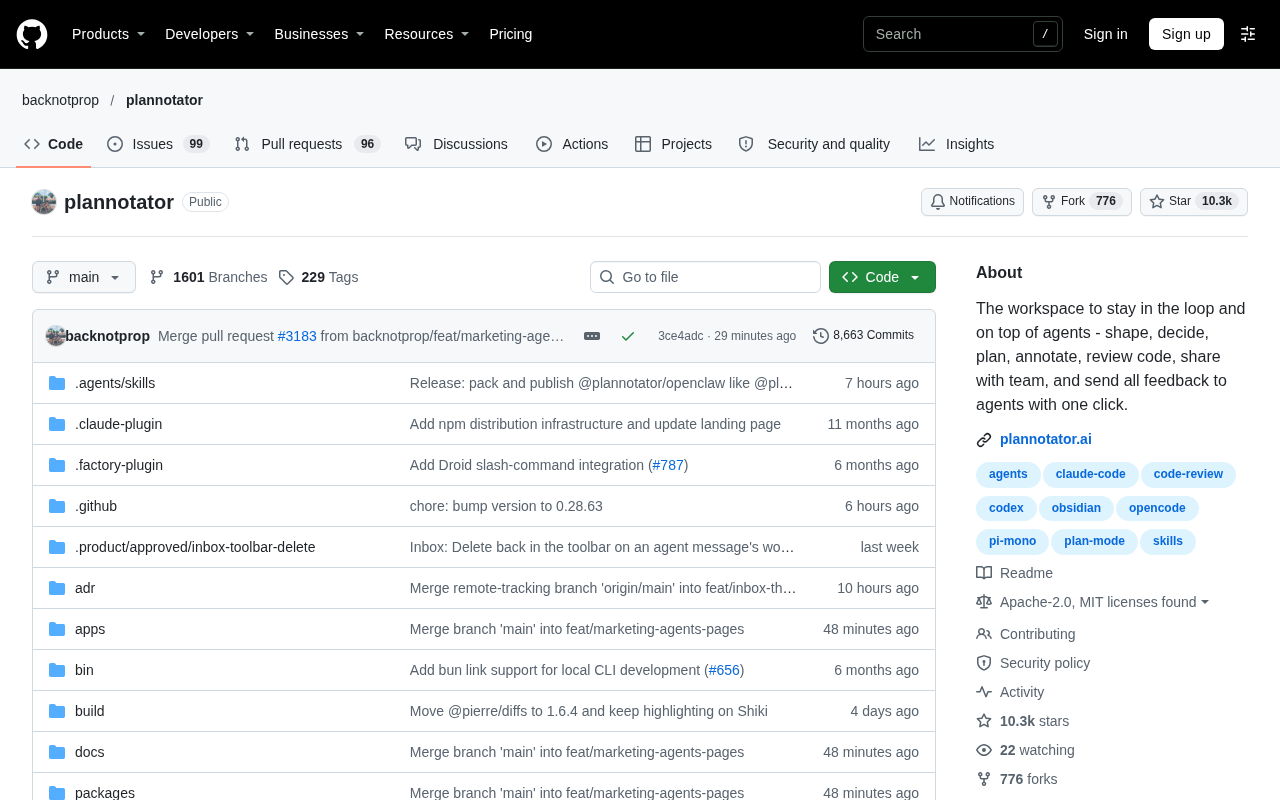

backnotprop/plannotator: Building a Human Workstation for Agents
This project ranks sixth, with over ten thousand stars, up 100 today. Its positioning can be summed up in one sentence: a workbench that lets you keep an eye on your agent and feed your thoughts back to it.
The problem it solves is very practical. Right now when you ask a coding agent to write code, it dumps hundreds of lines of diff on you all at once. You have to read through it from top to bottom, manually fix what you want changed, then copy it back into the conversation. That workflow is too fragmented. What plannotator wants to do is turn the review process itself into an interface: you first look at the agent's output, then annotate it, highlight key points, write comments, and finally send all that feedback to the agent with one click. You see, the point isn't making the agent smarter—it's making collaboration smoother.
The most noteworthy core feature is that one-click feedback relay. Annotations and comments don't just stay local for your own amusement—they're packaged into structured input the agent can directly understand. Get this step right, and the agent takes fewer wrong turns on the next round.
Who would use it? Scenarios where multiple team members review a single agent's output simultaneously, or when you're alone iterating on code with an agent over and over—it's handy either way. The tech stack is TypeScript, which tells you it takes the front-end experience route. For teams building developer tools, there's a lesson here: the collaboration layer may be an undervalued piece in the agent era.
A hundred stars a day isn't explosive, but it's a steady climb. This shows the demand is real, not just a flash in the pan.
louislam/uptime-kuma: The 90K-Star Veteran Is Still Growing
Ranked seventh, with over 93,000 stars, up 61 today. This is a self-hosted monitoring tool—put simply, you deploy a dashboard yourself and keep an eye on whether your websites and services are down.
It solves an old problem: third-party monitoring costs money, your data sits in someone else's hands, and configuration is a hassle. uptime-kuma turns this into a one-command affair, and the interface looks good too. That's the fundamental reason it's accumulated 90,000 stars.
Core features are self-hosting plus multi-protocol health checks, along with broad notification channel coverage. When your service goes down, it wakes you up through whatever channel you're used to.
Application scenarios are wide. Personal bloggers, small-team ops, even a batch of internal company services—all can use it. The tech stack is JavaScript, so the barrier is low and anyone can modify it.
Pay attention to its growth rate. A 90,000-star project still gaining over 60 stars a day shows this demand is evergreen. It's not news—it's infrastructure. In today's world where agents are everywhere, someone still has to watch the servers and make sure they don't go down. That hasn't changed.
tradermonty/claude-trading-skills: Breaking a Trader's Job Into Skill Packages
Ranked ninth, with over 3,800 stars, up 60 today. One-sentence positioning: a Claude Code skill set for stock investors and traders, covering market analysis, technical charts, economic calendars, stock screeners, and strategy development.
It fills a very specific gap. Claude Code is powerful, but if you want it to do quantitative analysis for you, you have to write a pile of prompts and scripts yourself. This project solidifies that into skills that work out of the box. You no longer have to train the agent from scratch—just pick it up and get to work.
Among the core features, technical charts and economic calendars are the most practical. The former lets the agent read candlestick patterns; the latter lets it know which days have major events. The stock screener and strategy development package up repetitive labor.
Application scenarios are clear: individual investors wanting to quickly run a screening round, or traders wanting to rapidly validate a strategy. But a word of caution here—tools are tools, and market analysis itself carries risk. Don't treat the agent's output as conclusions.
The tech stack is Python, which matches the financial data analysis ecosystem. The reference value for developers lies in how it demonstrates packaging domain knowledge into agent skills—a pattern that can be transplanted to many vertical industries.
3,800 stars, up 60 in a day—healthy growth. It shows people recognize this direction, but it hasn't reached universal adoption yet.
Likely7/Veyra-NRVideo: Feeding Frames With Compute
Ranked eleventh, with over 1,300 stars, up 245 today—the biggest gainer of the day. One sentence: a Windows video playback and capture enhancement tool featuring real-time preview, super-resolution, and frame generation.
The problem it solves is the conflict between image quality and frame rate. Your source material may only be 30 frames with mediocre resolution, but your monitor is high-res and high-refresh. This tool uses AI super-resolution and frame generation to fill in the picture. The description mentions being able to push GTA6 on PS5 to 120 frames—a claim with strong viral appeal, and one of the reasons it gained so fast today.
Its core feature is real-time. It's not offline processing—it enhances while playing, which demands high compute scheduling. The tech stack is C++, showing it stays close to the hardware—performance is its lifeline.
Application scenarios are gamers, video creators, and capture card users. When you're livestreaming or recording and want to output the enhanced picture directly, this is what you need.
245 stars in a day is clearly anomalous growth. On one hand it shows the hardware community spreads things fast; on the other, it reminds us that this kind of project heats up quickly, and whether it retains users depends on actual results. The reference value for developers lies in how it takes the DLSS approach and applies it to general-purpose video processing—a direction with plenty of room for imagination.
Today's Common Thread: After Agents Land, Engineering Problems Surface
Look at these four projects—two are directly agent-related. plannotator solves the collaboration interface between humans and agents; claude-trading-skills solves how to stuff domain knowledge into agents. What does this tell us? It tells us that once model capabilities reach a certain level, the bottleneck shifts to the engineering side. People no longer ask whether an agent can do something, but how to make it do it smoothly and how to plug human judgment into the loop.
The other two projects seem unrelated, but share the same core: trading compute for experience. One uses compute to watch services, the other uses compute to fill in frames. This is the underlying tone of 2026—compute has gotten cheap, and people are starting to trade it for all kinds of things.
Today's Must-See TOP 3
First, plannotator. It hits the freshly emerging pain point of agent collaboration, and its approach is clear.
Second, claude-trading-skills. It's a sample of a vertical-domain skill package, and the pattern is replicable.
Third, Veyra-NRVideo. The biggest gainer—worth checking out how exactly it uses C++ to achieve real-time enhancement.
As for uptime-kuma, it doesn't need a recommendation. It's already there.
A Final Word
What's worth watching tomorrow is the agent collaboration thread—whether more projects emerge. If tools like plannotator keep appearing, that means agents are truly starting to enter teams, not just being individual toys. That change is more worth paying attention to than how many stars any single project gains in a day.
One-line Summary
The main thread of today's ranking is the engineering problems after agents land: collaboration interfaces and domain skill packages; plannotator uses annotation plus one-click feedback relay to solve the human-agent collaboration gap; claude-trading-skills demonstrates a replicable pattern for packaging domain knowledge into agent skills
Related articles

The Ultimate Codex Tutorial: From Zero to Hands-On in 40 Minutes
A complete beginner's Codex tutorial: from GPT account registration and desktop installation to login error troubleshooting, permission and quota setup, and Pro membership upgrades—a step-by-step guide to getting started with an AI coding assistant, plus common fixes and practical advice.
AI-Driven Testing in Practice: How Agents Are Reshaping the Testing Workflow
Starting from how Agents work, this article analyzes the practical path of AI-driven testing: how task planning, tool calling, and feedback loops reshape the testing workflow, and the boundaries and acceptance authority human testers must retain.
How to Review a 22,505-Line PR? Matt Pocock's Stacked PRs and Ratchet Rules
Matt Pocock split a 22,505-line agent PR into 9 stacked PRs, used a two-way/one-way door framework to isolate the DB change, and enforced ratcheted lint rules and retro.