GitHub Universe Announcement: Copilot Fusion Delivers 40% Speedup, Redefining the SDLC for the Agent Era
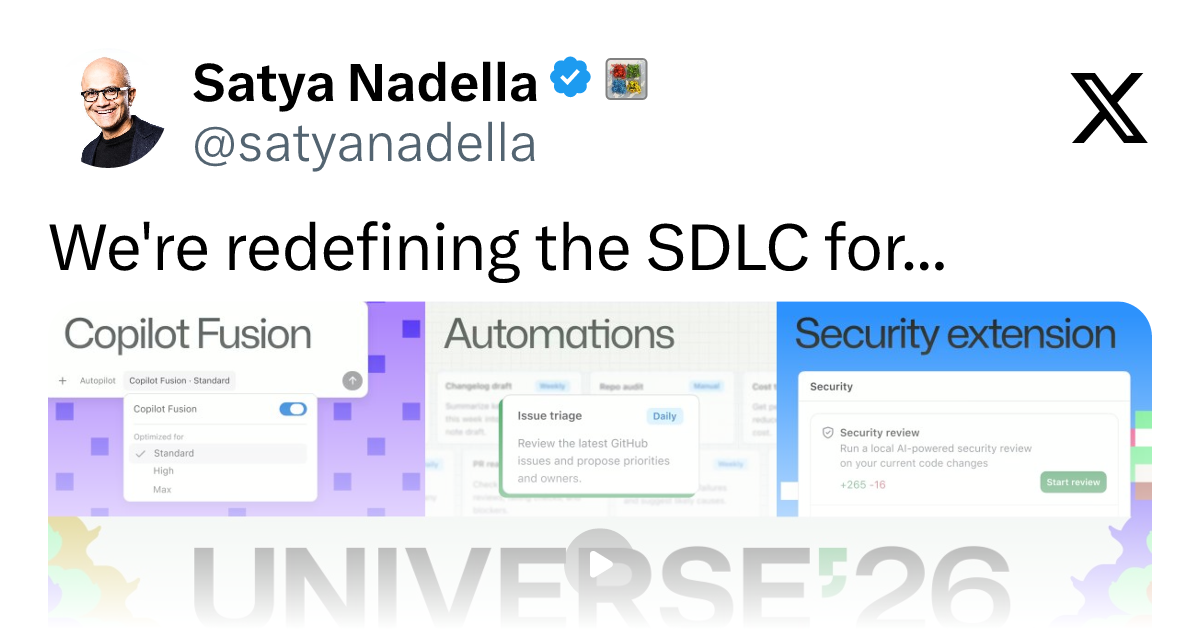
GitHub launches Fusion, Foundry, Projects, and architectural expansion to redefine the SDLC for the agent era.
At GitHub Universe, GitHub announced four updates aimed at reshaping the software development lifecycle for agents. Copilot Fusion claims frontier-level code quality with a 40% speedup and up to 77% lower costs, making high-quality generation economically viable at scale; a unified Copilot harness lands in the Foundry hosted service, providing state management and reliable tool calls for long-running agents; Copilot Projects uses an orchestration loop to enable multi-agent, cross-repository changes; and GitHub is expanding and hardening its architecture to handle continuously running agent workloads.
At GitHub Universe, GitHub rolled out a combined set of announcements with a clear goal: rewriting the software development lifecycle (SDLC) for the agentic era. A post from the official X account lays out multiple updates in one go, spanning model capabilities, runtime hosting, and multi-agent orchestration—covering the full path from writing code to running tasks.
Copilot Fusion: Squeezing Quality, Speed, and Cost at Once
The most closely watched item is GitHub Copilot Fusion. According to the official description, it delivers "frontier-level" code quality while being 40% faster and cutting costs by up to 77%. Viewed together, these three metrics all point to the same problem: until now, agent-written code either fell short on quality and required repeated human rework, or met the quality bar but incurred inference costs and latency that were hard to scale. Fusion attempts to flatten that curve, turning high-quality generation into a baseline capability teams can rely on daily rather than an occasional demo.
For teams, this means the marginal cost structure of code generation changes. When each generation is cheaper, faster, and close to frontier-model quality, it becomes economically viable to put agents into CI pipelines and batch-process repetitive refactors or test completion.
Unified Copilot Harness Lands in Foundry: A Hosted Foundation for Long-Running Agents
The second update puts a unified Copilot harness into Foundry—a hosted service for building long-running agents. The key words are "long-running" and "hosted."
For agents to actually get work done, they can't just answer questions within a single conversation; they need to reason continuously, call tools, and execute multi-step tasks. These workloads place very different demands on infrastructure than ordinary inference requests: state management, reliability guarantees for tool calls, and recovery from failures. Foundry takes on that complexity so developers can focus on agent logic instead of building their own runtime. A unified harness also means agents across different scenarios can share the same underlying capabilities, reducing duplicated effort.
What Harness Means in the Agent Context
Harness originally refers to "tack" or "safety harness," and in software and AI engineering it has come to mean a "control layer" or "execution framework." An agent harness typically refers to the full set of runtime components wrapping the underlying model: the task loop, parsing and routing of tool calls, context and memory management, error retries, and termination condition evaluation. It determines how model capabilities are reliably translated into executable action sequences. A unified harness means the same execution semantics can be reused across different agents, sparing every team from reimplementing tool-calling protocols and state machines, and making it easier for the platform to provide unified observability, rate limiting, and failure recovery.
Copilot Projects: Cross-Repository Multi-Agent Orchestration
The third update, Copilot Projects, provides an orchestration loop that lets multiple agents work together across repositories. This addresses what a single agent can't handle—real projects often span multiple codebases, and a single requirement may involve coordinated changes to frontend, backend, and infrastructure configuration.
The value of the orchestration loop lies in structuring the process of "decompose tasks, dispatch, aggregate, verify." Multiple agents each own a piece, while the orchestration layer coordinates dependencies and merges results. This is the shift from "an assistant helps you write a snippet" to "a team of agents drives a cross-repo change"—and the practical embodiment of what GitHub calls redefining the SDLC.
Typical Structure of an Orchestration Loop
The orchestration loop is the scheduling core of a multi-agent system and generally consists of four repeatedly executed phases: planning (breaking high-level goals into subtasks and identifying dependencies), dispatch (routing subtasks to agents with the appropriate tools and permissions), execution and aggregation (collecting each agent's output and merging conflicts), and verification (running tests or static checks to confirm results). The loop replans when verification fails until exit conditions are met. Unlike a single agent, the orchestration layer must also handle cross-agent context passing, concurrency control, and permission boundaries—precisely the most complex parts of cross-repository scenarios.
Capacity Expansion and Architectural Hardening: The Infrastructure Prerequisite for Agent Development
Beyond the three product updates, GitHub also mentions it is expanding capacity and strengthening its own architecture to make this "home for agent development" more resilient. This detail is easy to overlook, but for a platform-level product it carries significant weight: when large numbers of agents run continuously on the platform, frequently reading and writing repositories and triggering workflows, the platform's stability and capacity directly determine whether all the features above can be used with confidence.
What This Combined Set of Announcements Is Really Saying
Taken together, GitHub's narrative is layered: Fusion addresses "is generation good and how expensive is it," Foundry addresses "where do agents run and how do they run for long periods," Projects addresses "how do multiple agents collaborate," and architectural expansion addresses "can the platform keep up." Only with all four layers stacked does a complete agent development environment emerge.
What's worth noting is the ambition behind the phrase "redefining the SDLC." The traditional SDLC is designed around the rhythm of human collaboration—requirements, development, testing, deployment—with clear human handoff points at each stage. Once agents enter the picture, these handoff points become task transfers between agents, and the human role moves up to goal setting and result review. GitHub wants to occupy the infrastructure position for this new process.
However, the information disclosed in the official posts centers on capability claims. How Fusion's quality benchmarks are defined, where Foundry's hosting boundaries lie, and how Projects' orchestration performs in practice under complex repository structures all still need hands-on validation by developers. For teams, the more pragmatic approach is to start at a single point—first use Fusion to evaluate the actual change in generation costs, then consider migrating long-running tasks to Foundry, and only lastly take on organization-level changes like multi-agent orchestration.
SDLC and Human Handoff Points
The SDLC (software development lifecycle) is a classic framework describing the entire process of software from requirements to retirement, with common stages including requirements analysis, design, development, testing, deployment, and operations. The traditional SDLC is designed with humans as the primary executors, with human handoff points such as reviews, approvals, and merges between stages to control risk and quality. Once agents are involved, these handoff points can be partially converted into task transfers and automated verification between agents, with human responsibilities moving up to goal definition, constraint setting, and final review. Understanding this shift is what makes it clear that GitHub's so-called "redefining the SDLC" is not about replacing a particular stage, but about restructuring how stages connect to one another.
One-line Summary
GitHub launches Fusion, Foundry, Projects, and architectural expansion to redefine the software development lifecycle for the agent era.
Paragraph Summary
At GitHub Universe, GitHub announced four updates aimed at reshaping the software development lifecycle for agents. Copilot Fusion claims frontier-level code quality with a 40% speedup and up to 77% lower costs, making high-quality generation economically viable at scale; a unified Copilot harness lands in the Foundry hosted service, providing state management and reliable tool calls for long-running agents; Copilot Projects uses an orchestration loop to enable multi-agent, cross-repository changes; and GitHub is expanding and hardening its architecture to handle continuously running agent workloads. The four layers map to generation capability, runtime, orchestration, and infrastructure, together forming the complete picture of a redefined SDLC—though specific benchmarks and boundaries still await developer validation.
Related articles

Open-Source AI Desktop Robot: Built with a Laptop + Android + Pico
Open-source AI desktop robot PAL9000: a MacBook runs MediaPipe vision and llama-cpp dialogue, an Android phone is the animated face, and a Raspberry Pi Pico W drives a 2-DOF pan-tilt head. Modular design, reproducible piece by piece, with a discussion of anthropomorphic design.

Why Did Your Backtest 'Beat' SOTA? The Weather Covariate Leakage Trap
A backtest showed Timestral's MASE dropping from 0.71 to 0.49, seemingly beating SOTA—but it was caused by weather covariate leakage. After correction, it was only 0.66. This article analyzes the leakage, the archived forecast dilemma, and provides a checklist for time series backtesting.
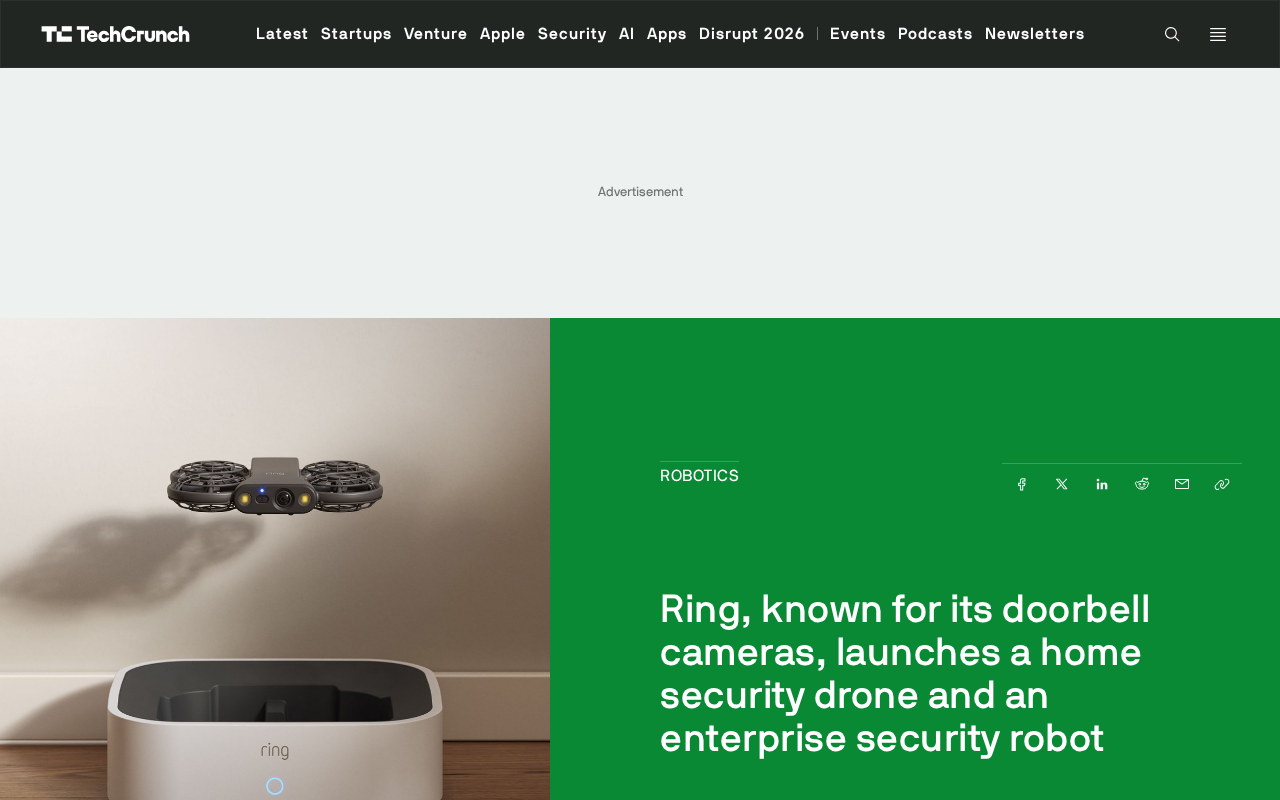
Ring Enters Robotics: Launching Home Security Drones and Enterprise Patrol Robots
Ring enters robotics with a home security drone and an enterprise rolling patrol robot. This article analyzes its product expansion logic, use cases, and practical challenges.