Giving Coding Agents Hearing: How AirShot Closes the Audio Feedback Loop

AirShot gives coding agents audio perception, runs purely on CPU offline, supports MCP resident invocation.
AirShot is a tool that gives coding agents audio perception, with pure CPU inference, locally loaded models, and offline use. It offers CLI and MCP invocation modes: CLI reloads the model each call (20–40s), while MCP keeps it resident in memory, nearly eliminating loading overhead and better suiting agent iteration loops. Its Critic module scores audio against 7 professional launch videos with timestamped suggestions, but scoring reflects style similarity, not absolute quality. Deployment is lightweight—CPU Torch, Doctor check, MCP registered into Cloud Code—no GPU needed. The author sees it as an alignment check, not a sole quality arbiter.
Coding agents can generate product demo code, but they can't hear the sounds they produce—and a tool called AirShot is filling that blind spot. It runs purely on CPU, works fully offline, and through the MCP protocol it can keep models resident in memory, avoiding the 20–40 second reload wait on every call. According to a YouTube tech channel, AirShot's Critic module can also score against 7 professional launch videos and provide timestamped revision suggestions.
What Problem Does AirShot Solve?
Most coding agent workflows stop at code generation and visual verification. Once the code runs and the UI renders correctly, the task is considered done. But the audio in product demos—narration pacing, background music mood, sound effects synced to visuals—remains entirely outside the agent's perception. AirShot's purpose is to close this gap: giving agents the ability to "hear," so they can judge and adjust audio content.
The tool's design trade-offs are clear: pure CPU inference, locally loaded models, and offline use once dependencies are installed. The question posed in the video is worth every team answering—do you care more about offline capability or accuracy? Offline means data never leaves the local machine and there's no network dependency; but whether a small local model can meet the audio understanding precision required for professional launch videos remains a variable that needs verification.
CLI and MCP: Two Ways to Run the Same Tool
AirShot exposes two invocation modes with significantly different performance. In CLI mode, every call reloads the model, taking 20 to 40 seconds per invocation; MCP mode keeps the model resident in memory, so subsequent calls have almost no loading overhead.
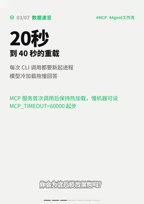
The video raises a pointed question: would you change your architecture for those few seconds? 20–40 seconds might be tolerable for a single analysis, but once an agent needs multiple rounds of audio judgment, the cumulative latency will drag down the entire workflow. The MCP resident approach is clearly better suited for embedding into a coding agent's loop, at the cost of introducing a protocol-layer dependency and persistent memory usage. Once the rules are public, the game changes—which approach a team chooses depends on how frequently the agent calls audio analysis and how latency-sensitive it is.
MCP (Model Context Protocol) is an open protocol proposed by Anthropic to standardize how large models connect to external tools and data sources. In AirShot's context, MCP acts like a "tool socket": coding agents discover and invoke AirShot's audio analysis capabilities through the protocol layer without writing separate integration code for each tool. Unlike CLI's one-off process calls, MCP services typically run as persistent processes—model weights are loaded only once, and subsequent requests go through in-process calls, which is the technical root of eliminating the 20–40 second loading delay. The cost is that the protocol layer itself introduces a layer of abstraction, and the persistent process continuously consumes memory, requiring trade-offs in resource-constrained environments.
Critic Module: Scoring Against 7 Professional Launch Videos
AirShot's Critic feature scores audio against 7 professional launch videos and outputs timestamped revision suggestions. The video makes a key qualification explicit: this is "how much it resembles those 7 videos," not an absolute standard. The reference set defines the boundaries of evaluation—audio that falls outside the style of these 7 videos may not receive reliable scores.

Timestamped suggestions are where Critic's practical value lies—the agent not only knows "what's wrong" but also "at which minute and second," allowing revisions to target specific segments. But the follow-up question in the video is equally valid: the model's score versus your own ears—which do you trust? When scoring only represents "resembling those 7 videos," the risk of handing launch video audio to a model for judgment is that it may misjudge innovative sound design as deviation.
Reference-based scoring is a common approach in audio and multimedia evaluation: the model doesn't learn an absolute quality standard but rather learns "similarity to given reference samples." This is practical when data is scarce, because collecting large amounts of human-annotated absolute quality scores is extremely costly, while a few universally acclaimed launch videos can serve directly as positive samples. But it has a structural limitation—the scoring space is "anchored" by the reference set, and the model tends to score audio that deviates from the reference style as low, even when that deviation is a deliberate artistic choice. Therefore, when using such scoring, it's usually necessary to pair it with manual spot-checking, or treat the score as an "alignment check" rather than a "quality verdict."
Installing CPU Torch and MCP Registration: A Deployment Path Without Touching a GPU
The deployment process is intentionally lightweight: install CPU Torch and dependencies, run Doctor to check the environment, and finally register the MCP into Cloud Code. No GPU is touched throughout, meaning any development machine or even a CI environment can run it.
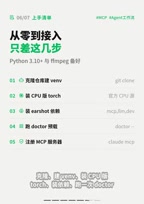
The existence of the Doctor step shows that dependency checking is treated as a first-class citizen, which is especially important for offline deployment—missing any link in the model, runtime, or protocol registration chain will cause silent failures. Registering the MCP into Cloud Code is the final step to integrate AirShot into the coding agent workflow; once registered, the agent can directly invoke audio analysis capabilities within the conversation loop.
CPU PyTorch is the official build that excludes CUDA dependencies—smaller install size, no GPU driver required, and runnable on any x86/ARM machine. The cost is significantly slower inference than GPU, but for audio analysis tasks like AirShot that involve modest model sizes and primarily offline batch processing, CPU inference remains acceptable. Another layer of significance in choosing the CPU build is portability: CI environments, GPU-less laptops, and even containerized deployments can all run it directly, avoiding the common problem of "works locally, errors on the server."
My Assessment
The trend AirShot represents is worth noting: the capability boundary of coding agents is expanding from "generating code" to "verifying multimodal output," and audio is the next perception gap after vision. But the tool's current evaluation system is built on similarity to 7 reference videos—essentially style imitation rather than quality judgment. It's suitable for alignment checks between launch video audio and existing professional standards, not as the sole arbiter of audio quality. The offline-versus-accuracy trade-off and the CLI-versus-MCP architecture choice are all questions teams need to answer before deployment.
Should your agent have hearing? If scoring only means "resembling those 7 videos," would you hand your launch video's audio over to it for judgment?
One-line Summary
AirShot gives coding agents audio perception, runs purely on CPU offline, and supports MCP resident invocation.
Paragraph Summary
AirShot is a tool that gives coding agents audio perception, featuring pure CPU inference, locally loaded models, and offline use. It offers two invocation modes: CLI reloads the model on every call, taking 20–40 seconds; MCP keeps the model resident in memory, nearly eliminating loading overhead, making it better suited for embedding into an agent's multi-round iteration loop. Its Critic module scores audio against 7 professional launch videos and outputs timestamped revision suggestions, but the scoring is essentially style similarity rather than absolute quality. The deployment path is lightweight: install CPU Torch, run Doctor to check the environment, register the MCP into Cloud Code—no GPU required throughout. The author's assessment is that the tool is suitable for alignment checks between audio and professional standards, not as the sole arbiter of quality.
Related articles
Microsoft Fabric Database Agent in Action: From Reactive Firefighting to Intelligent Detective
A deep dive into the Microsoft Fabric Database Agent: how to enable it, supported monitoring scenarios, a blocking-issue demo, and the roadmap from reactive to autonomous operations.

Zendesk Uses ChatGPT Enterprise to Build a Sales Agent with 1,000 Daily Active Users
Zendesk opened ChatGPT Enterprise to all employees, who built about 600 apps themselves, including a sales expansion agent with about 1,000 daily active users. This article analyzes how it turns internal data into sales opportunities and its "don't wait" implementation strategy.

Google Releases Gemini 4 Carbon: Its Strongest Model Yet, Debuting with a Cybersecurity Focus
Google releases Gemini 4 Carbon, calling it its strongest model, with a cybersecurity focus. It tops the third-party composite ranking at 59 points but leads by only one or two. This article analyzes its security test results, staged rollout, token pricing, and the divergence between self-reported and third-party tests on hallucinations.