GM's $220 Million Settlement: A Wake-Up Call for Driving Data Privacy

GM's $220M settlement makes explicit consent a hard requirement for driver data.
General Motors reached a $220 million settlement over the sale of drivers' private data, requiring explicit consent before collecting or sharing driving and location data. The article notes that connected cars generate gigabytes of data per hour, valuable to insurers, advertisers, and data brokers, while users often lack awareness of data flows. The settlement changes the underlying logic of data circulation: default checkboxes and bundled authorization no longer suffice, and data-selling business models face both consent thresholds and compliance costs. The case signals that data privacy compliance is shifting from a bonus to a must, and ignoring user data rights may cost far more than short-term gains.
Event Overview: GM's Record Settlement
According to RSS sources, General Motors (GM) has reached a $220 million settlement over the sale of drivers' private data. The news has drawn widespread attention in tech and privacy circles, as it involves not just a traditional automotive giant but also touches the most sensitive nerve of the connected-car era: who exactly owns the data generated by vehicles?
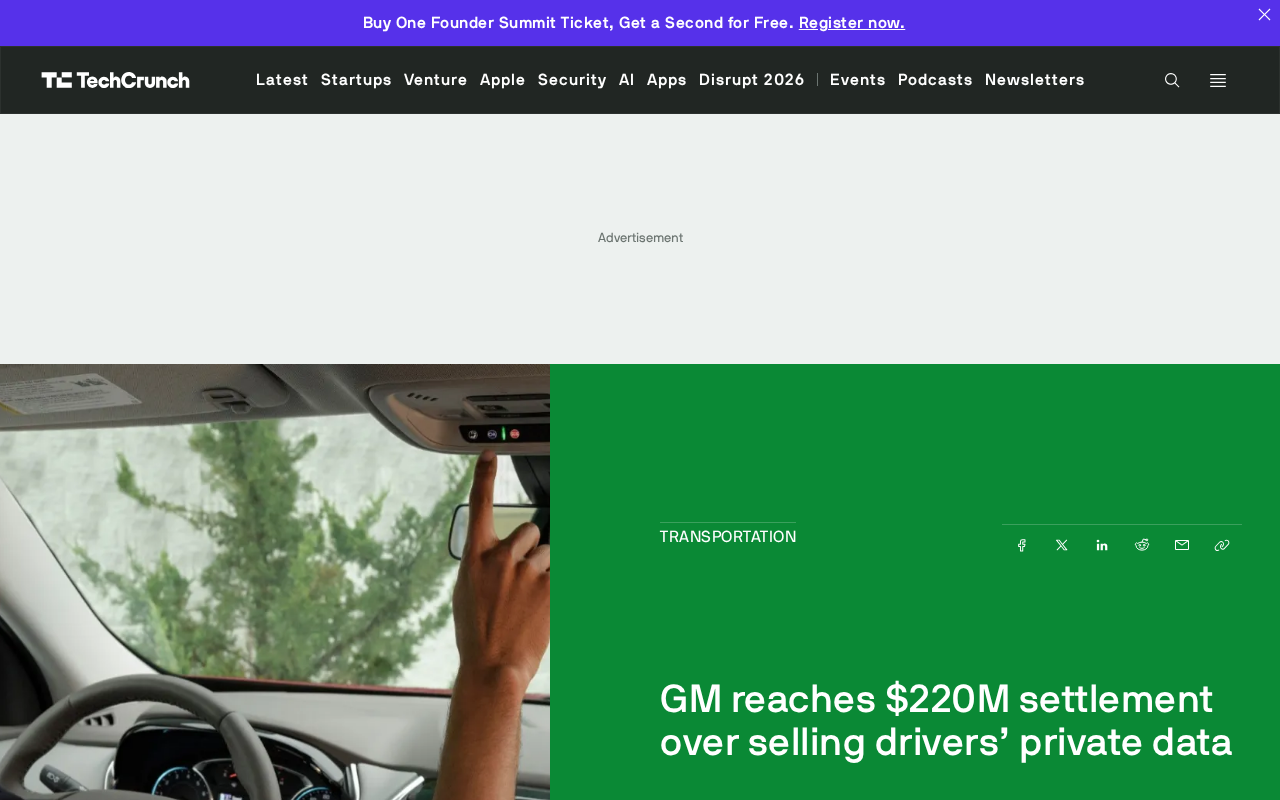
Under the settlement terms, GM must obtain drivers' explicit consent before collecting or sharing driving and location data. This means the business model of default collection, vague authorization, or outright data sales now faces direct legal constraints. For the entire auto industry, this is a clear signal: monetizing data cannot come at the expense of users' right to be informed.
Why Data Privacy Has Become the Auto Industry's "Gray Rhino"
Modern cars are no longer purely mechanical products. A connected vehicle can generate several gigabytes of data per hour, covering vehicle speed, braking habits, travel routes, in-cabin conversations, and even driver biometrics. This data is highly valuable to insurers, advertisers, and data brokers, and it represents new profit potential for automakers.
Yet the problem is that users often have no idea how much of their data is collected, where it flows, or what it is used for. The privacy terms many car owners sign at purchase are lengthy and complex, and the actual scope of authorization far exceeds what ordinary consumers understand. The core of GM's settlement is precisely the requirement that companies obtain "explicit consent" for data collection and sharing, rather than a blanket authorization buried in terms of service.
Gray Rhino is a concept introduced by American scholar Michele Wucker, contrasting with the "black swan": a black swan is a rare, unpredictable event, while a gray rhino is a high-probability, high-impact risk that has long been ignored. Automotive data privacy is a textbook case: data collection by connected vehicles has become an almost default industry practice, and warning signs of the associated risks have long existed, yet the issue has been set aside due to business-model inertia, limited user awareness, and lagging regulation. Once regulation tightens or class-action lawsuits erupt, companies are often caught off guard. Using "gray rhino" to describe this issue emphasizes the contradiction between the predictability of the risk and its systematic underestimation, and it also reminds the industry that privacy compliance can no longer be treated as a distant concern.
The Substantive Impact of the Settlement Terms
Explicit Consent Becomes a Hard Threshold
The settlement requires GM to obtain drivers' explicit consent before collecting or sharing driving and location data. This clause looks simple but actually changes the underlying logic of data circulation. In the past, automakers could lower compliance costs through default checkboxes and bundled authorization; now, every data collection and sharing action requires traceable, clear user permission.
Explicit consent is a core concept in data protection law, generally referring to authorization given by the data subject through a clear, affirmative action (such as actively checking a box or signing separately), rather than relying on default settings or presumed silence. It contrasts with "implied consent" and "blanket consent," requiring companies to obtain permission separately for specific data-processing purposes and to ensure users can withdraw it at any time. Under frameworks such as the EU's General Data Protection Regulation (GDPR), explicit consent also requires that information be sufficient, freely given, and verifiable. For automakers, this means consent interface design, record retention, and cross-system data flows all need to be rebuilt, significantly raising compliance costs.
The Data-Selling Business Model Takes a Hit
Selling driving data to third parties was once an incremental revenue source some automakers explored. The settlement directly restricts this path, requiring companies to obtain user consent before selling. Given the difficulty of obtaining user consent and the compliance costs, the economics of data sales may need to be recalculated. For players in the automotive ecosystem that rely on data monetization, this is undoubtedly a stress test of their business models.
Data brokers are companies that specialize in collecting, aggregating, and reselling personal data. They typically do not interact directly with consumers; instead, they acquire information in bulk from various apps, sensors, and transaction records, then process it into user profiles sold to advertisers, insurers, or financial institutions. In the automotive context, driving behavior, location trajectories, and in-cabin interaction data, once aggregated by brokers, can be used for personalized pricing, risk assessment, or even targeted marketing. Such transactions have long existed in a regulatory gray zone, with consumers having almost no way to know where their data flows. By requiring explicit consent, the GM settlement effectively cuts the most critical link in the "default collection—bulk resale" chain and pushes the role of data brokers in the automotive ecosystem to the forefront.
Implications for the Industry and Users
The significance of this settlement extends beyond GM alone. It sends a clear message to the entire auto industry: regulators and the judicial system are paying close attention to the collection and flow of vehicle data. As connected-vehicle penetration rises, data privacy compliance will shift from a "bonus" to a "must."
For users, this is also a reminder: while enjoying the convenience of smart cars, they need to take a more proactive interest in their data rights. Privacy terms at purchase are worth reading carefully, and questions about the scope of data collection should be raised proactively. Privacy protection is never a one-sided responsibility; users' awareness and choices are equally key.
From a broader perspective, GM's settlement provides a reference sample for automotive data governance. Finding a balance between technological innovation and privacy protection requires the joint evolution of law, technology, and business models. The $220 million price tag shows that the cost of ignoring users' data rights may far exceed short-term gains. For automakers still exploring data commercialization, this is a lesson worth taking seriously.
One-line Summary
GM reached a $220 million settlement over selling driver data, with explicit consent becoming a hard requirement.
Paragraph Summary
General Motors reached a $220 million settlement over the sale of drivers' private data, requiring it to obtain drivers' explicit consent before collecting or sharing driving and location data. The article notes that connected vehicles generate several gigabytes of data per hour, highly valuable to insurers, advertisers, and data brokers, yet users often lack awareness of where their data flows. The settlement terms change the underlying logic of data circulation: low-cost compliance methods such as default checkboxes and bundled authorization no longer work, and the data-selling business model faces pressure from both user authorization thresholds and compliance costs. This case sends a signal to the entire industry: data privacy compliance is shifting from a "bonus" to a "must," and the cost of ignoring users' data rights may far exceed short-term gains.
Related articles

LLM Application Development: A High-Paying Career Guide for Ordinary People
LLM application development offers fresh graduates up to 35K/month, with SP offers reaching 600K. This article explains the core skills, how to break in, and how ordinary people can seize AI opportunities through learning by doing.

Say Goodbye to AI Influencer Faces: A Complete Guide to Creating Visual Assets for AI Comic Dramas from Scratch
Bilibili creator shares a full workflow for zero-basics AI comic drama visual assets: use Doubao Work skills with script-first, visual references, and real-person texture to escape AI influencer faces, then lock character and scene consistency with asset sheet layouts, weapon detail images, scene nine-grids, and cinematic color palettes.

The AI Production Pipeline Behind Great Videos: From Research to Agent Validation
AI video production isn't just a model race. This article breaks down a transferable four-step pipeline: researching professional workflows, organizing a skill checklist, configuring agents, and experimental validation—and explains how general-purpose LLMs like DeepSeek can replace paid tools to run the entire process.