Gologin Cloud Browser: Solving Anti-Scraping Challenges for AI Agents

Gologin Cloud Browser provides AI agents with real cloud browsers via persistent sessions and anti-detection.
Gologin Cloud Browser is a cloud browser infrastructure for AI agents and scrapers, tackling anti-scraping bans and login state maintenance. It provides real Chromium instances with persistent sessions and built-in stealth anti-detection, plus proxies in 150+ countries. It runs fully in the cloud, scales to thousands of instances, and is Playwright/Puppeteer compatible via WebSocket. The team has 7 years of fingerprinting experience, SOC 2 Type II certification, a 99.9% SLA, and pricing from $4.50/month—though stealth effectiveness, latency, and long-term costs still need real-world testing.
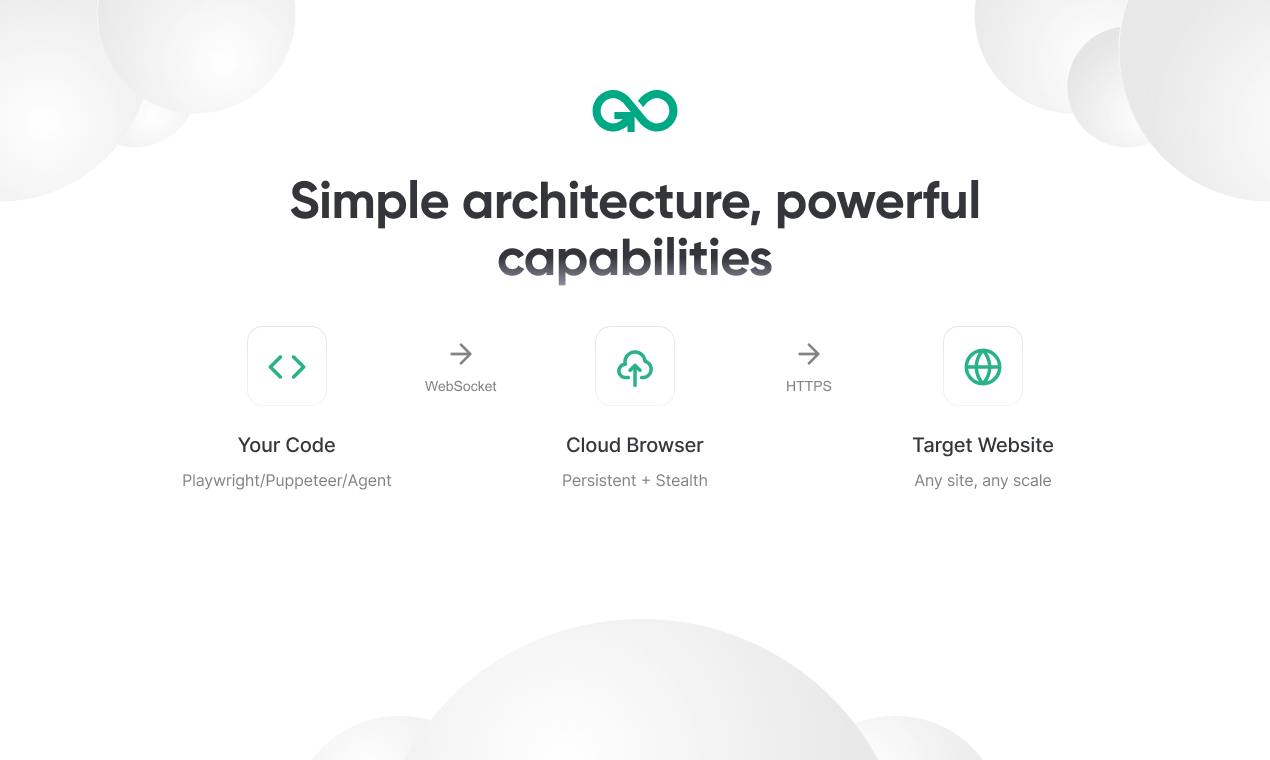
Why Do AI Agents Need a "Real" Browser?
When AI agents need to access web pages, scrape data, or perform automated tasks, they often face two practical obstacles: website anti-scraping mechanisms and maintaining login state. Traditional headless browser solutions get banned once identified as bots, and having to log in again on every run makes persistent tasks extremely cumbersome. Gologin Cloud Browser attempts to solve these two pain points at the infrastructure level—it provides real Chromium browser instances for AI agents and scrapers, and keeps login state persistent across runs.
Headless Browser refers to a browser without a graphical user interface that runs in the background, with page loading, rendering, and interaction controlled through code. Automation frameworks like Playwright and Puppeteer drive Chromium in headless mode by default—fast and low on resource usage—which is why they are widely adopted by scrapers and automation scripts. But headless mode exposes a range of detectable characteristics, such as navigator.webdriver being true, missing real GPU rendering information, abnormal WebGL fingerprints, and mismatches between window size and screen parameters. Website anti-scraping systems collect these signals to distinguish "real human browsers" from "bot browsers." Therefore, the term "real browser" usually refers to a browser environment with complete fingerprint characteristics that can pass the above detection—which is the fundamental reason cloud browser products emphasize stealth capabilities.
Core Features: Persistent Sessions and Anti-Detection
Gologin Cloud Browser's selling points center on three aspects.
Persistent sessions are the foundational capability. Each cloud browser instance retains complete login state and session data, which is not lost after a task ends, so the next run can continue directly. This means AI agents don't need to repeatedly execute login flows—especially critical for tasks requiring long-term tracking or multi-stage completion.
Built-in stealth and anti-bot protection is the differentiator. The product claims built-in stealth capabilities that help browser instances bypass common bot detection mechanisms. Combined with a proxy network covering more than 150 countries worldwide, users can make browsers appear as ordinary users from real geographic locations, reducing the probability of being banned by target websites.
Serverless architecture and development framework compatibility lower the barrier to entry. Gologin Cloud Browser runs entirely in the cloud, requiring no self-managed servers, and can scale to thousands of browser instances. It also supports Playwright and Puppeteer—the two mainstream browser automation frameworks—via WebSocket, so developers can migrate without significantly modifying existing code.
Browser Fingerprint is a set of characteristics websites use to identify visitors, including User-Agent, screen resolution, timezone, language, installed fonts, Canvas and WebGL rendering results, AudioContext parameters, hardware concurrency, and more. Combined, these parameters have high uniqueness and can be used for tracking even after cookies are cleared. The core idea of anti-detection is to give each browser instance a self-consistent and seemingly "normal" fingerprint, avoiding contradictory flaws (for example, claiming to be Windows but reporting a macOS font list). Furthermore, the fingerprint of the same instance needs to remain stable across multiple sessions; otherwise it will be identified as "the same user suddenly switching devices." The Gologin team's expertise in the fingerprint domain centers on fingerprint generation, consistency, and persistence.
SOC 2 Type II is an audit report under the trust services criteria established by the American Institute of Certified Public Accountants (AICPA). Unlike Type I, which only assesses whether control design is reasonable at a single point in time, Type II requires the auditing firm to continuously verify over an observation period (typically 6 to 12 months) whether the service provider's security, availability, processing integrity, confidentiality, and privacy controls actually operate as designed. For enterprise customers, this report is an important credential for evaluating a cloud provider's data governance level, often used in vendor security reviews and compliance processes. The accompanying SLA (Service Level Agreement) is a quantitative commitment to availability; 99.9% means roughly 43 minutes of allowed downtime per month, with service credits and other compensation terms typically accompanying any excess.
The Team Behind It and Compliance Endorsements
The Gologin team is no newcomer. According to product information, the team has 7 years of experience in browser fingerprinting and anti-detection, the product is SOC 2 Type II certified, and it offers a 99.9% SLA commitment. This information has real significance for enterprise customers—data security and stability are hard requirements when choosing cloud browser infrastructure. On pricing, plans start at $4.50 per month, a low barrier suitable for individual developers or small teams to try out.
Who It's For, and What to Watch Out For
Gologin Cloud Browser's target user profile is fairly clear: developers running large-scale scrapers, teams building web automation AI agents, and scenarios requiring stable login states for multi-account management. Its compatibility with Playwright/Puppeteer means existing automation scripts can migrate to the cloud at relatively low cost.
However, the product received 107 upvotes and 17 comments on Product Hunt, ranking 5th, indicating it has attracted some attention but has not yet generated large-scale discussion. For potential users, what needs evaluation is: the effectiveness of stealth capabilities against actual target websites, the response latency of cloud browser instances, and the long-term cost structure. The product page does not disclose these details, so small-scale testing is recommended before formal adoption.
Cloud browsers, as infrastructure for AI agents, are becoming a niche but critical segment. Gologin Cloud Browser addresses this need with persistent sessions and anti-detection capabilities. Whether it can build a reputation in the developer community depends on its stable performance in real-world scenarios.
WebSocket is a protocol that enables full-duplex communication over a single TCP connection, allowing the client and server to exchange messages at any time without rebuilding the connection on every request as with HTTP. In browser automation scenarios, Playwright and Puppeteer communicate with browser instances via CDP (Chrome DevTools Protocol), and cloud browser vendors typically wrap this local connection as a WebSocket endpoint, so developers only need to replace the connection address from localhost with a cloud URL to drive browsers remotely. The benefit of this design is that it abstracts away the complexity of underlying container scheduling, instance allocation, and network traversal, minimizing migration costs; the trade-off is additional network round trips, resulting in higher end-to-end latency than local execution—one of the key metrics to measure when evaluating cloud browsers.
One-line Summary
Gologin Cloud Browser provides AI agents with real cloud browsers through persistent sessions and anti-detection capabilities.
Paragraph Summary
Gologin Cloud Browser is a cloud browser infrastructure for AI agents and scrapers, designed to solve the two major pain points of anti-scraping bans and difficult-to-maintain login states. It provides a real Chromium instance for each task, persists sessions and login state across runs, and has built-in stealth anti-detection capabilities, combined with a proxy network covering more than 150 countries to reduce ban probability. The product runs entirely in the cloud with no self-managed servers, scales to thousands of instances, and is compatible with Playwright and Puppeteer via WebSocket for low migration cost. The team has 7 years of experience in browser fingerprinting, holds SOC 2 Type II certification and a 99.9% SLA, with pricing starting at $4.50 per month. The article also notes that stealth effectiveness, response latency, and long-term costs still need to be verified through testing.
Related articles

LangChain Retry Middleware Configuration: Practices and Selection Guide
Based on Reddit community discussion, this article analyzes LangChain ModelRetryMiddleware retry parameter configuration practices, covering the selection logic and alternatives for key options like max_retries, backoff_factor, and jitter.

Texas Senate Race in Trouble: Why Are Republicans Nervous?
Texas Senate race stirs Republican anxiety. Based on street interviews, this article analyzes the Democratic offensive in funding, organization, and running everywhere, and how Republicans are defending "Texas, Texas" amid the political pendulum effect.

Gemini Chat Now Generates and Edits Google Docs Directly, a New Breakthrough in Office Productivity
Google Gemini's chat interface now generates and edits PDF, Google Docs, Sheets, Slides, Markdown, TXT, and code files. Available to all users; web supports all formats, mobile only PDF for now.