Google Pixel Tag Officially Goes on Sale: A New Chapter for the Android Tracker Market

Google's first-party Pixel Tag goes on sale, completing the closed loop of the Android tracking ecosystem.
Google's own Pixel Tag is officially on sale; previously, the Android tracker market was occupied by third-party manufacturers such as Samsung, Motorola, and Pebblebee. The Pixel Tag was announced last August and works with Google's tracking network and the app now renamed Find Hub, priced similarly to Apple's AirTag. The article argues that this move fills in the first-party hardware piece, forming a "network + app + hardware" closed loop and potentially setting an experience baseline for third-party manufacturers. Network effects are the core moat of trackers, and Android's vast device base is Google's advantage. Third-party manufacturers are not out of the game and can still differentiate on form factor and scenarios. The future competitive focus will be positioning accuracy, privacy mechanisms, and cross-platform anti-abuse collaboration.
From Rumor to Shelf: Pixel Tag Is Finally Here
After years of third-party Android trackers from the likes of Samsung, Motorola, and Pebblebee, Google's own Pixel Tag is finally officially on sale. The product was first announced last August, positioned to work in tandem with Google's tracking network and its companion app—which was renamed Find Hub last year. In terms of price, the Pixel Tag sits in a similar range to Apple's AirTag.
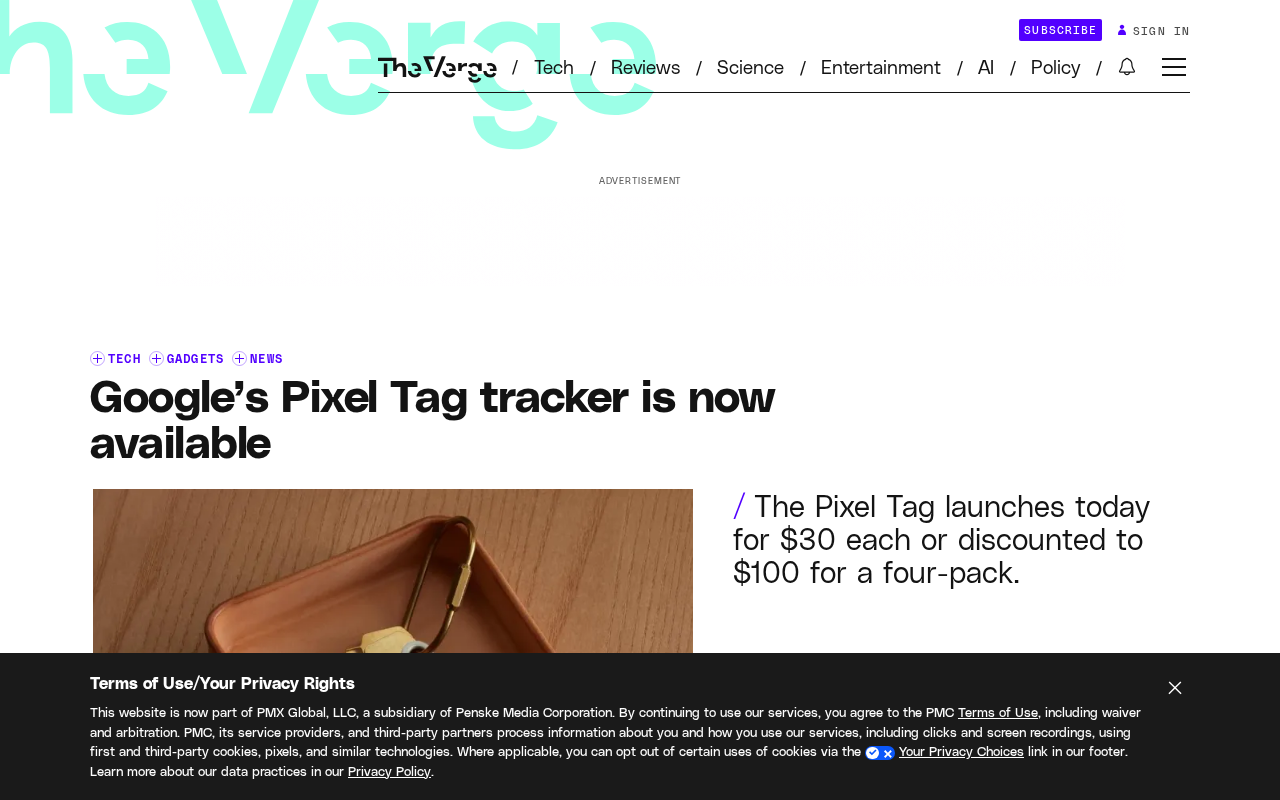
For users who have long followed the Android ecosystem, this news means more than just "a new toy." It marks Google's formal move—in the item-tracking niche—from "providing the platform and network" to "building the hardware itself."
Why Google Is Making Its Own Tracker
The Closed-Loop Logic of Platform and Hardware
Over the past few years, Google's role has been more like an infrastructure provider: the Find Hub (formerly Find My Device) network is open to third-party hardware makers, with Samsung's SmartTag series, Motorola's Moto Tag, and Pebblebee's products all plugging into it. This model expanded network coverage but also brought fragmented experiences—different brand apps, different pairing flows, different levels of feature support.
The arrival of the Pixel Tag fills in the missing piece of first-party hardware. Mirroring how Apple's AirTag integrates tightly with the Find My network, Google clearly wants to use its own hardware to showcase Find Hub's capabilities to the fullest while setting an experience baseline for third-party manufacturers.
UWB precise positioning technology: Ultra-Wideband (UWB) is a short-range wireless communication technology that achieves centimeter-level positioning accuracy by measuring the time of flight of radio waves. Unlike the rough distance estimates of Bluetooth RSSI, UWB can determine which direction a target is in and how far away it is, enabling "arrow navigation"-style finding when paired with a pointing interface on a phone. Apple AirTag's Precision Finding feature is based on this. For the Android ecosystem, UWB adoption varies widely, and whether Google opens this capability to third-party hardware will directly affect the gap between the Pixel Tag and competitors in close-range finding experiences.
Network Effects Are the Real Moat
The value of an item tracker depends heavily on network scale. Whether a lost device can be recovered depends on how many other devices nearby are willing to anonymously report its location. Google's tracking network relies on its vast base of Android devices—this is the core bargaining chip that gives it the confidence to compete head-on with Apple. As a first-party product, the Pixel Tag is expected to be a catalyst for drawing more users into that network.
How tracking networks work: These networks (called the Find My network by Apple and the Find Hub network by Google) are essentially crowdsourced Bluetooth positioning systems. The tracker itself contains no GPS or cellular module; it simply continuously broadcasts an anonymous identifier over Bluetooth. When other nearby user devices (such as Android phones) receive that signal, they report their own location along with the encrypted identifier to the cloud. When the owner queries through the app, they can only see locations reported by their own devices, while the stranger devices that helped report have no idea who they are locating. This design protects privacy while turning hundreds of millions of ordinary devices into positioning base stations—the larger the network, the higher the chance the tracker will be "seen."
Priced Against AirTag, With Clear Competitive Intent
The original article explicitly states that the Pixel Tag's pricing is close to that of the Apple AirTag. This is a market strategy with a clear signal: Google does not intend to disrupt the market with a low price, but rather to compete directly with the AirTag in the same price band.
For consumers, this means the decision focus when choosing a tracker will shift from "price" to "ecosystem affiliation"—iPhone users will continue to choose the AirTag, while Android users finally have an official first-party option and no longer have to choose among Samsung, Motorola, and Pebblebee.
You may not have noticed, but third-party manufacturers are not out of the game. They can still connect to the Find Hub network and differentiate on form factor, battery life, water-resistance rating, or special scenarios (such as pet collars or luggage tags). The Pixel Tag is more like defining the "standard answer," while third parties provide the variations.
Anti-abuse and anti-stalking mechanisms: One major controversy surrounding item trackers is their misuse for stalking. To address this, Apple and Google jointly developed industry standards: when an unknown tracker is detected traveling with a user for an extended period, the user's phone (whether iOS or Android) will proactively issue an alert; the tracker itself will also emit a sound after being separated from its owner for a certain time. Google's Find Hub network also allows users to scan for nearby unknown trackers. These cross-platform collaboration mechanisms are key to whether trackers can be socially accepted, and they are also a focus of regulators. After the Pixel Tag launches, the timeliness and coverage of its anti-stalking alerts will be an important dimension for measuring the product's maturity.
The Next Step for the Android Tracker Ecosystem
The Pixel Tag going on sale is just the starting point. What truly determines the success of such products is a few things that follow: whether the tracking network's positioning accuracy and privacy mechanisms can stand up to scrutiny, the functional completeness of the Find Hub app, and whether Google will open capabilities such as UWB precise positioning to third-party hardware.
From a broader perspective, item tracking is evolving from a standalone accessory into part of an operating-system-level capability. Apple and Google have each completed the "network + app + first-party hardware" trifecta within their own ecosystems. What comes next is not a contest over whose tracker is thinner, but over whose ecosystem has broader coverage, whose privacy design is more trustworthy, and who does a better job with cross-platform collaboration (such as anti-abuse alerts).
For Android users, the launch of the Pixel Tag finally fills in a piece of the puzzle that has long been missing. As for whether it can shake the AirTag's position, the answer is not in the spec sheet but in how the Find Hub network actually performs going forward.
One-line Summary
Google's first-party Pixel Tag goes on sale, completing the closed loop of the Android tracking ecosystem.
Paragraph Summary
Google's own Pixel Tag is officially on sale; previously, the Android tracker market was occupied by third-party manufacturers such as Samsung, Motorola, and Pebblebee. The Pixel Tag was announced last August and works with Google's tracking network and the app now renamed Find Hub, priced similarly to Apple's AirTag. The article argues that this move fills in the first-party hardware piece, forming a "network + app + hardware" closed loop and potentially setting an experience baseline for third-party manufacturers. Network effects are the core moat of trackers, and Android's vast device base is Google's advantage. Third-party manufacturers are not out of the game and can still differentiate on form factor and scenarios. The future competitive focus will be positioning accuracy, privacy mechanisms, and cross-platform anti-abuse collaboration.
Related articles

Microsoft Open-Sources Token Economizer: Saving 18%-31% on AI Coding Agent Costs
Microsoft's free open-source plugin Token Economizer cuts AI coding agent costs through micro skills, tool pruning, and failure loop intervention. Tests show 18.4% to about 31% average savings with Claude Code, Codex, and more.
Running GLM-5.3 on Two DGX Stations: A vLLM Tensor Parallelism Hands-On
NVIDIA engineers show how to run the 753B-parameter GLM-5.3 locally on two DGX Stations using vLLM tensor parallelism, covering RDMA setup, launch args, NCCL checks, and performance baselines.
97KB Single-File HTML Underwater World: A WebGPU Experiment in AI Programming
A developer used a single prompt in Claude Code to generate a 97 KB single-file HTML underwater world, fully procedurally generated with WebGPU—kelp forests, a shipwreck, and fish, no images or model libraries, MIT-licensed, playable on mobile.