Google Releases Frontier Model Gemini 4 Argon: Prioritizing Government and Cyber Defenders First

Google's Gemini 4 Argon debuts with a defense-first release strategy via the Fairwind Program for governments and cyber defenders.
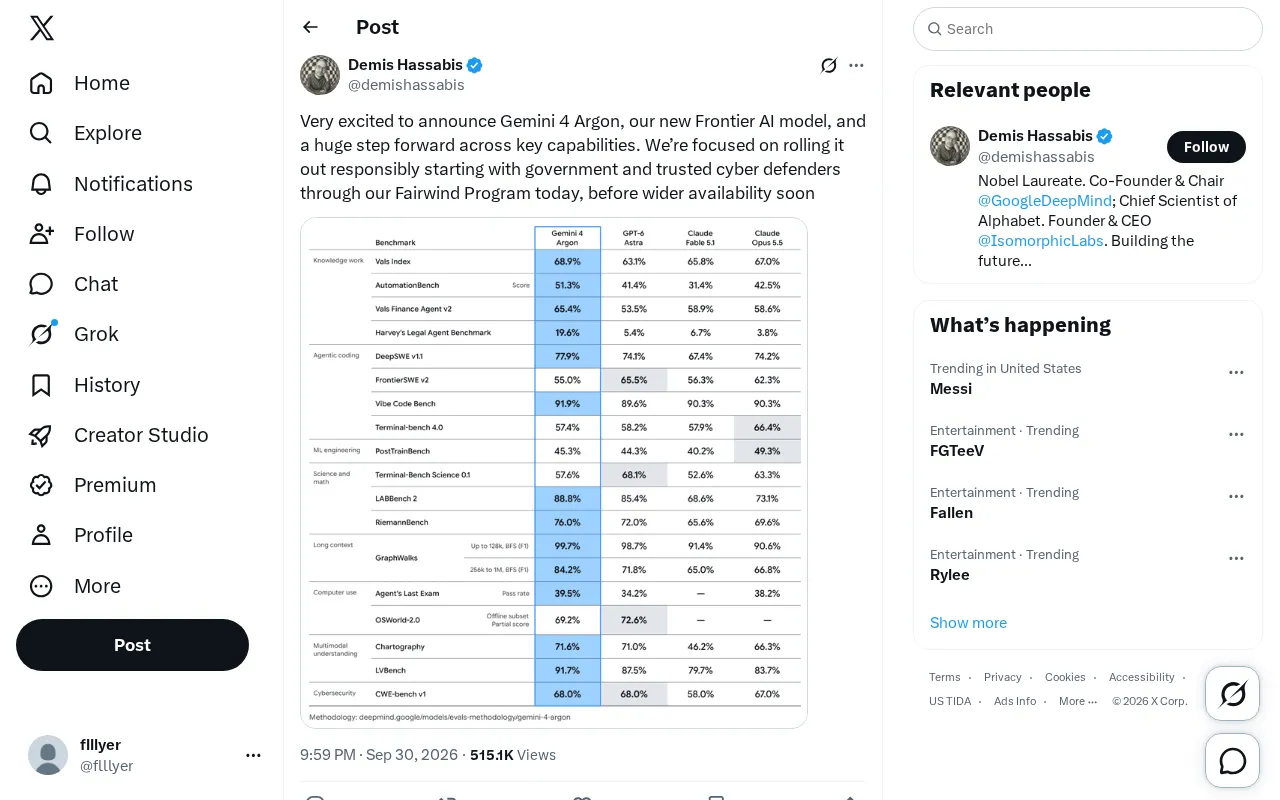
Google has announced Gemini 4 Argon, a new frontier AI model claiming major capability leaps. Unlike previous launches, it will first be made available to government agencies and trusted cyber defenders through the Fairwind Program before broader access. Google frames this as a "responsible rollout" — letting defenders gain advanced AI tools before capabilities spread more widely. Specific benchmarks, parameter scale, and quantitative comparisons with previous models have not yet been disclosed.
Google Announces Gemini 4 Argon
Google announced the launch of its new frontier AI model Gemini 4 Argon on social media, claiming it represents a "massive leap" across several key capabilities. The company emphasized this as a significant upgrade following the Gemini series, positioning it as a "Frontier AI model" — meaning it represents the highest level of capability Google has achieved to date.
Based on publicly available information, Google has chosen a notably cautious release path this time. Rather than making the model immediately available to developers or consumers as it has done with previous launches, Gemini 4 Argon will first be made available through a program called the Fairwind Program, prioritizing government agencies and "trusted cyber defenders" before gradually expanding access.
Why Prioritize Governments and Cyber Defenders
Google repeatedly emphasized the concept of "rolling it out responsibly" in its announcement. Choosing government agencies and cybersecurity defenders as the first wave of users sends several noteworthy signals.
On one hand, the more capable a frontier model becomes, the greater the potential for misuse. This is especially true in cybersecurity, where powerful AI can be used for both defense and offense. By opening access first to trusted defenders through the Fairwind Program, Google is essentially building a "defense-first" moat — giving the defending side more advanced tools before expanding access to a broader audience.
On the other hand, this phased, audience-segmented release strategy reflects a broader trend in responsible governance among leading AI labs: when a model reaches a new capability threshold, deploy it in a limited, controlled manner first, observe real-world performance and risks, then decide whether to scale up.
In cybersecurity, the "asymmetry between offense and defense" has long been a persistent problem: attackers only need to find one vulnerability to succeed, while defenders must cover every possible attack surface. Powerful AI models can assist defenders in performing high-intensity tasks such as vulnerability scanning, threat intelligence analysis, and malicious code detection — significantly reducing labor costs. However, those same capabilities, if obtained by malicious actors, could be used to automatically generate phishing content, write exploit code, or bypass security detection. This is precisely why frontier labs like Google typically list "Cyber Offense Capability" as a high-risk dimension in their safety evaluation frameworks. Giving defenders access to tools first theoretically helps establish defensive infrastructure and detection mechanisms before new model capabilities proliferate more widely.
The Significance of the Fairwind Program
Although official communications provide limited detail on the specific mechanics of the Fairwind Program, its name and positioning suggest it is a controlled access framework designed by Google for frontier models. The fact that "cyber defenders" are explicitly listed as a priority group indicates that Google wants the first wave of value from Gemini 4 Argon to be anchored in security and protection use cases.
This approach closely aligns with ongoing industry discussions around "balancing AI safety and capability." As model capabilities approach or surpass certain critical thresholds, every frontier lab must answer the question: how do you unlock commercial and societal value while keeping risks in check? Google's answer with Fairwind is: trusted defenders first, then broader access.
Controlled access mechanisms like this are not unprecedented in the AI industry. OpenAI established a "Red Teaming" phase for high-capability models like GPT-4, inviting security researchers to conduct adversarial evaluations before public release. Anthropic uses its "Responsible Scaling Policy" to set capability thresholds, mandating stricter deployment restrictions when a model reaches certain dangerous capability levels. Google's Fairwind Program is logically similar to these mechanisms, but it more explicitly defines "first users" as governments and cyber defenders — rather than internal researchers or third-party security experts — giving it a dual character as both a risk assessment tool and an operational deployment channel. It's also worth noting that the name "Fairwind" carries a nautical metaphor, suggesting Google wants to provide a "favorable conditions first" channel for trusted parties, which is consistent with its longstanding enterprise security partnership narrative.
Potential Industry Impact
From a product cadence perspective, the launch of Gemini 4 Argon signals that Google continues to push forward in the frontier model race. The "4" in the name denotes a generational leap, while "Argon" as a codename suggests this may be a distinct, high-capability variant rather than a simple minor iteration.
For enterprises and developers, the more noteworthy phrase is "wider availability soon." This means general users and developers will need to wait for the controlled phase to conclude before they can access the model. In the short term, real-world performance of this model will primarily be validated by government and security institutions, making it difficult for outside observers to obtain firsthand evaluations.
It's worth noting that publicly available information remains relatively limited. Google has not disclosed specific benchmark results, parameter scale, or quantitative comparisons with previous models. What exactly constitutes the "massive leap in key capabilities" — whether in reasoning, coding, multimodality, or safety alignment — remains to be clarified in more detailed technical documentation.
Summary
Gemini 4 Argon represents another step forward in Google's frontier AI capabilities, but what's more significant is how it's being released: with safety and responsibility at the core, prioritizing governments and cyber defenders before opening access to the general public. This "defense-first, phased release" strategy may well become a template for how future high-capability models are launched. Until more complete technical details and third-party evaluations are available, assessments of its specific capabilities should remain cautious.
Related articles

Last Week Tonight Exposé: The Dangerous Ties Between Politicians and White Supremacy
Last Week Tonight investigates Georgia Senate candidate Mike Collins and Florida candidate Marshall Rawson, exposing their multiple ties to white supremacists and the Republican Party's silent response.
AI Buzz Weekly: GPT-6.5 Leak, New Claude Model, and MiniMax's Cost-Effectiveness
This week's AI buzz roundup: suspected GPT-6.5 leak, Microsoft configs showing GPT-6.1 Tera, Anthropic's new model that can identify entire classes of bugs, disappointing early Gemini 4 Carbon results, and MiniMax M3.1 Flash beating Claude Opus 5 and GPT-5.6 Sol in benchmarks at extremely low cost.

AI Briefing: Gemini 4 Carbon Released, Ant Open-Sources Ling-3.1
AI Briefing: Google releases Gemini 4 Carbon qubit model, claiming to surpass Opus 5.5 with half-price tokens; Ant open-sources Ling-3.1-1019 for real-task Personal Agents; domestic AI drug discovery succeeds in 18 of 19 projects, hitting all 6 GPCR targets; zero-revenue company valued at $20B raises another $1B; Sichuan convenience store robot sales fail.