Google Releases Gemini 4 Carbon: Cybersecurity Capabilities Take Center Stage

Google releases Gemini 4 Carbon, with dense updates from OpenAI, open-source models, and tech giant earnings and regulatory developments.
Google released the frontier model Gemini 4 Carbon, focusing on common-sense tasks and cybersecurity, with a vulnerability discovery score of 88.2% and launch pricing of $2 per million input tokens and $10 per million output tokens. OpenAI offers ChatGPT Pro and Business users up to $500 per month in API credits, Dot supports SMS interaction and plans to integrate Chat and Work. SenseTime, NVIDIA, and MiniMax heavily open-sourced video generation, speech transcription, and agent workflow tools. Microsoft and Alphabet earnings show strong cloud growth, with Microsoft earning $10 billion from its OpenAI commercial arrangement. The US Department of Justice is inquiring into NVIDIA's $12.93 billion acquisition of Hugging Face.
Google released its frontier model Gemini 4 Carbon this week, focusing on improving common-sense tasks and cybersecurity capabilities. According to the official description, the model is first being made available to select cybersecurity defenders, then expanded through Fairwind. On pricing: the launch-period rate is $2 per million input tokens and $10 per million output tokens, rising to $4 and $20 respectively after the promotional period ends.
In tests disclosed by Google, Gemini 4 Carbon scored 88.2% on vulnerability discovery, with security testing conducted under conditions where protections were disabled. The independent organization Artificial Analysis gave it an intelligence index of 59, and three Arena rankings placed it on the Pareto frontier. One tester ran a range of personal tests on the preview model, including 3D generation and interface design, showing that its capability boundaries are still being explored.
OpenAI Ecosystem Updates: API Credits and Dot Updates
OpenAI is offering API credits to eligible ChatGPT Pro and Business users, up to $500 per month, with the actual amount depending on the subscription tier or workspace seats. Claiming the credits requires linking an eligible API organization; this credit does not increase the subscription allowance used to sign in to Codex.
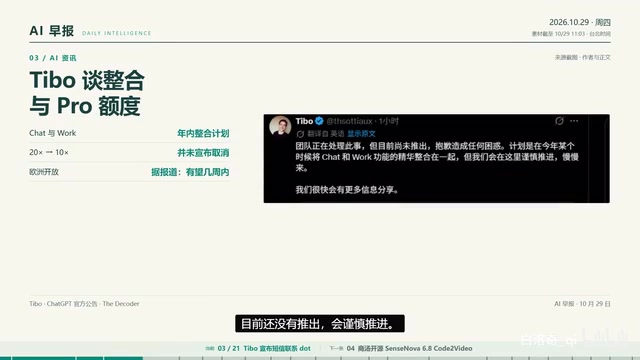
Tibo announced a Day 24 update: users can now text Dot as they would a friend, forwarding content, sending photos and voice messages, or asking Siri to send requests on their behalf, and Dot will proactively reply with relevant progress. The feature is delivered via iMessage or RCS and is currently in preview for Pro users in the US. Tibo also said the team plans to integrate the core capabilities of Chat and Work this year; this has not yet launched and will be rolled out carefully.
Regarding speculation about canceling the $200 Pro plan and cutting Plus allowances from 20x to 10x, Tibo replied "I wish," but did not announce any cancellation of the cuts. Separately, according to The Decoder, OpenAI said at an event in Berlin that it expects broader availability in Europe within a few weeks, and that weekly active Codex users in Germany have grown 20-fold since January this year.
RCS (Rich Communication Services) is a carrier-grade messaging standard that replaces traditional SMS, supporting read receipts, group chats, high-definition images, and end-to-end encryption; on Android devices it is typically handled by Google Messages. Dot being delivered via iMessage or RCS means it does not need a standalone app but is embedded in the messaging entry point users already have, lowering the barrier to use—though the cross-platform experience depends on carrier and device support.
An API organization is the workspace unit in the OpenAI platform used to manage keys, members, and billing. After linking a ChatGPT subscription to an API organization, credits are issued according to the subscription tier or seats, but these credits are independent of the subscription allowance used to sign in to Codex and cannot be transferred between them.
Open-Source Models and Multimodal Tools Debut in Force
SenseTime open-sourced SenseNova 6.8 Code 2 Video, a lightweight model that produces short videos by generating executable code; the model weights, skills, prompts, vision, and generation traces are all public. NVIDIA released the speech-to-text model NVIDIA Nemotron 3.5 Transcribe 30B-A4B, publishing the weights, data, and recipe along with a real-time demo. MiniMax open-sourced Mcode Stack, publishing the agent workflows and skill sets its development team uses daily, including project review, context management, and task handling—though the repository does not include the original MiniMax Code source code.
Google enhanced Chrome autofill: when users fill out forms, they can get suggestions from Gmail for order numbers, shipping, and flight information. The feature is gradually rolling out to Gemini in Chrome users in the US who have enabled personal intelligence, covering desktop and mobile. Google also opened a preview of the Connected Apps Platform, where developers can build and manage apps that connect to, search, and work with Gemini; it will expand in phases. Strava also announced that subscribers can connect Gemini to get more personalized analysis based on training records.

GateHub released Copilot Automations: after developers define tasks, they can run on demand, on a schedule, or automatically based on events, and share settings, access permissions, and spending limits with the team. Anthropic added a prebuilt Artifacts gallery to Cloud for Legal, covering tasks such as contract review, regulatory tracking, and citation checking; legal teams can verify results using source links, and the product has added more than 60 legal service connectors since launch. Anthropic launched Smart Reports, letting enterprises view how teams use Cloud, costs, and common blockers. According to TechCrunch, Anthropic disclosed to investors that the company achieved operating profitability in the second quarter of this year, and that Cloud Code's net revenue retention reached 900%.
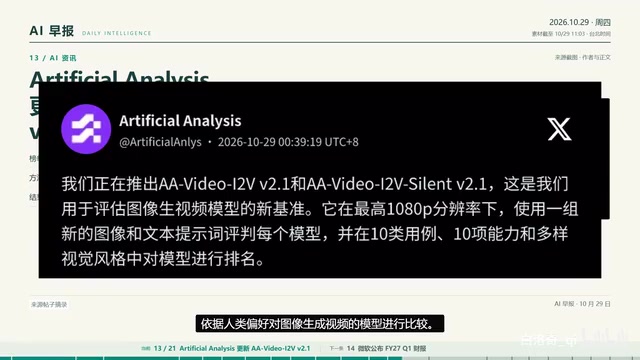
Google launched immersive exploration in the Gemini app, letting users explore topics through layered, interactive visual content—for example, space, jet engines, and the prehistoric world. Artificial Analysis updated its image-to-video evaluation, launching the AA Video i2V 2.1 leaderboard, which compares image-to-video models based on human preference; the leaderboard distinguishes between results with and without sound, and model rankings change with votes. On the leaderboard with sound, Dream Nascidents 2 5 ranks first, with Mini Max H3 as the open-weight model; on the silent leaderboard, Mini Max H3 Max ranks first.
The Pareto frontier is a concept in multi-objective optimization referring to the set of solutions that cannot be improved on any one metric without sacrificing another. In model evaluations, plotting intelligence index against dimensions such as price and latency means models on the frontier are the best-performing at that cost, or the lowest-cost at that performance. Arena's three rankings place Gemini 4 Carbon on the Pareto frontier, indicating it is competitive in the performance-cost tradeoff—but this is not the same as being first in any single category.
The intelligence index is a normalized score from Artificial Analysis that combines multiple benchmark tests, used to compare the capabilities of models from different vendors. A score of 59 should be understood in the context of the leaderboard: it reflects a relative level rather than absolute capability, and scores from different versions of the index cannot be compared directly across periods.
Tech Giants' Earnings and Industry Regulatory Developments
Microsoft reported first-quarter fiscal 2027 earnings: revenue of $92.3 billion, up 19% year over year; Microsoft Cloud revenue of $63.9 billion, up 30% year over year. According to TechCrunch citing regulatory filings, Microsoft earned $10 billion in revenue from its commercial arrangement with OpenAI in the quarter. Microsoft also said Foundry revenue grew more than 3x year over year (19% growth), the number of agents in Agent 365 exceeded 50 million, and Copilot is integrating chat, collaboration, autonomous driving, and coding features. Microsoft also said Windows will integrate with Agent 365, letting agents run within the device security boundary.
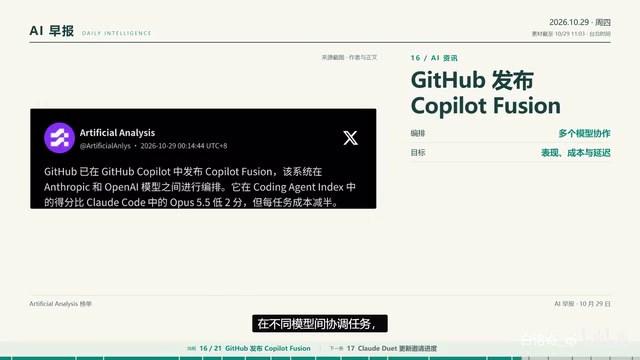
Alphabet reported third-quarter earnings: revenue of about $127.6 billion, up 25% year over year; Google Cloud revenue of about $30.7 billion, up 103% year over year. Shares fell in after-hours trading following the announcement. Artificial Analysis described how GitHub Copilot Fusion uses multi-model orchestration to coordinate tasks across different models to optimize performance, cost, and latency. According to the product lead, Cloud Duet will first send invitations to US Max subscribers, then to US Pro users, with international access in progress and a date not yet announced. The Cloud Code team said that after investigating drawings submitted by users, it found no single root cause; higher reasoning effort, agent teams, and long tasks may increase consumption, and fixing related minor issues is also planned to improve feature and cost prompts.
NVIDIA CEO Jensen Huang said that doubling model inference speed could double AI labs' revenue, a judgment that depends on conditions such as whether there is demand for the added capacity and actual pricing. According to Reuters, Anthropic wrote to the governor of California on October 15, suggesting the government could seek court injunctions to block the release of AI models that pose serious risks to the public. According to Reuters citing people familiar with the matter, the US Department of Justice is making inquiries about NVIDIA's acquisition of Hugging Face, a $12.93 billion deal, focusing on whether the transaction could give NVIDIA control of an important model distribution channel.
Net Revenue Retention (NRR) measures the retention and expansion of revenue contributed by an existing customer base over a year; it excludes new customers and counts only renewals, upsells, downgrades, and churn among existing customers. An NRR of 900% means the same group of customers spends 9 times as much the following year as the previous year, which typically appears in developer tools with usage-based billing that rapidly penetrate enterprise workflows. This metric reflects product stickiness and expansion efficiency, but high NRR often depends on a small base and should be judged alongside absolute revenue scale.
Operating profitability refers to profit after deducting operating costs and operating expenses, excluding interest and taxes, and is used to measure the profitability of the core business itself. Anthropic's disclosure to investors that it achieved operating profitability in the second quarter means its inference and subscription revenue has covered day-to-day operating expenses beyond model training—though training capital expenditures are usually not included in this measure.
One-line Summary
Google releases Gemini 4 Carbon, with dense updates from OpenAI, open-source models, and tech giant earnings and regulatory developments.
Paragraph Summary
Google released the frontier model Gemini 4 Carbon, focusing on improving common-sense tasks and cybersecurity capabilities, with a vulnerability discovery score of 88.2% and launch-period pricing of $2 per million input tokens and $10 per million output tokens. OpenAI is offering ChatGPT Pro and Business users up to $500 per month in API credits, Dot supports SMS interaction and plans to integrate Chat and Work. SenseTime, NVIDIA, and MiniMax have密集 open-sourced video generation, speech transcription, and agent workflow tools. Microsoft and Alphabet earnings show strong cloud growth, with Microsoft earning $10 billion from its OpenAI commercial arrangement. The US Department of Justice is making inquiries about NVIDIA's $12.93 billion acquisition of Hugging Face.
Related articles

LLM Application Development: A High-Paying Career Guide for Ordinary People
LLM application development offers fresh graduates up to 35K/month, with SP offers reaching 600K. This article explains the core skills, how to break in, and how ordinary people can seize AI opportunities through learning by doing.

Say Goodbye to AI Influencer Faces: A Complete Guide to Creating Visual Assets for AI Comic Dramas from Scratch
Bilibili creator shares a full workflow for zero-basics AI comic drama visual assets: use Doubao Work skills with script-first, visual references, and real-person texture to escape AI influencer faces, then lock character and scene consistency with asset sheet layouts, weapon detail images, scene nine-grids, and cinematic color palettes.

The AI Production Pipeline Behind Great Videos: From Research to Agent Validation
AI video production isn't just a model race. This article breaks down a transferable four-step pipeline: researching professional workflows, organizing a skill checklist, configuring agents, and experimental validation—and explains how general-purpose LLMs like DeepSeek can replace paid tools to run the entire process.