Google's September AI Roundup: A Quick Look at the Latest Updates

Google releases its September AI monthly roundup, but specific update details require checking the official blog.
Google has published its September AI monthly roundup on its official blog, continuing its established practice of disclosing AI progress on a regular cadence. These recaps serve both as an information management tool that consolidates updates across product lines and as a brand communications strategy reinforcing a narrative of rapid iteration — a format now standard among top players like OpenAI and Meta. However, since the available material only includes a title and minimal copy, no specific product names, feature details, or technical specs for September have been disclosed. Readers are advised to treat the monthly summary as a directional index and consult Google's official blog and third-party reviews for accurate technical details.
Google's September AI Updates at a Glance
Google has published its monthly AI roundup on the official blog, highlighting the company's latest developments in artificial intelligence. These monthly recaps have become a regular window into Google's AI communication strategy, helping developers, enterprise users, and industry observers quickly get up to speed on product and research updates.
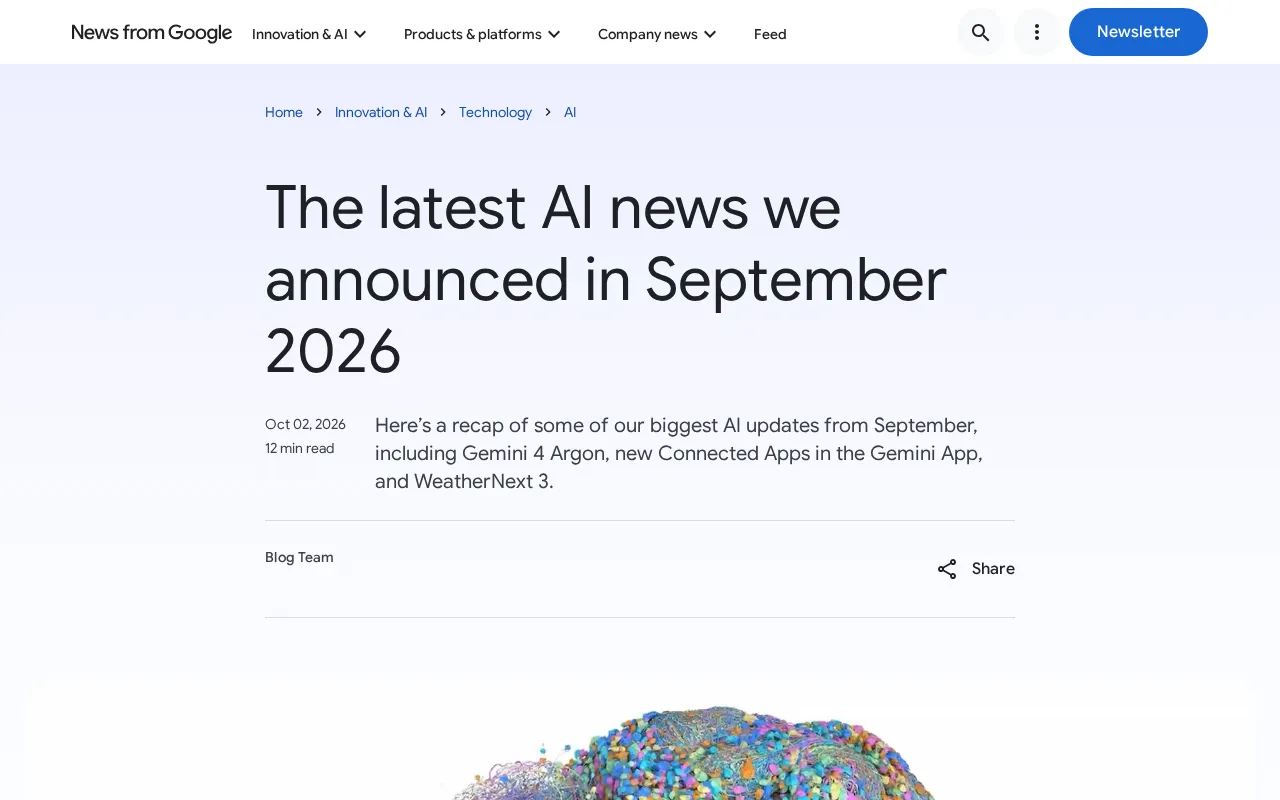
Google's continued commitment to monthly recaps signals that AI has become the core engine driving its entire product portfolio. Whether it's consumer-facing apps, developer tools, or foundational model research, Google is pushing updates at a high cadence and communicating them through a unified content channel.
The Strategic Intent Behind Monthly Recaps
For a tech company of Google's scale, consolidating AI progress scattered across multiple product lines into a single monthly summary is itself a form of information management. It lowers the cost for users to stay informed, while continuously reinforcing the brand narrative that "Google is iterating on AI at high speed."
This approach is especially common in today's fiercely competitive AI landscape. Leading players broadly adopt the practice of periodic recaps and consolidated releases to sustain attention and establish predictable communication expectations. For professionals tracking the AI space, following these official summaries is a key reference point for understanding product roadmap direction.
From a communications standpoint, this "consolidated release" strategy also serves an agenda-setting function: by controlling the timing and framing of information, companies can proactively shape how media and the public perceive their technical capabilities. Compared to scattered product announcements, the monthly summary format is more likely to be picked up wholesale by tech media, delivering broader coverage at relatively low PR cost. Major competitors including OpenAI, Meta, and Microsoft operate on similar content cadences — to the point where the "monthly AI update" has effectively become an industry-standard disclosure format.
How to Approach Official Summaries Like This
It's worth noting that the source material for this piece only provides a title and minimal introductory copy, with no disclosure of specific product names, feature details, or technical specifications for September. Therefore, any interpretation of the actual updates should be verified against the full text of Google's official blog.
For readers, it's best to treat monthly recaps as an "index" rather than a "conclusion" — they point to areas worth exploring in depth, but the truly valuable technical details, availability information, and real-world performance still require consulting the individual update documentation or third-party reviews for each item.
On the fact-checking front, official monthly summaries typically go through rigorous brand review, tend toward positive framing, and will not proactively disclose product shortcomings, delayed releases, or negative test results. Independent evaluation sources — such as benchmark reports from research institutions — and real-world feedback from developer communities can fill in the dimensions missing from the official narrative. For practitioners, cross-referencing official summaries with third-party technical analysis is a common approach to forming a reasonably objective view.
Conclusion
Google has maintained its habit of disclosing AI progress on a monthly cadence, and the September roundup once again reflects the company's sustained investment in artificial intelligence. Given the limited information currently available, readers seeking complete details on specific updates are encouraged to visit Google's official blog for accurate and comprehensive coverage.
Related articles

Building an AI Agent with Claude Code from Scratch: From Workspace to Cloud Autonomy
No coding required: build an AI Agent in four steps with the Claude Code desktop app—from workspace setup and Agent Designer to Skills, Memory, and cloud autonomy.

No Python Required: How Cursor AI Coding Is Reshaping Automated Testing and Test Development
Test engineers can do automated testing without learning Python? This article examines how Cursor and other AI coding tools empower functional testing, automation scripts, test platform development, and performance tuning, compares the cost and access restrictions of mainstream domestic and foreign tools, and offers capability transformation advice for testers.

Nearly 5,000 Affected! AI Coding Plugin Found with Backdoor, Officials Urgently Remove It
Claude Code's VS Code extension version 2.1.313 was maliciously tampered with, implanting a backdoor for remote login and persistent control, potentially affecting up to 5,000 users. Officials have removed the malicious version; this article details the attack method and cleanup steps.